
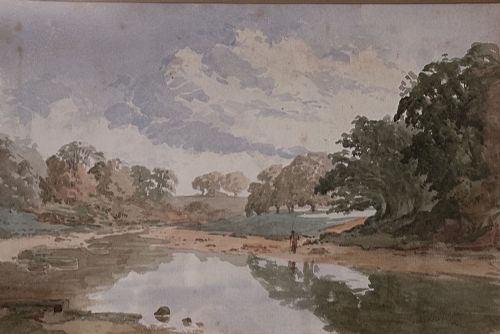


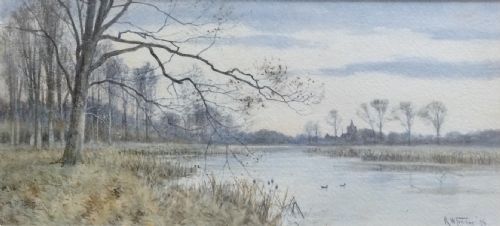


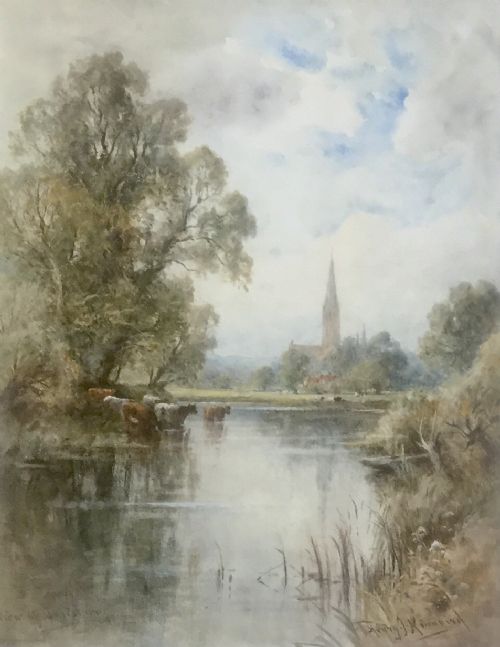

Grey Watercolour River Scene
A grey watercolour river scene captures waterways and pastoral life through monochrome tones on paper.
Grey Watercolour River Scene
A grey watercolour river scene depicts British waterways, coastal rivers and historic landmarks rendered through delicate washes on paper. These paintings span the Victorian, Edwardian and mid-twentieth-century periods, capturing scenes from the Thames to rural Suffolk streams and fenlands.
Buyers most frequently encounter works featuring boats, bridges, and figures by the water executed in muted palettes. The selections range from detailed topographical views of London to quiet pastoral compositions by established British and Irish painters.
How they were made
These works utilise watercolour paint applied directly onto paper supports, often framed beneath protective glass within wooden and gilt surrounds. Artists built up their compositions through layered washes to capture the atmospheric grey tones of British river weather.
The technique relies on the natural luminosity of the paper showing through thin pigment applications to create light and depth. Practitioners balanced controlled architectural lines with fluid washes for water and sky.
What varies in quality
The strength of a grey watercolour river scene lies in the artist's handling of tone and atmospheric perspective across the paper. Superior examples demonstrate confident brushwork in rendering architectural details like St Paul's Cathedral or the Houses of Parliament alongside natural water reflections.
Compositional balance distinguishes the finer works from simpler topographical records. The best pieces capture movement in the water and sky while maintaining structural harmony throughout the landscape.
Alfred Grey RHA·A. G. Hayward·Thomas James Lloyd·Walter Duncan·Frank W. Scarborough·Robert Winchester Fraser·Henry John Sylvester Stannard·Frank Wasley·Carleton Grant·Herbert John Finn·Henry J. Kinnaird
The Grey Watercolour River Scene Glossary
- Watercolour paint
- A medium consisting of colour pigments suspended in a water-soluble vehicle, applied to paper to create transparent washes.
- Topographical
- A style of painting that accurately records specific real-world locations, buildings and landscapes.
- Gilt
- A thin layer of gold leaf or gold-coloured paint applied to wooden frames to enhance the presentation of the artwork.
- Pastoral
- A genre of art that romanticises rural life, country streams and agricultural landscapes.
Grey Watercolour River Scene: Frequently Asked Questions
How should I frame these watercolours?
Protect the paper from direct sunlight and moisture by using acid-free mounts under glass. Professional framing preserves the delicate pigments and prevents deterioration over time.
Ensure the painting does not touch the glass directly to allow air circulation. Traditional wooden and gilt frames complement the historic periods of these waterworks.
Where were these river scenes painted?
Artists painted these scenes along prominent waterways including the River Thames in London, the River Stour in Suffolk, and various rural streams. Many depict recognisable landmarks such as Windsor Castle, Salisbury, and the Houses of Parliament.
Others focus on quieter fenlands and coastal areas across Britain and Ireland. Each location offers a glimpse into nineteenth and twentieth-century topography.
How do I identify the date of a piece?
Examine the signature, subject matter, and framing style for clues to the period of creation. Victorian and Edwardian works often feature specific architectural details or costume elements that indicate the era.
Stylistic shifts from nineteenth-century realism to later twentieth-century interpretations also help narrow down the decade. Comparing signatures with known records of the listed artists provides further confirmation.
Are these original paintings?
Every listed piece is an original watercolour painting executed by hand on paper. Artists applied liquid pigment directly to the surface, resulting in unique brushstrokes and wash effects.
These are not prints or reproductions, meaning each work possesses distinct textural qualities. The use of hand-applied paint ensures that no two river scenes are identical.