

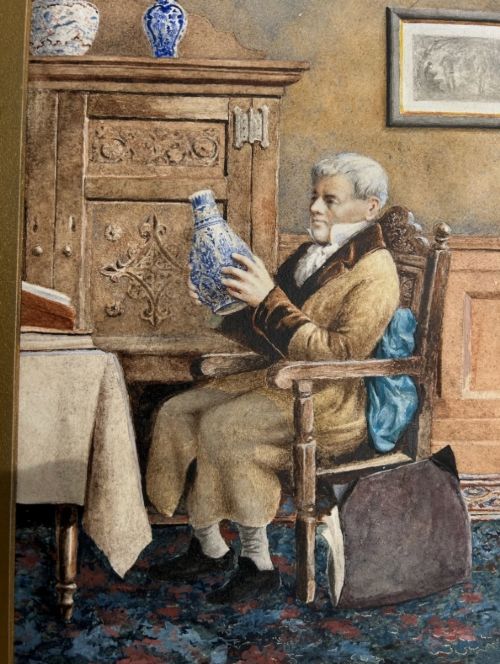


Victorian Style Watercolours
Victorian style watercolours are works on paper capturing pastoral scenes, portraits and narrative subjects from the nineteenth century.
Victorian Style Watercolours
Victorian style watercolours encompass works executed on paper using watercolour pigment, often presented within wood and glass frames with gold leaf details. You will encounter framed artwork and wall art reflecting nineteenth century aesthetic concerns, including English school traditions and Pre-Raphaelite influences.
The selections span portraiture, landscape, and still life, ranging from intimate miniature paintings to larger group portraits and coastal scenes. Pieces date from the nineteenth century through the early twentieth century, showing connections to Georgian revival and Victorian pastoral styles.
How They Were Made
Artists applied watercolour pigment and occasionally gouache directly onto paper sheets or prepared supports, utilising water-soluble binders to achieve translucent washes and fine linear detail. Pencil underdrawing frequently guides the composition, visible beneath the pigment in portrait and landscape studies.
Finished watercolours were housed behind protective glass within wood frames, frequently enhanced with gold leaf gilding to accentuate the painted subject. Miniature paintings and framed works relied on these traditional framing methods to preserve the delicate paper surfaces from atmospheric moisture and handling.
Victorian Style Watercolours Retail Price Guide 2026
Typical asking prices for victorian style watercolours among the pieces listed under this phrase on Sellingantiques today, from the lower quarter to the upper quarter. They describe what is for sale here now, not the wider market.
Among the portraits sit three Georgian folks captured with such distinct expressions they appear ready to interrupt the viewer.
What Varies in Quality
The distinction between standard examples and superior pieces rests upon the finesse of the brushwork and the confidence of the draughtsmanship. Works showing precise handling of pigment, particularly in facial expressions or detailed botanical and animal elements, reveal an accomplished hand.
Compositional complexity and the preservation of the paper support also dictate the standing of a piece. Stronger works maintain clear pigment saturation without excessive fading, retaining the tonal contrasts intended by the nineteenth century artist.
Philip Richard Morris·Alice Anne Renshaw·Eloise Harriet Stannard·Karl Feiertag
The Victorian Style Watercolours Glossary
- Watercolour
- A painting method where natural pigments are suspended in a water-soluble vehicle, traditionally applied to paper surfaces. It produces luminous transparent washes or opaque areas when mixed with white.
- Gouache
- An opaque water-based paint composed of pigment, water, and a binding agent such as gum, often used alongside watercolour to add highlights. It creates solid areas of colour with a matte finish.
- Pre-Raphaelite
- An artistic movement associated with detailed observation, bright colours, and complex literary or religious subjects. Works in this sphere frequently display meticulous attention to nature and historical detail.
- Miniature
- A small-scale painting, often a portrait or delicate landscape, executed with fine brushstrokes. These compact works were commonly housed in protective cases or small frames.
Victorian Style Watercolours: Frequently Asked Questions
How should I frame and hang antique watercolours?
Keep watercolours away from direct sunlight to prevent the pigment from fading over time. Use UV-protective glass and acid-free mount boards during framing to protect the paper from environmental damage.
Ensure they hang in rooms with stable humidity levels. Avoid placing them near heat sources or in damp spaces like unvented kitchens.
What subjects are typical in these paintings?
Common subjects include pastoral countryside scenes, coastal views with fishing boats, and botanical still lifes. Portraiture ranges from individual studies to detailed group portraits of families.
Narrative and allegorical scenes drawn from literature or classical mythology also appear frequently. These subjects reflect nineteenth century tastes for storytelling and romanticized rural life.
How do I identify the period of a watercolour?
Examine the framing style, paper type, and artist signatures or inscriptions on the reverse. Nineteenth century works often utilise handmade or early machine-made paper alongside traditional wooden framing.
Stylistic cues such as Pre-Raphaelite detailing or Victorian costume provide strong chronological indicators. Comparing the execution to documented works from the same decade helps narrow down the date.