




Victorian Stone Clock
These Victorian stone clock pieces are heavy architectural timepieces shaped from slate and marble, bringing solid nineteenth-century weight and classical presence to a mantelpiece.
Victorian Stone Clock
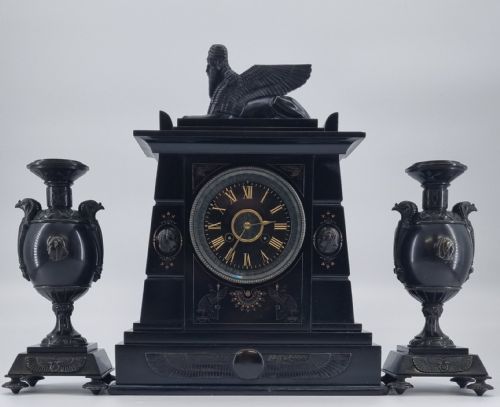
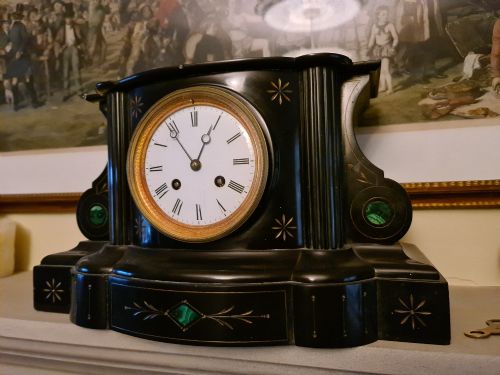
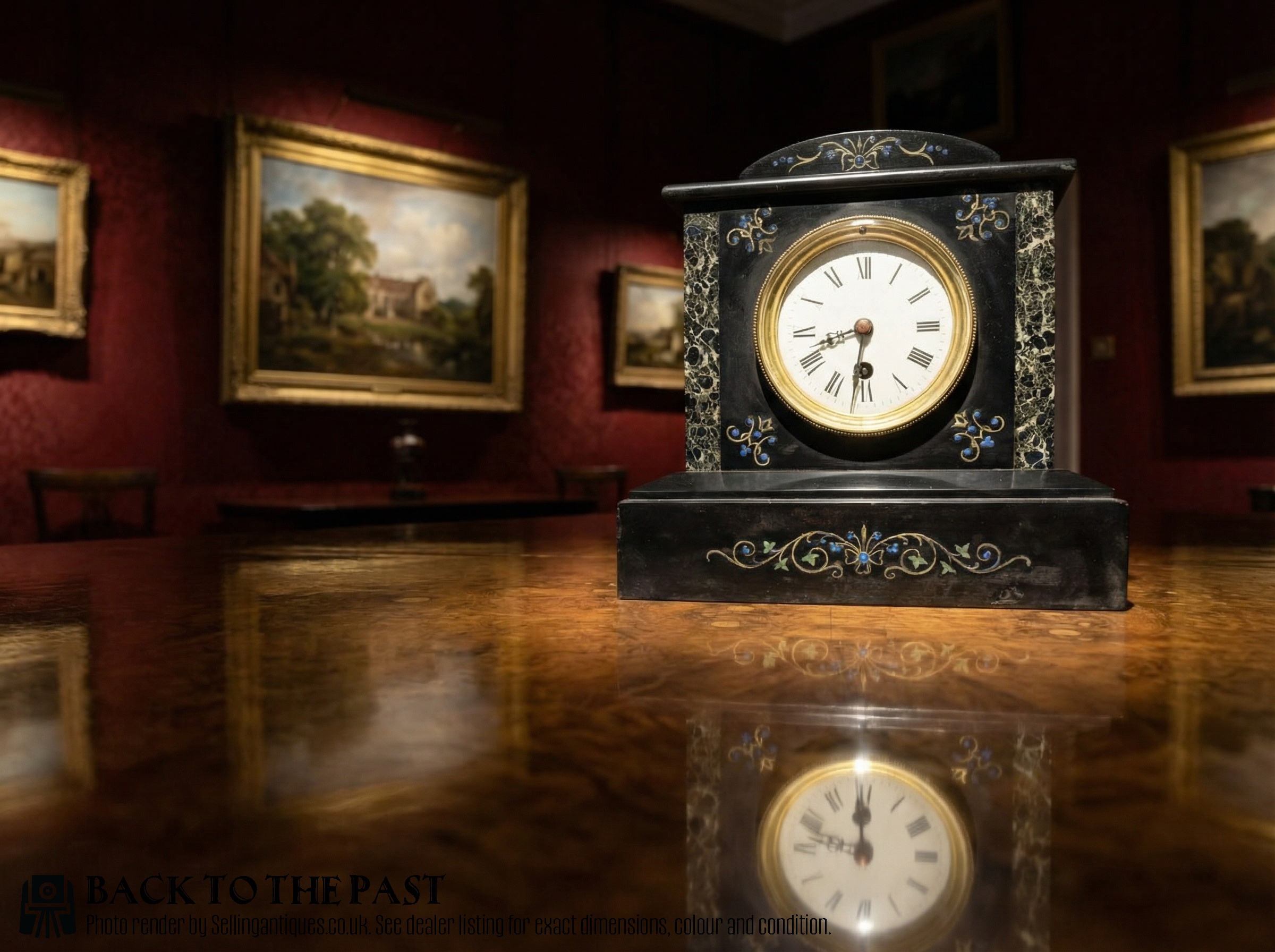
When you search for a victorian stone clock, you encounter heavy architectural mantel pieces formed predominantly from black slate, marble, and sienna stone. These domestic timepieces stand solidly upon table surfaces, usually housing eight-day movements behind glass and enamel dials.
The versions most commonly met on this page date from the middle to late nineteenth century, spanning decades from eighteen sixty through to eighteen ninety. They frequently arrive alongside matching side garnitures or present striking drumhead configurations designed to anchor a room's decor.
How they were made
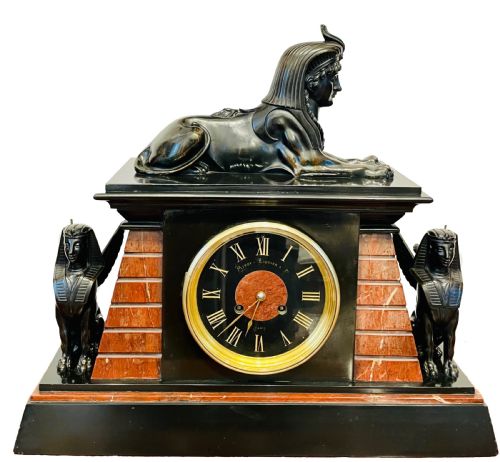
Masons shaped dense blocks of black slate and marble into architectural facades, incorporating classical revival and Egyptian influence motifs directly into the stone. Enamel dials and brass bezels were then fitted alongside mechanical movements.
Details such as bronze accents and inlaid malachite sections were applied to enhance the polished stone surfaces, creating heavy and durable casings built to house precise clockwork.
Listings incorporate slate, marble, and sienna stone alongside brass and glass elements across Victorian mantel pieces.
What varies in quality
The distinction between standard domestic pieces and superior examples rests upon the selection of the stone and the ambition of the architectural design. Richly veined marble, complex geometric massing, and integrated garniture sets separate the finest works from simpler slate drums.
Execution of decorative detailing, including bronze mounts or intricate brass bezels, elevates the overall presence and demonstrates the skill of the original workshop.
Philippes Paris
The Victorian Stone Clock Glossary
- Slate
- A fine-grained metamorphic rock used as the primary dense body for many nineteenth-century mantel timepieces. It takes a dark, uniform polish that contrasts sharply with lighter marble accents.
- Garniture
- A set comprising a central clock and matching ornamental side pieces, usually urns or vases. These balanced groupings were designed to sit together across a mantel shelf.
- Drumhead clock
- A timepiece featuring a circular clock case mounted centrally upon a rectangular stone plinth. The shape resembles a drum viewed from the side.
- Egyptian Revival
- An architectural style drawing upon ancient motifs and geometric forms popular during the Victorian era. It frequently manifests in stone mantel pieces through incised hieroglyphic patterns and pyramid-like masses.
- Movement
- The mechanical inner workings of the clock that drive the hands and regulate time. Eight-day versions required winding approximately once a week.
Victorian Stone Clock: Frequently Asked Questions
How heavy is a Victorian stone clock?
These timepieces are exceptionally heavy due to their solid construction from slate, marble, and stone. They require a sturdy mantelpiece or shelf capable of supporting substantial weight safely.
Moving them demands care, and lifting from the base rather than the decorative top elements prevents accidental damage or strain to the stone joints.
What is an eight day movement?
An eight day movement is a mechanical clockwork system that runs for roughly a week before requiring another turn of the key. This mechanism freed owners from daily winding.
Most quality pieces from this era utilise this reliable system to keep steady time on the household mantel.
Where did garnitures go?
Garniture sets were designed to flank the central clock on a mantelpiece, creating a balanced and formal decorative arrangement across the fireplace. The matching side pieces mirror the materials of the main body.
Some surviving sets remain complete with their original pairs, while others appear as individual timepieces.
How do I date a marble clock?
Dating relies upon stylistic clues such as architectural revival themes, specific marble varieties, and the form of the enamel dial and brass bezel. Mid-century examples often favour classical symmetry.
Later decades introduced varied stone colours like sienna and incorporated more eclectic ornamentation into the heavy stone bodies.