






Victorian Starburst Ring
A victorian starburst ring catches the light with celestial motifs and glittering stones, offering a timeless piece of antique jewellery to wear daily.
Victorian Starburst Ring
A victorian starburst ring combines celestial design with precious metals and stones, presenting a distinct silhouette shaped around a central gemstone or diamond. These rings draw the eye through star motifs engraved or set directly into the band.
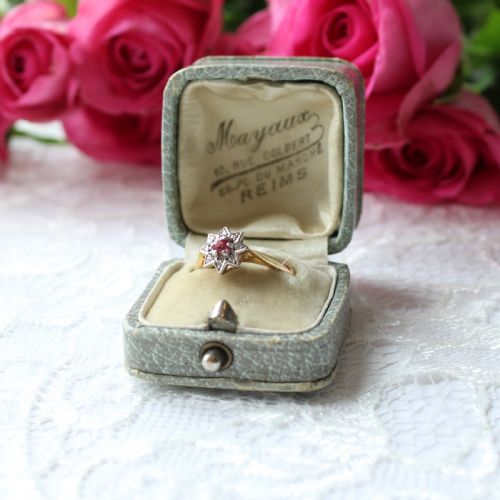
Most examples encountered here originate from the nineteenth century and the Edwardian era, spanning periods defined by detailed craftsmanship. Buyers frequently discover variations incorporating diamonds, rubies, sapphires, and blue enamel.
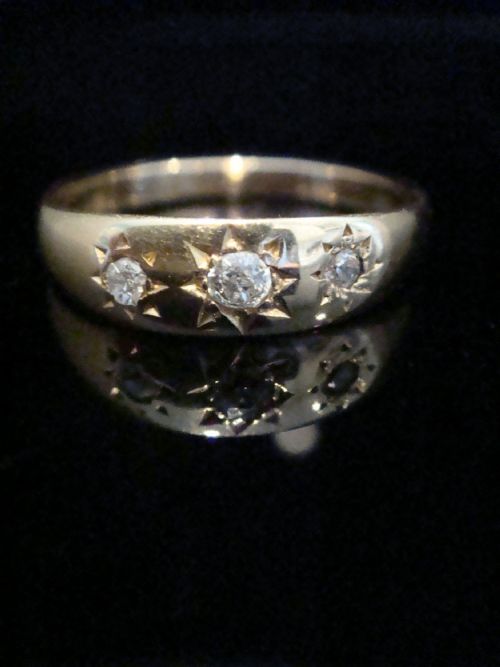
The forms range from gypsy bands to buckle rings and solitaire settings, reflecting the diverse stylistic preferences of their original makers. Gold content varies between nine carat and eighteen carat yellow gold.
Materials and construction
Goldsmiths utilised yellow gold in nine carat and eighteen carat purities to form the foundational bands and star settings. Old cut diamonds, rubies, and sapphires were then flush set or star set directly into the metal surface.
Detailing often included blue enamel accents and hand-engraved rays radiating outwards from the central stones. This technique created the characteristic celestial burst pattern seen across nineteenth century and Edwardian specimens.
Listings feature yellow gold in nine carat and eighteen carat purities, alongside platinum-free nineteenth century settings.
Quality differences
Quality rests upon the crispness of the engraved star rays and the security of the flush settings holding the stones. Superior examples display precise symmetry and well-matched gemstones that sit flush within the heavy gold bands.
Heavier gold weights and intact enamel work separate finer pieces from lighter, simpler bands. The presence of well-cut old diamonds or rich rubies and sapphires elevates the overall standard of the jewellery.
The Victorian Starburst Ring Glossary
- Starburst
- A decorative motif featuring engraved or channelled rays radiating from a central point to resemble a star. This design dominates the aesthetic of celestial jewellery from the period.
- Gypsy ring
- A ring style where the stones are set flush into the thick band rather than held in traditional claws. This mounting method protects the girdle of the gemstone.
- Old cut
- A diamond facet arrangement predating modern brilliant cuts, characterised by a smaller table and higher crown. These stones exhibit distinctive scintillation under candlelight.
- Enamel
- A glassy substance fused to metal through firing for colour and decoration. Blue enamel frequently appears on nineteenth century rings to simulate the night sky.
Victorian Starburst Ring: Frequently Asked Questions
What is a starburst ring?
A starburst ring is a piece of antique jewellery featuring a central gemstone surrounded by engraved or set rays that form a star shape.
These designs drew inspiration from nineteenth century interest in astronomy and celestial motifs.
How do I wear a gypsy ring safely?
Gypsy rings sit low to the finger with stones flush in the metal, making them practical for daily wear.
Their smooth profile prevents the settings from snagging on clothing.
What metals were used in these rings?
Goldsmiths constructed these rings primarily in nine carat and eighteen carat yellow gold.
Some pieces also incorporate contrasting metals or coloured enamel details.
How do I date a starburst ring?
Dating relies on stylistic clues, shank profiles, and stone cutting techniques typical of the Victorian and Edwardian eras.
Hallmarks stamped inside the band provide further chronological evidence.