


Victorian Staffordshire Greyhound Figure
These Victorian staffordshire greyhound figure examples bring the distinct charm of nineteenth-century ceramic animals into the home.
Victorian Staffordshire Greyhound Figure
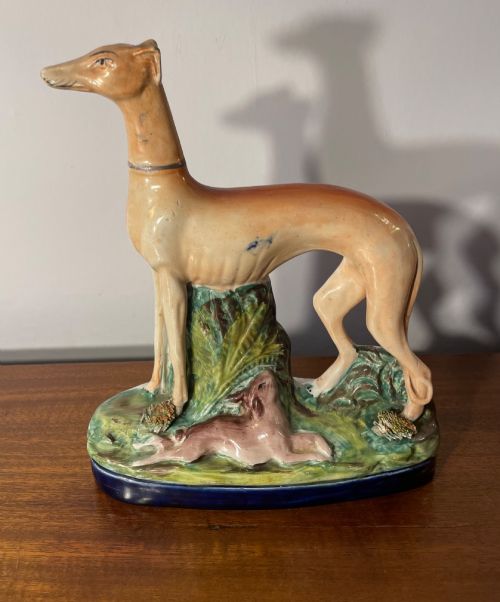
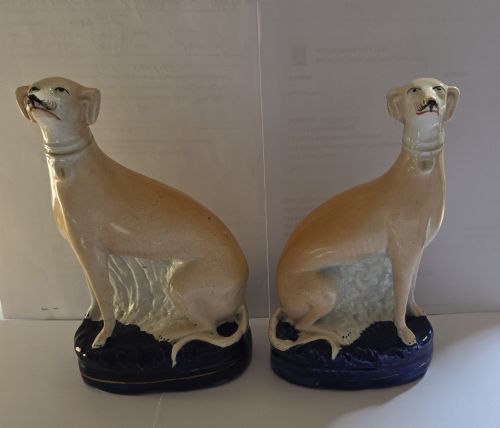
A victorian staffordshire greyhound figure captures the likeness of nineteenth-century hounds, often modelled as seated pairs or accompanied by hares. These pottery ornaments frequently served functional purposes alongside decoration, appearing as quill holders and inkwells upon the desk.
The pieces on this page span the nineteenth century, including examples from around eighteen-fifty through to eighteen-eighty. Buyers regularly encounter both single figures and matched pairs shaped by Staffordshire potters.
Makers produced these decorative ornaments using earthenware and pottery, shaping them into distinctive canine forms. Collectors find variety in scale, ranging from large hounds to smaller desk accessories.
How they were made
Certain examples incorporate touches of gold leaf alongside the enamel colours to highlight collars or bases. The combination of glazed ceramic and hand-applied pigments gives each nineteenth-century piece its individual surface character.
Listings feature earthenware and pottery bodies finished with lead glaze and enamel paint.
What varies in quality
The crispness of the modelling sets individual examples apart, as sharper definition in the hound's musculature and the accompanying hare reveals greater skill in the original mould. Softer details indicate lower-tier production where the mould has seen extensive use.
The execution of the enamel paint and glaze application dictates the visual appeal of the piece. Controlled brushwork and consistent glaze coverage separate standard decorative ware from finer sculptural examples.
Thomas Parr
The Victorian Staffordshire Greyhound Figure Glossary
- Earthenware
- A porous pottery body fired at lower temperatures, commonly used for nineteenth-century Staffordshire figures. It requires a glaze to become impermeable to liquids.
- Lead glaze
- A glossy coating applied to ceramic wares before firing, producing a smooth and shiny surface. This finish protects the underlying enamel paint and pottery body.
- Quill holder
- A desk accessory featuring a modelled figure with built-in channels or rests for writing quills. These functional pieces combine utility with decorative pottery design.
Victorian Staffordshire Greyhound Figure: Frequently Asked Questions
Were all of these figures used as inkwells?
While some models incorporated inkwells or quill holders for desk use, many others served purely as decorative ornaments for the mantelpiece.
Buyers will find both functional desk accessories and standard decorative figures represented among the pottery pieces.
How do I distinguish pairs from single figures?
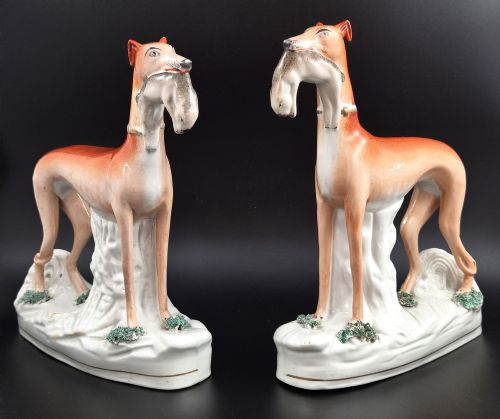
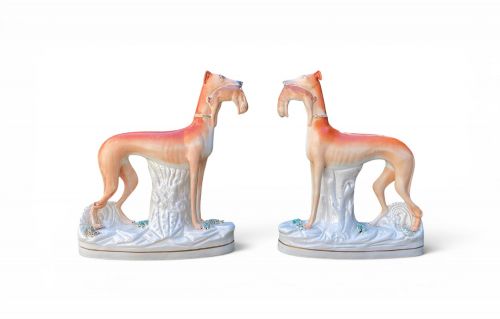
Matched pairs were modelled to face one another as mirror images, often designed to sit symmetrically on either side of a fireplace.
Single figures appear on their own and generally lack the corresponding counterpart found with matched Staffordshire pairs.
What periods do these greyhound figures date from?
The listings span the nineteenth century, with the majority originating from the Victorian era between eighteen-fifty and eighteen-eighty.
Earlier pieces from around eighteen-forty also appear, showing slight variations in early Staffordshire modelling styles.
How should I care for antique Staffordshire pottery?
Keep these glazed earthenware pieces out of direct sunlight to protect the hand-painted enamel colours from fading over time.
Dust them gently with a soft dry cloth and avoid using water or cleaning agents on the painted surfaces.