





Victorian Small Sofa
A victorian small sofa provides compact seating with period character, offering tailored upholstery and timber frames suited to smaller reception rooms.
Victorian Small Sofa
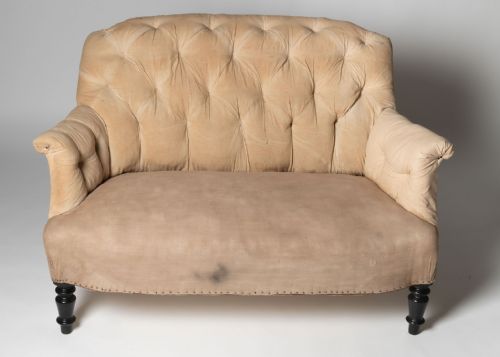
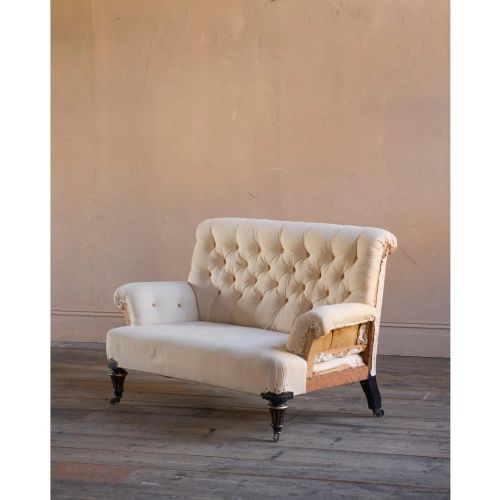
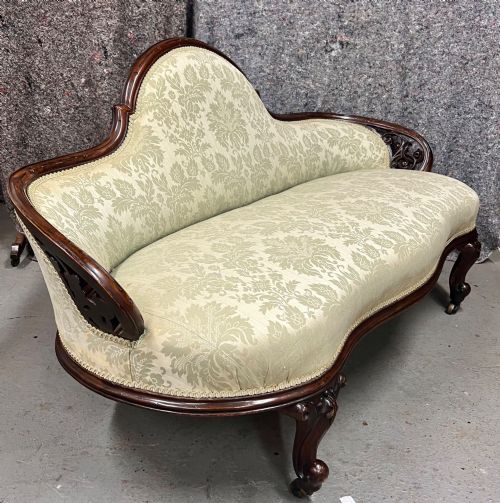
When searching for a victorian small sofa, buyers encounter nineteenth century seating pieces including two seater settees, button back canapes, and small bedroom sofas. These pieces emerge primarily from the Victorian period alongside Edwardian examples, taking the form of compact settees designed for intimate spaces.
The selections span distinct stylistic revivals such as Victorian Rococo and Edwardian adaptations, whilst maintaining modest proportions suited to contemporary drawing rooms or bedrooms. Frames are constructed from timbers like mahogany and walnut, frequently upholstered in fabrics including velvet with decorative tassel trims.
How they were made
Cabinet makers utilised dense hardwoods including mahogany, walnut, burr walnut, and rosewood for the structural frames and exposed woodwork. Upholstery relied on traditional stuffing techniques, finished with textiles such as blue velvet and secured with brass detailing or tassel trims.
Joinery combined traditional frame construction with turned or carved wooden supports, while decorative variants incorporated marquetry inlay and button back padding to the sprung or stuffed backs.
Victorian Small Sofa Retail Price Guide 2026
Typical asking prices for victorian small sofa among the pieces listed under this phrase on Sellingantiques today, from the lower quarter to the upper quarter. They describe what is for sale here now, not the wider market.
Design influences span across Victorian, Regency, Arts and Crafts, and Sheraton Revival styles within the recorded inventory.
What varies in quality
Quality rests upon the crispness of the timber carving, the selection of figured veneers such as burr walnut or rosewood, and the integrity of the underlying frame construction. Finer examples display harmonious proportions and sophisticated joinery rather than purely utilitarian assembly.
The execution of upholstery work, from the depth of the buttoning to the quality of the fabric and trim, dictates the visual refinement of the finished piece.
Jackson and Graham·Howard and Sons·W Turner Lord and Co·Gillow·Liberty and Co
The Victorian Small Sofa Glossary
- Button back
- Upholstery style where deep tufting is secured with fabric covered buttons, creating a padded, geometric pattern across the backrest.
- Canape
- An ornamental sofa or settee featuring an exposed wooden frame and upholstered seat and back.
- Burr walnut
- Timber cut from walnut tree growths, prized for its highly figured, swirling grain pattern used in decorative veneering.
- Marquetry
- Decorative technique applying small pieces of wood veneer to form intricate pictorial designs on furniture surfaces.
Victorian Small Sofa: Frequently Asked Questions
Where should I place a small sofa?
These compact settees fit comfortably in bedrooms, studies, or smaller drawing rooms where standard seating proves too bulky. Their modest footprint allows them to sit easily beneath windows or alongside fireplaces.
Positioning them away from direct sunlight preserves the upholstery fabrics and timber finishes over time.
How do I clean the wooden frame?
Dust the timber regularly with a soft, dry cloth to prevent the accumulation of grit. Apply a traditional beeswax sparingly to nourish mahogany and walnut surfaces.
Avoid commercial silicone sprays, as they can penetrate porous historic finishes and damage the wood.
Are these sofas suitable for daily sitting?
Nineteenth century frames provide sturdy support, though the internal webbing and padding benefit from professional assessment if used heavily. Many buyers utilise them as occasional seating rather than primary lounge furniture.
Gentle daily use preserves both the delicate upholstery trimmings and the antique wooden joints.
What fabrics were originally used?
Period seating frequently featured textiles such as velvet, damask, and wool upholstery. Tassel trims and decorative braids often finished the lower borders of the seating.
Many surviving pieces retain later replacement covers chosen to suit subsequent interior schemes.