


Victorian Silver Plated Coaster
These robust victorian silver plated coaster examples protect polished dining tables while holding wine bottles, decanters and champagne securely.
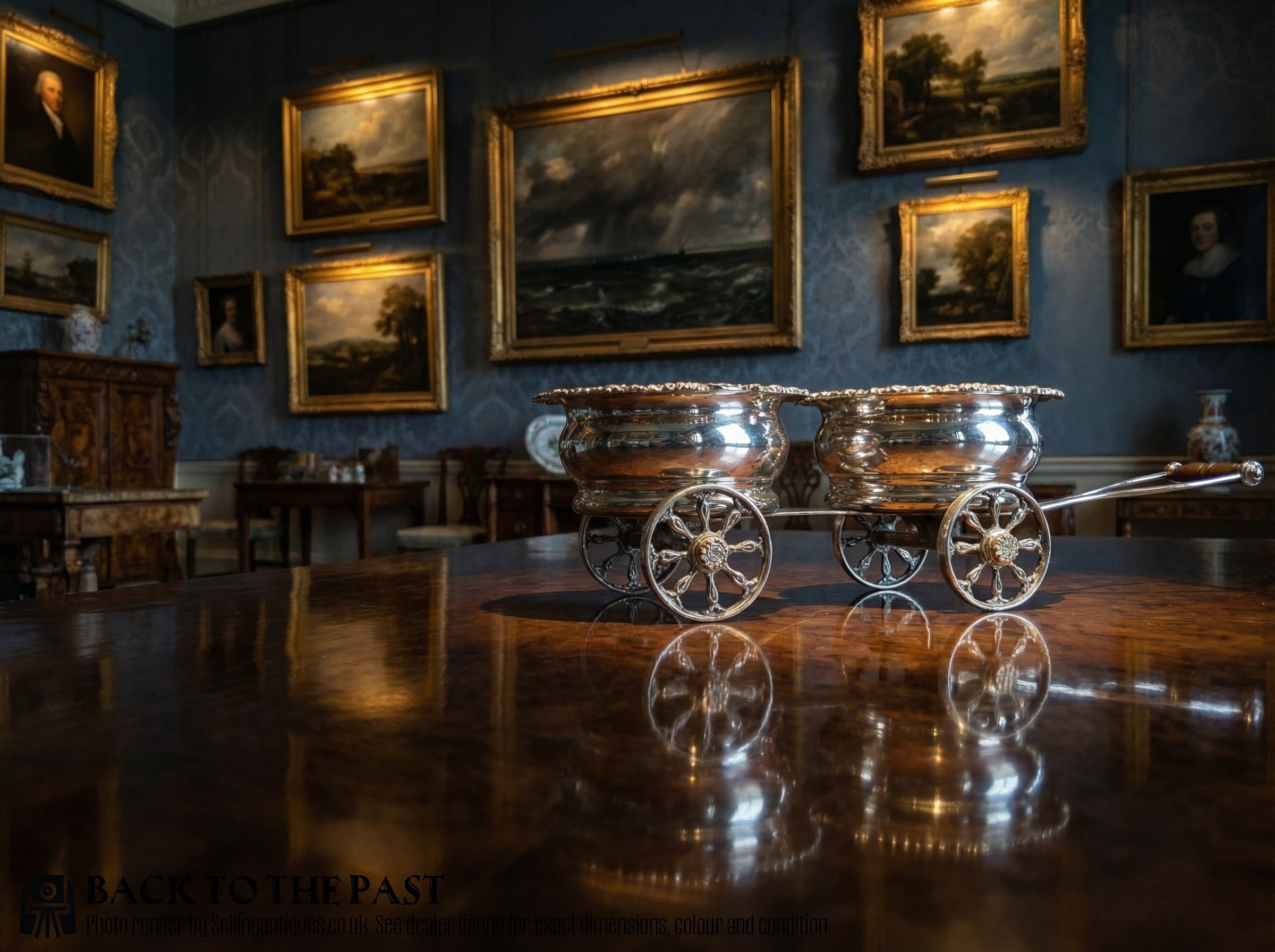
Victorian Silver Plated Coaster
A victorian silver plated coaster serves as a protective base for wine bottles, decanters and champagne at the dining table. These pieces emerge in various forms, from simple round dishes to large double carts and tall bottle holders.
Most examples found here date from the nineteenth century, reflecting the dining customs of the period. Makers produced both single items and matched pairs to accommodate social gatherings of different sizes.
While traditional round wine coasters dominate, the selection also includes specialised decanter carriages and bottle sleeves. Materials range from standard silver plate and electroplated nickel silver to Old Sheffield Plate.
Methods and Materials
Makers utilised a base metal such as copper or nickel silver, applying a layer of silver over the surface through early plating techniques or electroplating. Old Sheffield plate examples involved fusing a thin sheet of silver to a copper ingot before rolling.
Many items incorporate turned wood bases, often mahogany, fitted inside the metal rim to cushion the base of a decanter. Pierced galleries, embossed vine leaf borders and grape motifs often decorate the sides, shaped through stamping and chasing.
Listings feature items incorporating copper, mahogany, porcelain and silver plate alongside standard electroplated nickel silver.
Distinctions in Quality
Quality rests in the crispness of the chased decoration and the weight of the metal base. Finer items show deep, deliberate piercing and well-defined grape and vine motifs rather than soft, shallow stamping.
The integrity of the underlying silver layer matters significantly, as does the condition of any fitted wooden base. Maker marks from established silversmiths often indicate a higher standard of production.
Rupert Favell Co·Hawksworth Eyre Co·Elkington·Maple London
The Victorian Silver Plated Coaster Glossary
- Old Sheffield Plate
- An early method of fusing silver to a copper base before rolling into sheets. This technique predates standard electroplating and often reveals a thin copper seam along the edges.
- Electroplated Nickel Silver
- A durable base alloy of copper, nickel and zinc coated with a layer of silver using an electrical current. It became widely utilised during the Victorian era.
- Decanter Carriage
- A wheeled wheeled stand holding one or more bottles, allowing diners to pass drinks smoothly around the table. They often feature complex frames and handles.
- Pierced Gallery
- An openwork metal border perforated in geometric or botanical patterns. It lightens the visual weight of the coaster while securing the bottle inside.
- Pontil Mark
- A scar left on the bottom of older glass decanters that sat inside these coasters, sometimes requiring a wood or baize insert to level the base.
Victorian Silver Plated Coaster: Frequently Asked Questions
Were these always used for wine?
Dining practices of the period meant these vessels held wine bottles, port decanters and champagne.
Some smaller or flat variations also served as stands for teapots or syphon bottles during parlour gatherings.
What is a bottle carriage?
A bottle carriage is a wheeled coaster frame designed to roll across a mahogany dining table. Diners pushed the drinks between guests without lifting heavy decanters.
These mechanical pieces often feature multiple rings for larger gatherings.
How do I date a silver plated piece?
Examine the construction method, style of decoration and any stamped maker marks on the underside. Old Sheffield plate usually indicates an earlier nineteenth-century origin.
Electroplated marks became more common after the mid-nineteenth century as industrial techniques advanced.