




Victorian Serpentine Vitrine
A victorian serpentine vitrine brings glass-fronted display and curved mahogany or kingwood into a room with genuine nineteenth-century flair.
Victorian Serpentine Vitrine
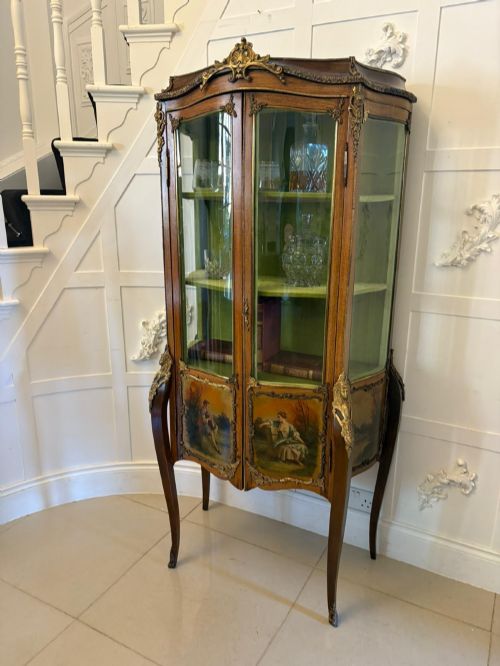
A victorian serpentine vitrine serves primarily as a glazed display cabinet for porcelain, miniatures and small curiosities. The form relies on a distinct undulating serpentine front that softens the rigid geometry typical of standard display cabinets.
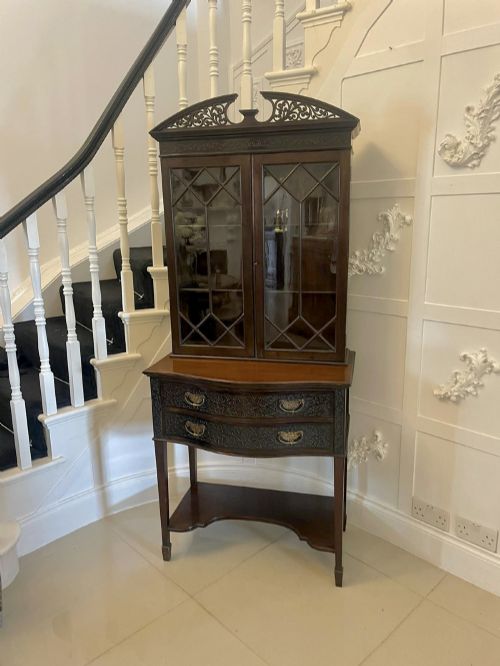
Most examples found here date across the nineteenth century into the Edwardian period, spanning styles from Sheraton Revival to French Louis XV Revival. Makers such as Edwards and Roberts contributed heavily to this tradition, producing freestanding ormolu-mounted cabinets of notable presence.
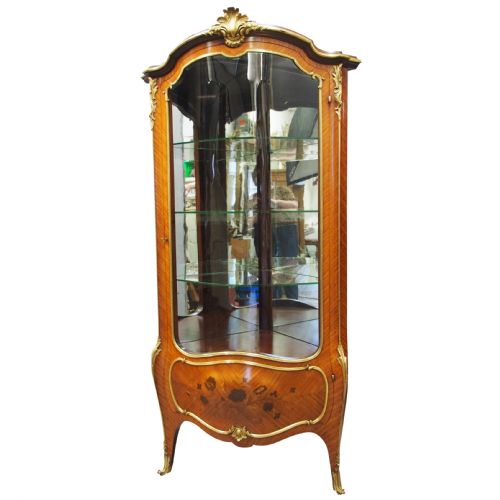
The objects vary from modest mahogany display cabinets to elaborate kingwood bombe shaped corner vitrines and double pairs. Mahogany and satinwood predominate, frequently enhanced by marquetry, fruitwood inlay or Vernis Martin decoration.
How they were made
The construction depends on dense timbers such as mahogany, kingwood and satinwood, chosen for their stability when shaped into curved fronts. Cabinetmakers employed precision joinery to support the sweeping glass panels and intricate internal shelving.
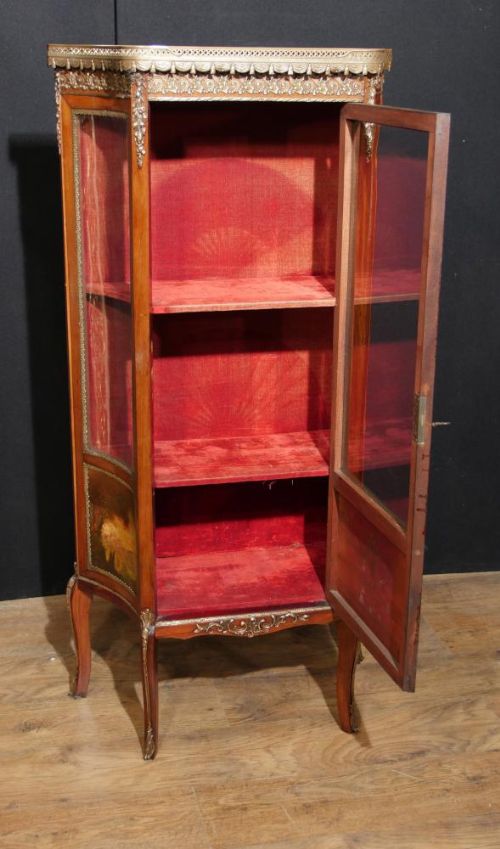
Decoration involves detailed fruitwood inlay, marquetry patterns and cast ormolu mounts applied to frame doors and corners. Fabric linings of velvet often cover the interior surfaces to cushion displayed items and reflect light through the glass.
Listings incorporate nineteenth-century and Edwardian periods, utilising mahogany, kingwood, satinwood and glass across display cabinets and vitrines.
What varies in quality
Quality reveals itself in the fluency of the serpentine curve and the crispness of the carved mahogany or fruitwood inlay. Better cabinets demonstrate superior integration between the timber framework and the cast ormolu mounts.
The choice of cabinetmaker elevates certain pieces, particularly signed examples by established firms like Edwards and Roberts. Attention to secondary timbers and the complexity of the marquetry distinguish standard production from exceptional workshop output.
Edwards and Roberts
The Victorian Serpentine Vitrine Glossary
- Serpentine
- A cabinet front featuring a convex centre flanked by concave curves, creating an undulating silhouette. This shape requires advanced woodworking skill to execute properly.
- Vitrine
- A glass-fronted display case designed specifically for showing decorative objects and porcelain. The term originates from the French word for glass.
- Ormolu
- Gilded bronze mounts applied to furniture for decorative accent, popular in French revival pieces. The finish provides a metallic contrast against polished mahogany or kingwood.
- Marquetry
- Decorative patterns formed by fitting contrasting veneers into a wooden background. Craftsmen use various dyed and natural woods to create intricate floral or geometric designs.
- Bombe
- A swelling, outward-curving furniture profile associated with continental revival styles. The contour adds visual weight and curved depth to corner and freestanding cabinets.
- Vernis Martin
- A type of simulated Japanese lacquer developed in France, often featuring painted figures or landscapes. Cabinets bearing this finish display translucent layers of varnish.
Victorian Serpentine Vitrine: Frequently Asked Questions
What is a serpentine vitrine?
A serpentine vitrine is a glazed display cabinet defined by its undulating, wave-like front profile. These cabinets combine glass panels with timber frames to exhibit porcelain, silver and small collectibles.
Originating largely in the nineteenth century, they draw upon French and English revival styles. The curved glass and woodwork require specialised craftsmanship to achieve the distinct serpentine shape.
How do I date a vitrine?
Dating relies on examining the timber species, construction techniques and decorative styles recorded in the piece. Victorian and Edwardian examples often feature mahogany, satinwood or kingwood alongside characteristic revival motifs.
Cabinetmakers sometimes stamped their work on drawer edges or hinges, offering direct evidence of origin. Stylistic markers such as ormolu mounts and marquetry inlay also help place the piece within the nineteenth or early twentieth century.
Where should I place a vitrine?
These cabinets suit drawing rooms, reception spaces or studies where they can be viewed without obstructing movement. Freestanding and corner configurations allow them to anchor wall spaces or fit neatly into room angles.
Direct sunlight should be avoided to protect both the timber polish and any delicate fabric linings inside. Adequate lighting nearby helps illuminate the interior through the glass panels.
Can I adjust the shelves?
Many nineteenth-century cabinets feature fixed wooden or glass shelving designed to support specific weights of porcelain. Altering them requires caution to avoid compromising the structural integrity of the interior framework.
When loading the shelves, heavier items belong at the bottom to maintain stability. The original glass shelves, where present, should remain undisturbed to preserve authenticity.