

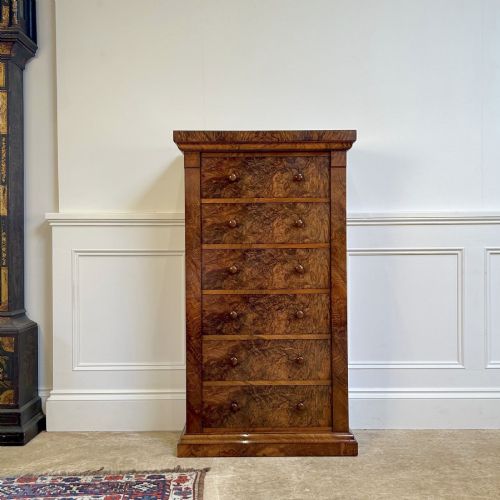


Victorian Semainier Cabinet
A victorian semainier cabinet is a tall, narrow storage piece prized for its seven daily drawers, bringing upright elegance to compact rooms.
Victorian Semainier Cabinet
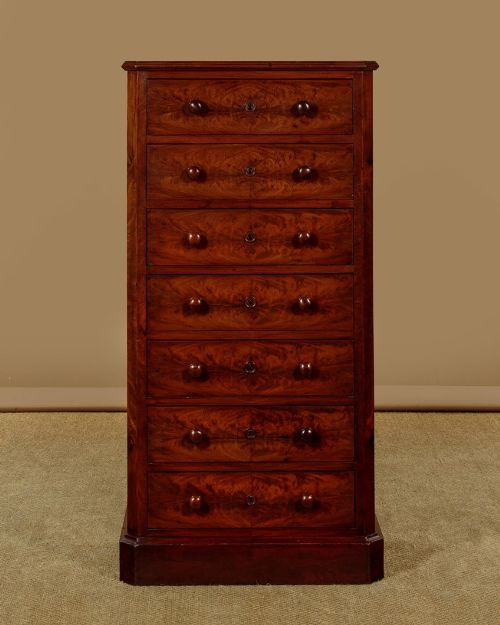
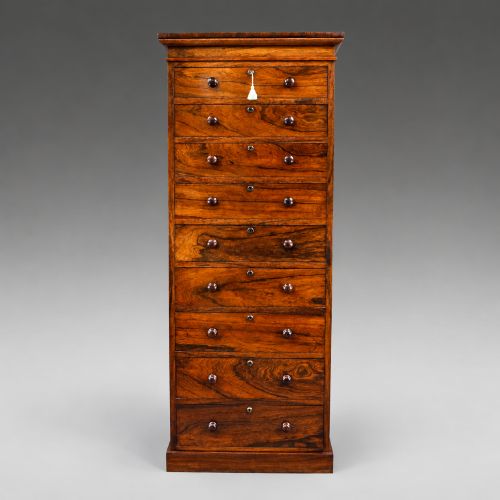
When you search for a victorian semainier cabinet, you encounter tall, narrow chests of drawers designed with multiple tiers to hold the papers or small items of the household. These pieces span the nineteenth century, including Victorian, late Victorian, and Edwardian periods, alongside continental and French examples.
The format typically manifests as a Wellington chest or a tall narrow chest of drawers, occasionally appearing as pairs of bedside drawers or larger double configurations. Their vertical proportions serve rooms where floor space is limited while offering substantial internal storage through stacked compartments.
Makers and workshops of this era constructed these upright forms in varied regional interpretations, from English mahogany and walnut to French designs. The selection on this page demonstrates how these slender chests bridge the gap between utilitarian storage and formal reception room furniture.
Materials and construction
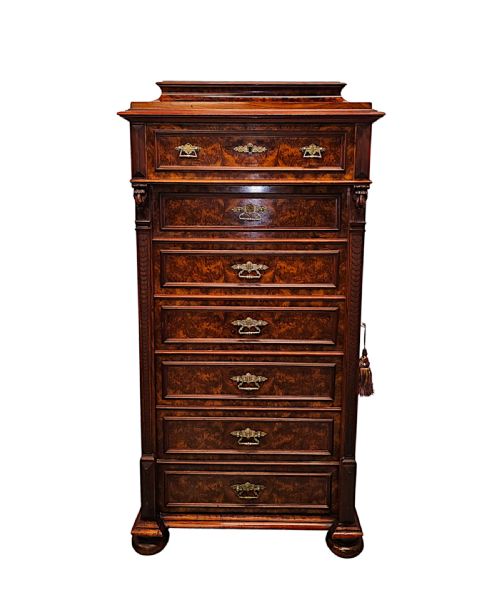
Cabinetmakers utilised rich timber veneers such as burr walnut and figured walnut applied over stable core woods, alongside solid cuts of mahogany and satin birch. Ebonised wood details and brass hardware frequently accent the exterior structure.
The joinery relies on deep carcass construction to support the tall stacking of multiple drawers without twisting. Drawer linings and secondary timbers show careful hand-fitting appropriate to nineteenth-century workshop production.
Victorian Semainier Cabinet Retail Price Guide 2026
Typical asking prices for victorian semainier cabinet among the pieces listed under this phrase on Sellingantiques today, from the lower quarter to the upper quarter. They describe what is for sale here now, not the wider market.
Some tall chests hide a fold-down writing surface, proving that Victorians loved a secret desk inside a tower of drawers.
Assessing quality and finish
The distinction between standard examples and finer pieces rests upon the choice of timber figure, particularly the symmetry and depth of burr walnut or figured walnut veneers. Grain matching across the drawer fronts dictates the visual harmony of the tall facade.
Subtle differences appear in the precision of the drawer sides, the crispness of any applied mouldings, and the integration of locking side stiles where fitted. Well-preserved surfaces retain their original polish depth rather than heavy modern restoration.
Gillows
The Victorian Semainier Cabinet Glossary
- Semainier
- A tall, narrow chest traditionally possessing seven drawers, one for each day of the week. This form originated in France before being adopted by British cabinetmakers.
- Burr walnut
- A highly figured wood veneer taken from the wart-like growths on walnut trees. It yields swirling, organic patterns prized for formal nineteenth-century cabinetry.
- Satin Birch
- A pale, lustrous hardwood used for nineteenth-century furniture interiors and occasional case pieces. Its distinct golden sheen offers a lighter contrast to dark mahogany.
- Secretaire
- A desk disguised as a chest of drawers featuring a drop-down writing flap. This combines upright storage with a fitted writing compartment.
Victorian Semainier Cabinet: Frequently Asked Questions
What is a semainier?
A semainier is a tall, narrow chest of drawers traditionally designed with seven tiers, one for each day of the week. This vertical format maximises storage while occupying minimal floor space in a bedroom or dressing room.
Originating in continental Europe and adopted by British makers, these pieces offer a distinct alternative to standard horizontal drawer chests.
How do I spot a Wellington chest?
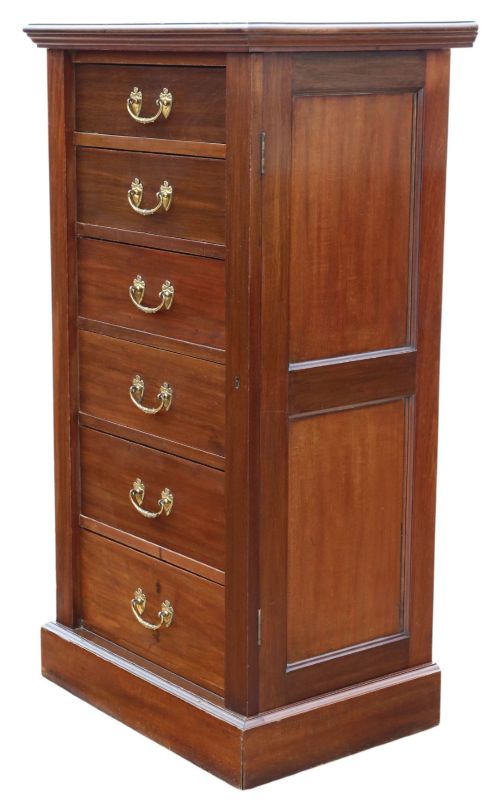
A Wellington chest is identified by its tall, narrow proportions and a hinged locking flap on one side that secures all the drawers at once. When unlocked and swung aside, it releases the stacked drawers.
This locking mechanism provides both security and a clean architectural facade to the narrow chest.
Where should I place a tall chest?
These slender chests suit alcoves, hallways, and bedrooms where a wide chest of drawers would obstruct movement. Their vertical height draws the eye upward while keeping a compact footprint.
Ensure there is sufficient clearance beside the piece if it incorporates a swinging side locking bar.
How do I care for walnut veneer?
Walnut veneer requires protection from direct sunlight and excessive temperature fluctuations to prevent the timber from drying or warping. Dust the surface regularly with a soft, dry cloth.
Applying a traditional beeswax polish occasionally helps nourish the wood and maintain its rich lustre.