

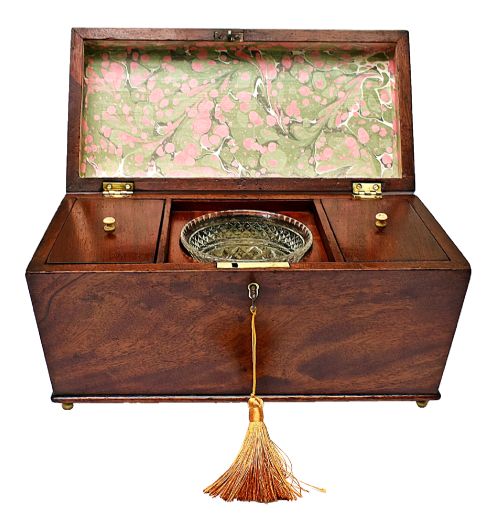


Victorian Sarcophagus Tea Caddy
A victorian sarcophagus tea caddy is a grand tabletop receptacle designed to hold precious leaves, built to last and display in the formal rooms of the period.
Victorian Sarcophagus Tea Caddy
A victorian sarcophagus tea caddy typically presents a distinct burial-vault silhouette with a domed or stepped lid, resting on bun feet or a plinth base. These lidded containers were essential domestic objects in nineteenth-century households for securing costly black and green tea blends.
Dated examples span the nineteenth century, drawing on Victorian, Regency, and William IV aesthetics. Some pieces incorporate specialised decorative traditions such as Tunbridge Ware inlay or brass stringing, reflecting the diverse tastes of their original makers.
Materials and Construction
Cabinetmakers constructed these boxes using solid timbers and decorative veneers, notably figured rosewood and burr walnut applied over secondary woods. Such tropical hardwoods provided a stable and heavily grained surface suited to high-status domestic furnishings.
Surface ornamentation relied on precision craftsmanship, incorporating boxwood stringing, brass inlay, and intricate Tunbridge Ware mosaic panels. Interior arrangements frequently utilised fitted compartments, mixing bowls, and delicate bone escutcheons around keyholes.
Victorian Sarcophagus Tea Caddy Retail Price Guide 2026
Typical asking prices for victorian sarcophagus tea caddy among the pieces listed under this phrase on Sellingantiques today, from the lower quarter to the upper quarter. They describe what is for sale here now, not the wider market.
Design variations among these containers include specialised Tunbridge Ware inlay, brass stringing, and fitted interior mixing bowls.
Factors That Distinguish Quality
Quality rests upon the selection of timber veneers and the precision of the cabinetwork. Heavily figured burr walnut or masterfully matched rosewood grain distinguishes superior examples from plain or utilitarian counterparts.
The inclusion of specialised decorative elements, such as intricate Tunbridge Ware micro-mosaic banding or complex brass inlay work, elevates a piece. Furthermore, intact interior fittings like glass mixing bowls and functioning locks with matching keys contribute to a higher standard of preservation.
Henry Hollamby
The Victorian Sarcophagus Tea Caddy Glossary
- Sarcophagus
- A heavy, sloping-sided architectural form with a domed lid resembling a stone coffin, adopted by nineteenth-century cabinetmakers for luxury containers. This distinctive shape gives the caddy its imposing presence on a table.
- Tunbridge Ware
- A form of British mosaic woodwork produced in Kent, utilising thousands of tiny dyed wood blocks to create pictorial or geometric scenes. These intricate bands frequently decorate the lids and borders of fine boxes.
- Teapoy
- A larger version of a tea container, often mounted on a central pillar with tripod or platform feet rather than resting directly on a surface. It serves the same function as a caddy but functions as a freestanding piece of furniture.
- Stringing
- Thin lines of contrasting wood, such as boxwood, inlaid into channels cut into the primary veneer to outline the edges and panels of the box. This technique highlights the geometric form of the piece.
- Escutcheon
- A small plate of brass or bone surrounding the keyhole on the front of the box. It protects the surrounding wood from wear and adds a metallic accent to the facade.
Victorian Sarcophagus Tea Caddy: Frequently Asked Questions
What is a sarcophagus tea caddy?
A sarcophagus tea caddy is a lidded wooden container fashioned with a sloping, monumental silhouette reminiscent of ancient stone tombs. Nineteenth-century households used these decorative boxes to store and protect expensive tea leaves under lock and key.
Cabinetmakers utilised rich timbers like rosewood and mahogany, often mounting the boxes on small feet. They stand out for their architectural presence and refined surface decoration.
How were these boxes used?
These containers held dry tea leaves when tea was an expensive, heavily taxed commodity kept strictly under the control of the head of the household. The interior typically featured lidded compartments to separate different varieties of tea.
Many examples also included a central glass mixing bowl where the leaves could be blended before brewing. Over time, similar architectural boxes were adapted to serve as sewing boxes or jewellery storage.
How do I tell Victorian pieces from Regency ones?
Regency and William IV pieces tend to display cleaner neoclassical lines with restrained brass inlay and architectural severity. Victorian examples often incorporate heavier proportions, more ornate grain patterns in rosewood or walnut, and sometimes complex Tunbridge Ware mosaics.
Construction details and secondary woods inside the box also provide clues, though styles often overlapped as makers transitioned across the nineteenth century.
How do I care for a wooden tea caddy?
Keep wooden caddies away from direct sunlight and steady sources of artificial heat to prevent the rosewood or mahogany veneers from drying and splitting. Maintaining a stable room temperature protects both the delicate interior fittings and the exterior polish.
Occasional dusting with a soft, dry cloth is sufficient for surface maintenance. Avoid using modern liquid polishes or silicone sprays, which can damage historic finishes.