
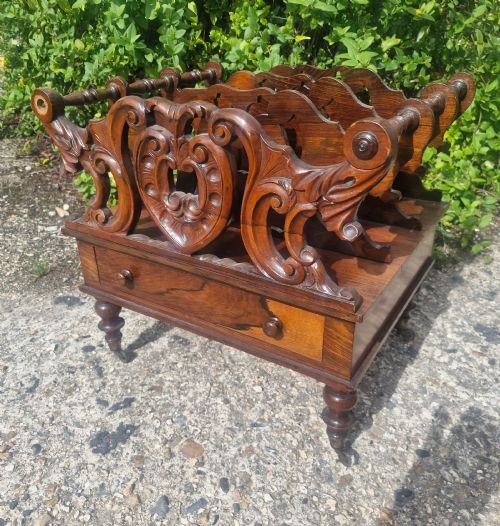
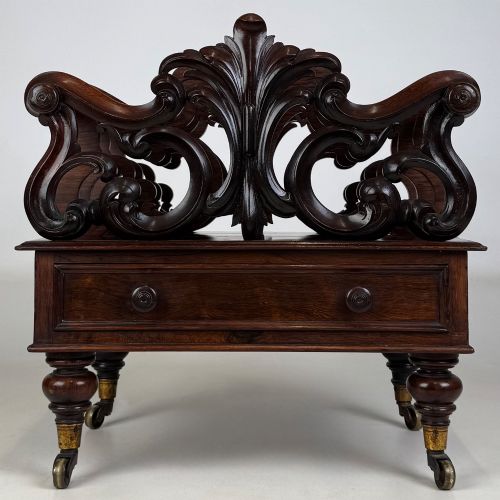


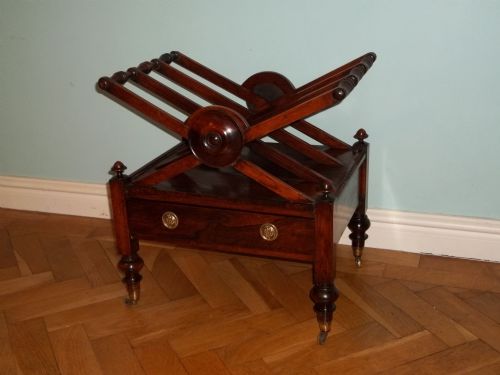


Victorian Rosewood Sheet Rack
A victorian rosewood sheet rack organises scores and journals with timber divisions and upright legs.
Victorian Rosewood Sheet Rack
A victorian rosewood sheet rack is most commonly encountered as a Canterbury or music stand holding folios and papers. The examples here span the nineteenth century, Victorian, William IV, and Regency periods, alongside Gothic Revival and French nineteenth-century variants.
Makers fashioned these pieces primarily as magazine racks, music canterburys, and occasional tables with compartmented sections. They appear across the listings as stands designed for domestic parlours and music rooms.
Most pieces date to the nineteenth century, taking the form of low tiered racks equipped with slatted divisions. Certain items integrate drawers or combine the rack format with a whatnot structure.
How they were made
Craftsmen built these pieces using dense rosewood timbers, frequently incorporating brass details and ceramic elements. Metal components and glass accents supplement the construction alongside inlay and castors.
Structural elements include turned uprights, carved foliate details, and integrated drawers beneath the main rack. Workshops shaped the timber to form vertical divisions suitable for holding sheets and folios upright.
Castors let nineteenth-century musicians chase errant sheet music across the parlour floor.
What varies in quality
Quality rests in the crispness of the carved foliate detailing on the rosewood frame and the stability of the slatted divisions. Superior examples display precise joinery in the compartment frames and well-turned upright supports.
The Victorian Rosewood Sheet Rack Glossary
- Canterbury
- A low stand with compartmented uprights used for holding music sheets, newspapers, and magazines. The form originated in the eighteenth century and remained popular through the Victorian era.
- Rosewood
- A dense, dark timber prized for its rich grain and purplish-brown colouring. It takes a high polish and was heavily utilised in nineteenth-century cabinet making.
- Whatnot
- A piece of open shelving with multiple tiers supported by slender uprights. Makers occasionally combined this form with a Canterbury base.
- Gothic Revival
- A nineteenth-century design style drawing on medieval architectural motifs such as pointed arches and quatrefoils. Pieces in this style exhibit heavier structural lines.
- Castor
- A small wheel fitted to the base of furniture legs to aid movement. Many nineteenth-century stands feature these to allow easy repositioning across carpets.
Victorian Rosewood Sheet Rack: Frequently Asked Questions
What is a Victorian rosewood sheet rack?
A Victorian rosewood sheet rack is a nineteenth-century stand designed to hold musical scores, folios, and periodicals. These pieces typically feature wooden vertical divisions and upright supports.
Most examples in this category correspond to Canterburys and music stands. They served practical storage needs in period sitting rooms and parlours.
How were these stands used originally?
Households placed these racks beside pianos and seating areas to keep sheet music and journals tidy. The upright slats kept folios sorted and accessible for daily use.
Some iterations included lower drawers for smaller accessories or combined display tiers for books. They functioned as both mobile storage and decorative furniture.
How do I care for rosewood furniture?
Keep rosewood pieces away from direct sunlight and steady heat sources to prevent the dense timber from drying out. Dust the slatted divisions regularly with a dry cloth.
Avoid using silicone-based polishes on antique timber surfaces. A periodic application of appropriate furniture wax preserves the finish and grain.
How do I identify a Regency period piece?
Regency pieces typically exhibit cleaner classical lines and restraint in ornamentation compared to later Victorian items. The timber selection often highlights strong rosewood grain.
Design influences from the early nineteenth century favour architectural restraint and neat proportions. Details such as simplified turned legs point to this earlier timeframe.