


Victorian Religious Pendant
These victorian religious pendant pieces combine devotional significance with period metalwork, offering wearable history for the discerning collector.
Victorian Religious Pendant
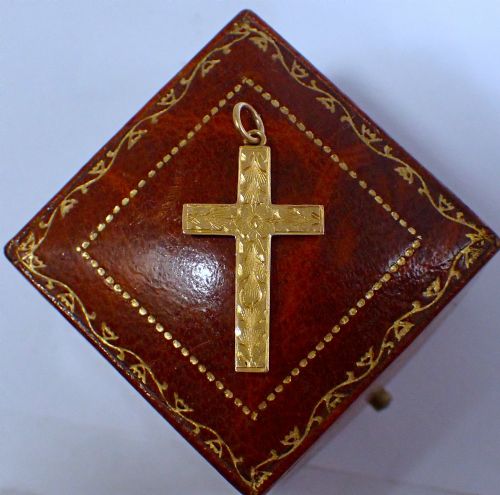
A victorian religious pendant unites devotional purpose with the ornamental metalwork of the nineteenth century. These pieces take the form of crosses, crucifixes, medals and devotional objects intended for personal wear.
The versions most commonly met on this page span the Victorian period and extend into the Edwardian era, incorporating French, Spanish and Italian styles. Cross pendants dominate the selection, frequently doubling as brooches or incorporating locket compartments.
Makers utilised gold, silver, tortoiseshell and mother of pearl to create these sacred ornaments. Gemstones such as diamonds, pearls, turquoise, sapphires and enamel work frequently enhance the primary devotional design.
Materials and Technique
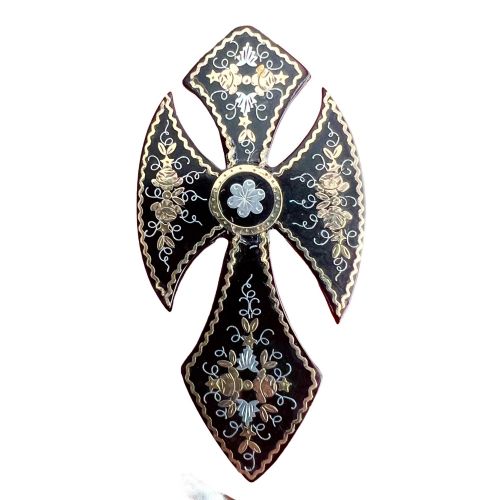
Goldsmiths employed fifteen-carat and nine-carat yellow gold alongside silver and rolled gold to construct the structural forms of these pendants. Inlay techniques, such as gold and silver combinations, add textural contrast to the metallic surfaces.
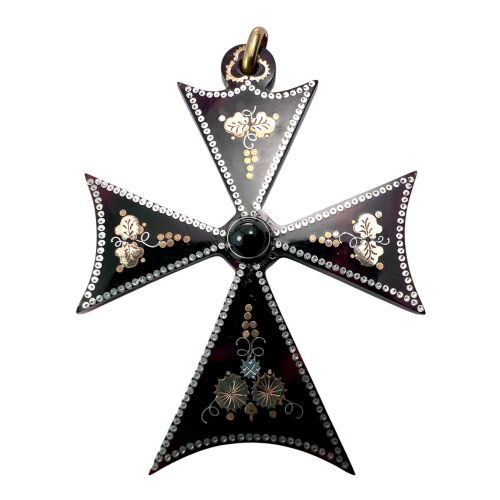
Pique work in tortoiseshell and finely carved mother of pearl provide alternative sculptural bases for the religious imagery. Enamel work in blue and other shades supplies vivid colour fields behind precious stones.
Rafael’s cherub peers out from mother of pearl, reminding us that Renaissance art found a tiny home in nineteenth-century pendants.
Assessing Quality
The refinement of hand-engraving and the precision of the metal inlay separate standard pieces from superior examples. Master jewellers achieved crisp contours on figural medals and delicate symmetry in cross geometries.
The selection and matching of gemstones, from diamonds to seed pearls and turquoise, dictate the overall value and visual impact. Higher grade pieces integrate superior stones with complex enamel or multi-metal construction without crowding the devotional focus.
Henry Cook
The Victorian Religious Pendant Glossary
- Crucifix
- A cross bearing the figure of Jesus Christ, designed as a focal point for Christian devotion and remembrance. These items form a substantial category within period devotional jewellery.
- Pique
- An inlaid decorative technique involving tiny gold or silver pins pressed into a tortoiseshell base. This method creates delicate geometric or floral patterns across the surface of the pendant.
- Devotional object
- An item created specifically to aid personal prayer and religious practice, often worn close to the heart. Examples include medals bearing images of the Virgin Mary and saints.
- Rolled gold
- A durable material made by fusing a sheet of gold to a base metal core, common in nineteenth-century manufacturing. It provides the appearance and wear resistance of solid gold at a different cost level.
- Rose-cut diamond
- An antique gemstone cut featuring a flat base and a domed crown with triangular facets. This facet arrangement produces a soft, candlelit gleam rather than modern brilliance.
Victorian Religious Pendant: Frequently Asked Questions
How do I wear a convertible brooch pendant?
Many period cross pendants feature a concealed folding bail alongside a secure pin mechanism on the reverse. This dual construction allows the wearer to suspend the piece from a chain or fasten it directly to garments.
When wearing the piece as a brooch, ensure the safety catch is fully engaged to protect the antique metalwork and setting during movement.
What is the difference between a cross and a crucifix?
A plain cross consists simply of intersecting bars representing faith, whereas a crucifix specifically bears the corpus or figure of Christ. Both forms appear frequently across nineteenth-century devotional jewellery.
Collectors often distinguish between purely decorative crosses set with diamonds and pearls and those intended strictly for religious observance.
How do I care for antique gold and tortoiseshell?
Organic materials like tortoiseshell and seed pearls require gentle handling and protection from harsh chemicals, perfumes and prolonged sunlight. Cleaning should involve only a soft, dry cloth to preserve the polished surface and inlay.
Gold and silver components may be wiped carefully with a specialised jewellery cloth to remove tarnish without disturbing fragile enamel or gemstone settings.
How can I date a religious pendant?
Dating relies upon examining hallmarked precious metal grades, the style of gemstone cuts, and manufacturing techniques such as pique work or hand engraving. Pieces from the later nineteenth century often display distinct Gothic Revival influences or French manufacture marks.
Comparing the construction methods of the bail, hinge and pin mechanism provides further clues to the decade of origin.