


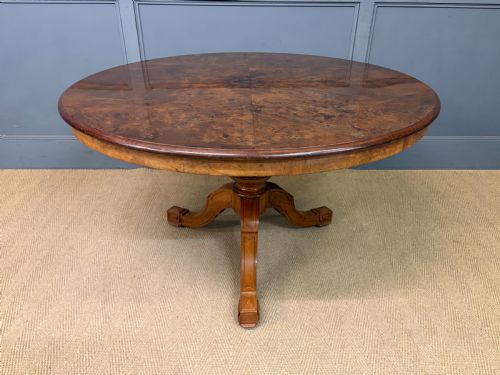
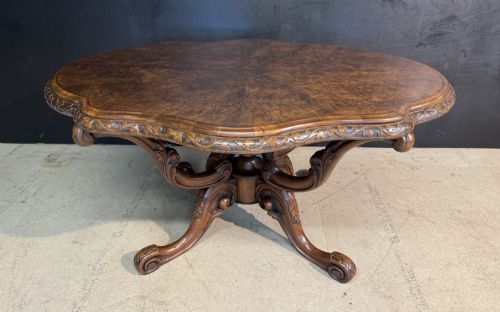
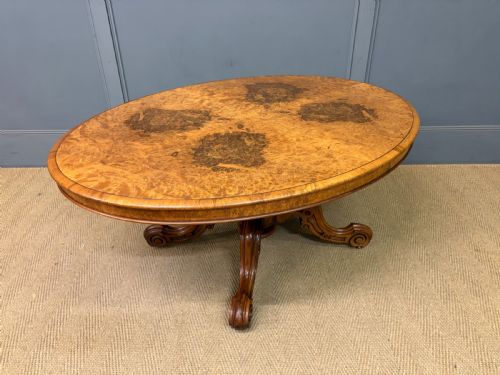
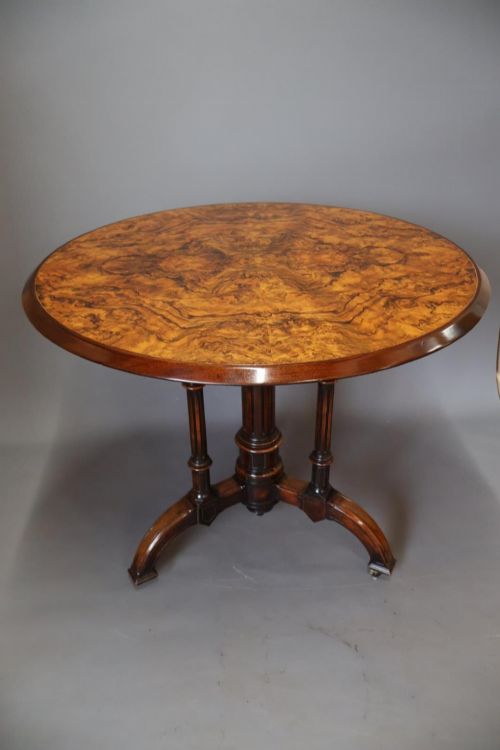
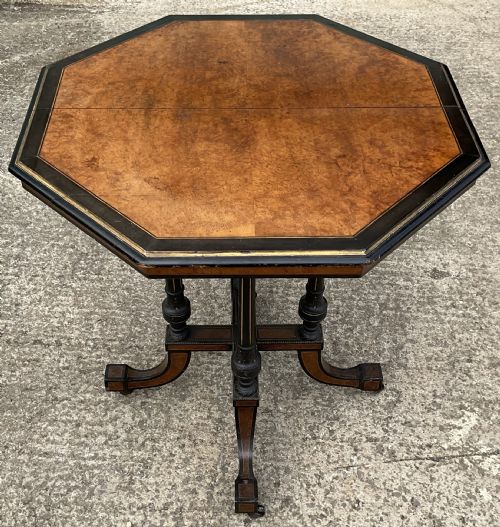


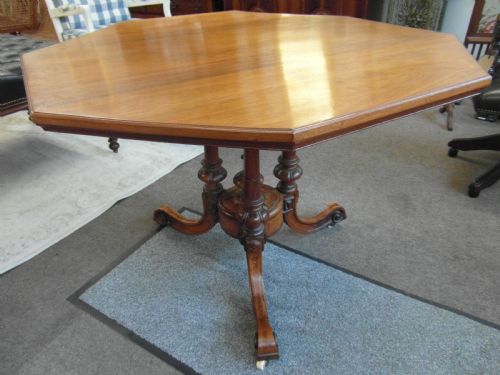


Victorian Quadruped Centre Table
A victorian quadruped centre table anchors a room with timber grain and four-legged balance, built for display in the middle of a space.
How they were made
Cabinet makers utilised dense hardwoods such as mahogany and rosewood alongside decorative veneers like burr walnut and amboyna. Surfaces frequently incorporate marquetry, boxwood inlay and hand-carved wooden bases.
Pedestal constructions often employ a quadruped configuration to distribute weight from the central column to four distinct feet. Tilt-top mechanisms, known as loo table formats, permit the surface to fold away when not in use.
What varies in quality
The selection of timber veneer dictates visual depth, with figured burr walnut and amboyna mounts sitting above plainer native woods. Precision in marquetry inlay and hand-carving defines the skill applied to the structure.
Proportion and stability separate standard examples from finer works attributed to notable cabinet makers. The integrity of the pedestal and the crispness of the carving reveal the original workshop standard.
Victorian Quadruped Centre Table Retail Price Guide 2026
Typical asking prices for victorian quadruped centre table among the pieces listed under this phrase on Sellingantiques today, from the lower quarter to the upper quarter. They describe what is for sale here now, not the wider market.
Object forms recorded here include pedestal centre tables, snap-top loo tables, octagonal lamp tables, and oval dining tables.
Gillows
The Victorian Quadruped Centre Table Glossary
- Quadruped
- Having four feet or supports. This describes the four-way base spreading from a central pedestal.
- Burr walnut
- A mottled, highly figured timber grain derived from the growths on walnut trees. It creates intricate patterns across large table tops.
- Loo table
- A large round or oval card table from the nineteenth century. The top usually tilts on a pivot for storage.
- Marquetry
- Decorative veneer work forming pictures or geometric patterns. Craftsmen fit thin slices of wood into a ground veneer.
- Aesthetic Movement
- A late nineteenth-century design style emphasising visual beauty over narrative. Pieces from this movement display simpler, refined lines.
Victorian Quadruped Centre Table: Frequently Asked Questions
What is a quadruped centre table?
A quadruped centre table is a freestanding nineteenth-century table supported by a central column resting on four feet.
These pieces sit in the middle of a room rather than against a wall, designed to be viewed from all angles.
How do I date a Victorian table?
Dating relies on timber choices, secondary woods, construction methods and stylistic shifts recorded across the period. Mid-century examples often favour mahogany and rosewood, while later decades introduce burr walnut and ebonised details.
Cabinet-making techniques evolved from hand-cut joints towards machine assistance by the late nineteenth century, helping narrow the decade of origin.
Can I use a centre table for dining?
Certain large formats, such as loo tables and oval dining tables, accommodate seating for multiple people. Their tilting mechanisms and sturdy pedestals make them adaptable for meals.
Smaller occasional and lamp tables remain unsuited for dining due to their compact footprints and delicate inlaid tops.
How do I care for burr walnut?
Burr walnut requires stable humidity and protection from direct sunlight to prevent veneer cracking and fading. Regular dusting with a dry, soft cloth preserves the polished surface.
Application of appropriate furniture wax maintains the moisture of the timber without building up heavy residues.