

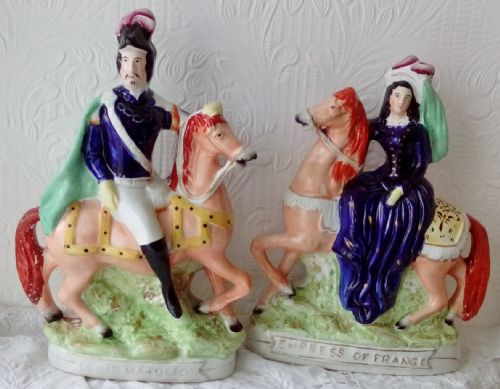


Victorian Pottery Horse Ornaments
Victorian pottery horse ornaments are nineteenth-century ceramic figures of riders and mounts that bring robust nineteenth-century character to a mantelpiece.
Victorian Pottery Horse Ornaments
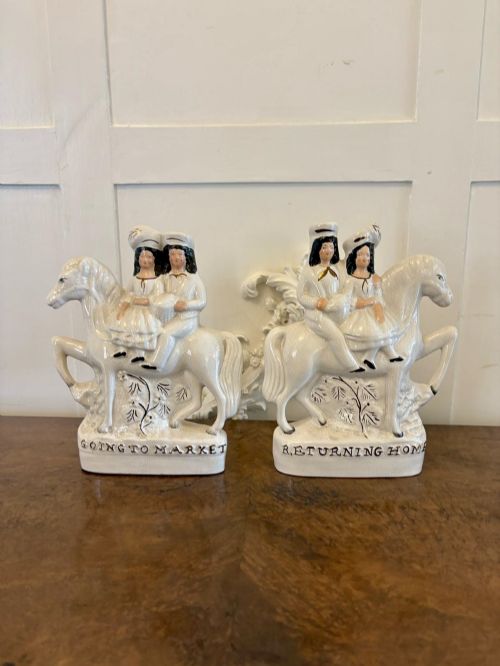
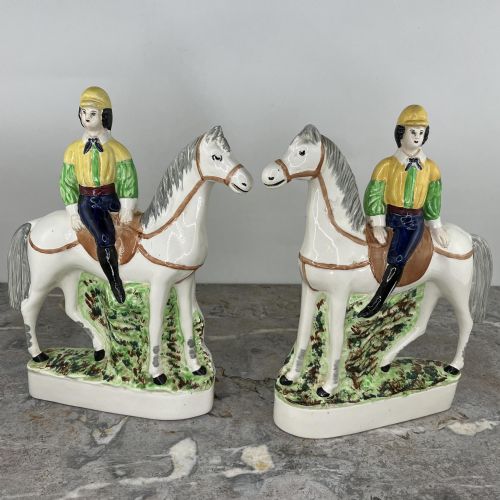
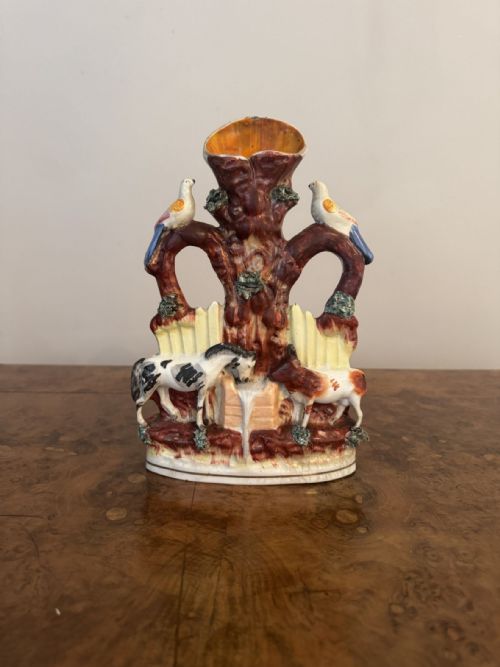
Victorian pottery horse ornaments encompass a range of nineteenth-century earthenware figures depicting equestrian subjects, soldiers, royalty, and literary characters. Buyers searching for victorian pottery horse ornaments frequently encounter flatback pairs designed to stand against a wall, alongside spill vases and singular modelled riders.
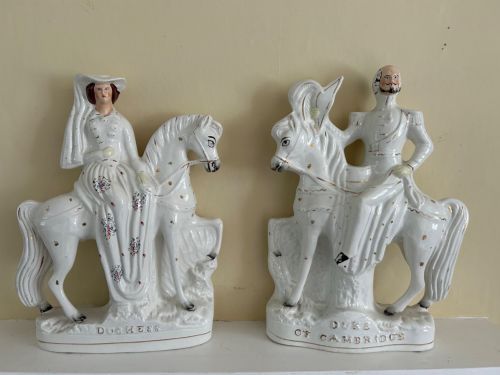
The subjects span historical figures such as the Duke and Duchess of Cambridge and Louis Napoleon, alongside Scottish highlanders, jockeys, highwaymen, and leopard hunters. These ceramics capture popular tastes of the eighteen-sixties, eighteen-eighties, and earlier nineteenth-century periods through distinct regional and Staffordshire traditions.
Portobello pottery also appears among these sculptural forms, offering primitive Scottish interpretations of riders on horseback. Each piece serves primarily as a decorative ceramic, reflecting the domestic mantel ornament styles of the nineteenth century.
Materials and construction
Makers shaped these ornaments from earthenware and ceramic bodies, frequently utilising slip-casting or press-moulding techniques to form the figures and their mounts. The resulting hollow-backed or flatback structures allowed the pieces to dry evenly and reduced weight during kiln firing.
Surfaces received hand-applied lead glaze and enamel colours, sometimes accented with gilt touches to highlight details on costumes and harness equipment. The combination of earthenware and rich enamel pigments gives these figures their characteristic nineteenth-century finish.
Victorian Pottery Horse Ornaments Retail Price Guide 2026
Typical asking prices for victorian pottery horse ornaments among the pieces listed under this phrase on Sellingantiques today, from the lower quarter to the upper quarter. They describe what is for sale here now, not the wider market.
The listings show pieces spanning from the early nineteenth century through the eighteen-eighties, utilising earthenware, enamel, and lead glaze.
Quality and execution
The crispness of the mould transfer and the stability of the glaze firing separate standard decorative pieces from finer sculptural representations. The distinctiveness of the subject, such as named historical portraits or well-executed pairs, also elevates the standing of a piece.
The Victorian Pottery Horse Ornaments Glossary
- Flatback
- A figure moulded with a finished front and a plain, unglazed or minimally finished flat rear surface designed to stand against a wall. This construction method saved ceramic material and production time in nineteenth-century potteries.
- Earthenware
- A porous, non-vitreous ceramic body fired at lower temperatures than stoneware or porcelain. It formed the standard structural base for nineteenth-century Staffordshire figures before being glazed and enamelled.
- Spill vase
- A hollow cylindrical receptacle incorporated into a figure group to hold wooden spills for lighting fires or candles. These dual-purpose ceramic pieces combined utility with decorative mantel display.
- Lead glaze
- A glossy coating containing lead oxide applied to pottery before firing to provide a smooth, waterproof surface. It enhances the brightness of underlying enamel colours on nineteenth-century figures.
- Portobello pottery
- Earthenware produced in the Portobello district near Edinburgh, known for primitive folk art styles and distinct regional figures. These pieces often feature bold, simple modelling and rustic charm.
Victorian Pottery Horse Ornaments: Frequently Asked Questions
What are flatback horse figures?
Flatback horse figures are ceramic ornaments manufactured with a detailed front and a flat, unornamented back designed to sit flush against a wall or shelf.
This construction method allowed nineteenth-century makers to save space in the kiln and material during production while maintaining a decorative appearance from the front.
How were these ornaments displayed?
These ceramic pieces typically stood upon mantelpieces, sideboards, and drawing-room shelves in nineteenth-century homes.
Pairs were often arranged symmetrically to frame a fireplace or mirror, while single figures or spill vases served as decorative focal points.
What subjects do these figures depict?
The subjects range from historical and royal personages such as the Duke and Duchess of Cambridge to literary characters and military figures.
Equestrian groups also feature jockeys, highwaymen, Scottish highlanders, and hunters accompanied by animals.
How do I care for antique pottery?
Antique earthenware requires gentle dusting with a soft, dry brush to prevent accumulation of dirt on the glaze and enamel surfaces.
Avoid using water or liquid cleaning agents, as nineteenth-century glazes and pigments can be sensitive to moisture.