




Staffordshire Equestrian Ornaments
Staffordshire equestrian ornaments bring nineteenth-century flatback portraiture and folklore directly to your shelf.
Staffordshire Equestrian Ornaments
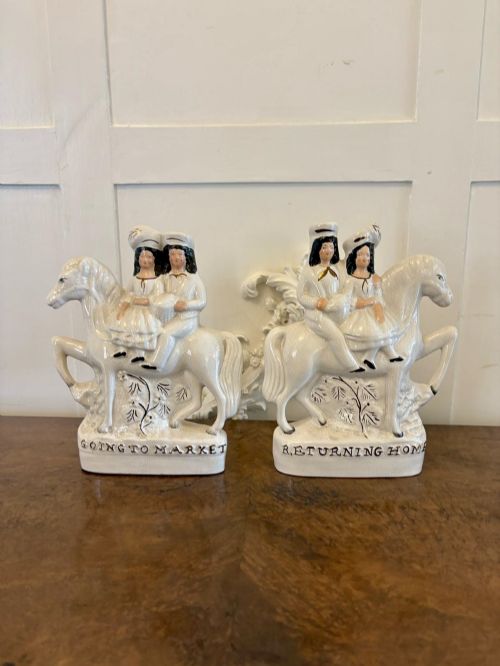
These pieces are ceramic figures depicting historical personalities, literary figures, and anonymous riders mounted on horseback. You will most frequently encounter nineteenth-century flatback pottery figures modeled as pairs or single subjects during your search.
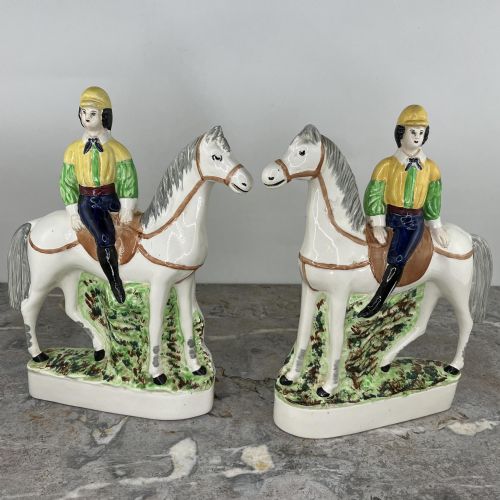
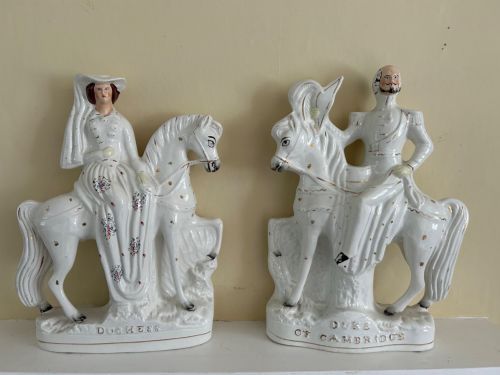
The subjects range widely from named royals like the Duke and Duchess of Cambridge and Louis Napoleon to romanticised characters such as Joan of Arc, Scottish highlanders, and highwaymen like Tom King. Makers also captured sporting subjects, including mounted jockeys and leopard hunters.
Produced primarily as decorative ornaments for Victorian mantelpieces, these earthenware figures are designed to be viewed from the front. The flat or minimally finished backs distinguish them from fully rounded sculptures meant to stand in the centre of a room.
How they were made
Potters shaped these earthenware figures using press-moulding techniques in two halves before joining them together with a flat or semi-flat reverse. The clay body is a typical porous Victorian pottery that received a transparent lead glaze over hand-applied enamel colours.
Detailing relied heavily on manual skill rather than precision printing. Painters applied bright enamel glazes directly onto the fired ceramic body, sometimes adding gilt highlights to uniforms, bridles, and bases to catch the candlelight of a Victorian parlour.
Staffordshire Equestrian Ornaments Retail Price Guide 2026
Typical asking prices for staffordshire equestrian ornaments among the pieces listed under this phrase on Sellingantiques today, from the lower quarter to the upper quarter. They describe what is for sale here now, not the wider market.
Listings span the nineteenth century, specifically focusing on Victorian Staffordshire pottery styles including earthenware, lead glaze, and enamel decoration.
What varies in quality
The ambition of the subject also defines the tier of the piece. Standard pairs of children or riders sit at the accessible end, whilst large, named historical personages or complex mounted figures demand greater sculptural skill and command stronger visual presence.
The Staffordshire Equestrian Ornaments Glossary
- Flatback
- A ceramic figure modelled with a detailed front and a largely unadorned or flat rear side. This construction method saved weight and material for mantelpiece display.
- Earthenware
- A porous, fired pottery body that requires a glaze to become impermeable to liquids. It served as the standard medium for Victorian Staffordshire potteries.
- Lead glaze
- A glossy glass-like coating containing lead oxide applied to pottery before firing. It gives these nineteenth-century pieces their characteristic shiny surface.
- Gilt
- A thin layer of gold leaf or gold paint applied to ceramic details. Potters utilised this finish to accent regalia, buttons, and titles.
Staffordshire Equestrian Ornaments: Frequently Asked Questions
What are Staffordshire equestrian ornaments?
These are nineteenth-century ceramic figures depicting people and animals on horseback. They were moulded in pottery and hand-painted with enamels for Victorian home display.
Subjects include royalty, historical heroes, jockeys, and literary characters. They typically feature a flat back designed to sit closely against a mantelpiece wall.
How do I date these figures?
Dating relies on stylistic clues, costume details, and the characteristics of the earthenware body and lead glaze. Most pieces on this page originate from the Victorian era between eighteen-sixty and eighteen-eighty.
Historical subjects often correspond to specific events or popular publications of the nineteenth century. Examining the hand-painted palette also helps place the piece within its manufacturing period.
Why are the backs flat?
Potters left the backs flat because these ornaments were intended to stand on narrow mantelpieces or shelves against a wall. This saved valuable workshop time, clay, and kiln space.
Detailing was concentrated entirely on the front where the viewer would see it. The flat reverse is a defining characteristic of Victorian Staffordshire flatback figures.
Were these figures made as pairs?
Many Staffordshire equestrian ornaments were produced as symmetrical pairs to flank a clock or mirror on a Victorian fireplace. Subjects like mounted jockeys, musicians, and children with horses frequently appear in matched sets.
Single figures also exist, representing specific historical personalities or dramatic scenes that stood alone. Pairs command particular interest for their balanced decorative impact.