


Victorian Pearl Earrings
Victorian pearl earrings bring together organic lustre and nineteenth-century metalwork in wearable designs that range from simple clusters to elaborate drop assemblies.
Victorian Pearl Earrings
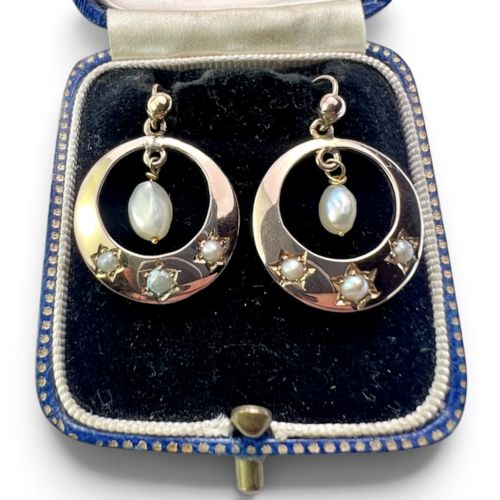
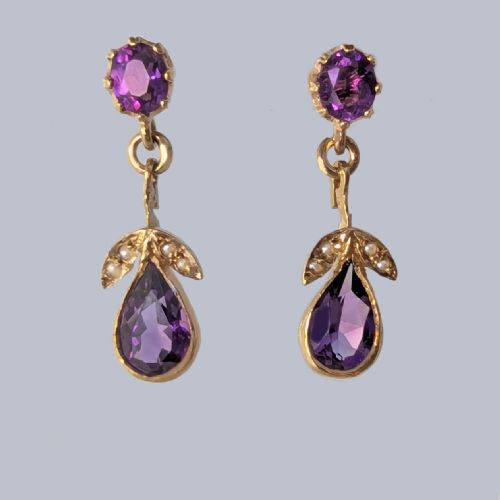
When you examine victorian pearl earrings, you encounter a variety of forms including drop earrings, floral and star clusters, dormeuses, and matching jewellery suites.
The most common versions on this page are authentic Victorian pieces alongside later revivals, featuring seed pearls or larger natural pearls paired with coloured gemstones.
Motive designs frequently draw upon naturalism, incorporating birds, flowers, crescents, and horseshoes executed in gold and silver mounts.
Construction and materials
Goldsmiths utilised various purities of yellow and rose gold, predominantly nine-carat and fifteen-carat, alongside silver settings for diamond-set sections to enhance sparkle.
Pearls, including seed pearls, baroque pearls, and natural saltwater varieties, were combined with diamonds, amethysts, turquoise, and garnets using claw, bezel, and star settings.
Swallows feature frequently as symbols of loyalty, returning faithfully to the same nesting spot year after year.
Quality factors
The distinction between tiers rests upon the origin and uniformity of the pearls, the intricacy of the metalwork, and the presence of verified natural gemstones.
Mastery of proportion and the survival of original closures or screw-back mechanisms elevate a pair above standard production.
The Victorian Pearl Earrings Glossary
- Seed pearl
- Very small, naturally occurring pearls, often drilled and threaded or glued onto foil-backed settings to form floral or geometric clusters.
- Dormeuse
- A type of sleeper earring designed to be comfortable for wearing overnight, typically featuring a secure hinged back fitting.
- Mabé pearl
- A cultured half-pearl grown against the inside shell of an oyster rather than within the tissue, resulting in a domed shape with a flat back.
- Parure
- A matched set of jewellery intended to be worn together, commonly comprising earrings, a necklace or pendant, and sometimes a brooch or ring.
- Old cut diamond
- A hand-faceted diamond cut prior to the modern brilliant standard, characterised by a smaller table, higher crown, and open culet.
Victorian Pearl Earrings: Frequently Asked Questions
What is the difference between seed pearls and natural pearls?
Seed pearls are exceptionally tiny pearls that were harvested in large quantities and used extensively in nineteenth-century cluster and floral jewellery. They are typically un-nucleated and gathered from freshwater mussels.
Natural pearls grow organically within molluscs without human intervention, varying significantly in shape, size, and lustre. Certified natural pearls command higher interest among collectors due to their rarity.
Are these earrings comfortable for modern pierced ears?
Many Victorian earrings utilise secure shepherd hooks, hinged dormeuse backs, or post fittings that adapt easily to standard modern piercings. Some pieces feature screw-back mechanisms designed for non-pierced lobes.
Conversion of screw-backs to posts is occasionally performed by specialists, though many collectors prefer to keep the original historical hardware intact.
How can I date Victorian pearl jewellery?
Dating relies on stylistic clues, metal hallmarks, and the construction techniques employed in the mounts. Earlier nineteenth-century pieces often incorporate closed-back foil settings for gemstones, while later decades favour open-backed mounts.
Stylistic shifts from Georgian-influenced heavy gold work towards lighter Edwardian platinum and silver-topped gold provide reliable chronological markers.