


Victorian Diamond Drop Earrings
Victorian diamond drop earrings combine nineteenth-century candlelight sparkle with graceful movement, offering buyers authentic period charm.
Victorian Diamond Drop Earrings
Victorian diamond drop earrings suspend stones below the earlobe, catching the light with every turn of the head. When searching for victorian diamond drop earrings, buyers encounter pieces from the nineteenth century alongside later Edwardian and vintage adaptations.
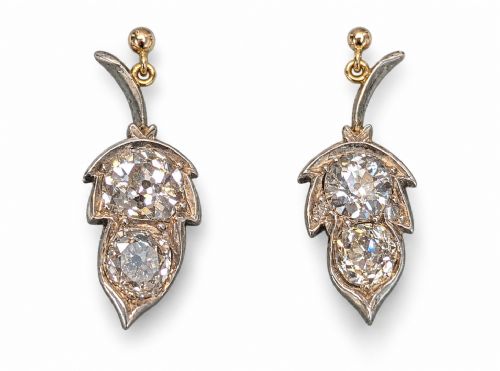
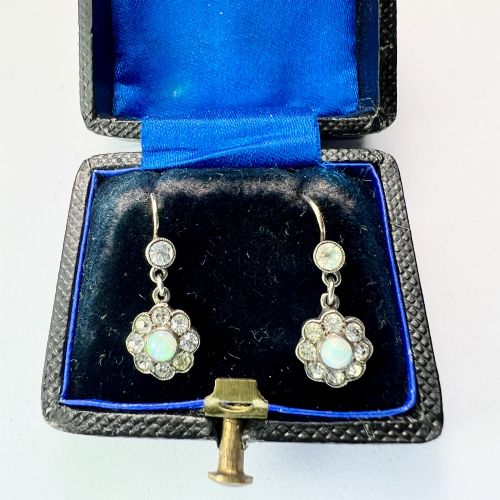
The selections span simple gold hooks to elaborate silver-topped clusters set with old cut diamonds and natural pearls. Many examples integrate coloured gems such as emerald, ruby, sapphire, opal, or tourmaline alongside the central diamonds.
The prevailing form on this page centres on the Victorian aesthetic, supplemented by Edwardian work and mid-century revivals. Drop configurations range from straightforward pear shapes to articulated bows and dangling clusters.
Materials and Construction
Goldsmiths combined gold and silver, mounting diamonds in silver set over gold backs to reflect candlelight effectively against the stones. The metals include nine-carat, fifteen-carat, and eighteen-carat yellow and rose gold.
Cutters shaped diamonds by hand into old cuts and rose cuts, producing softer facets than modern brilliant cuts. Settings incorporate foliate mounts, closed backs, and hinged drops designed for fluid movement.
Victorian Diamond Drop Earrings Retail Price Guide 2026
Typical asking prices for victorian diamond drop earrings among the pieces listed under this phrase on Sellingantiques today, from the lower quarter to the upper quarter. They describe what is for sale here now, not the wider market.
The listings span periods from the mid-nineteenth century through the Edwardian era up to the nineteen-fifties, utilising gold, silver, diamonds, and natural pearls.
Evaluating Quality
Quality rests on the integrity of the setting and the character of the hand-cut stones rather than uniform symmetry. Original integration of stones and metalwork separates authentic period pieces from later assembled items.
The presence of certified natural pearls, substantial diamond carat weights, and well-preserved foliate mounts elevate an example within its period. Metal purity marks and the preservation of delicate silver collets also distinguish finer specimens.
Knoll and Pregizer
The Victorian Diamond Drop Earrings Glossary
- Old cut diamond
- A hand-faceted diamond cut before modern machinery, characterised by a smaller table and high crown.
- Rose cut diamond
- A flat-bottomed diamond with a domed top covered in triangular facets, resembling an opening rosebud.
- Natural pearl
- A pearl formed organically in a mollusk without human intervention, frequently found paired with nineteenth-century diamonds.
- Silver-topped gold
- A technique where silver is soldered to a gold backing, allowing white metal around the stones while retaining gold strength.
Victorian Diamond Drop Earrings: Frequently Asked Questions
How do I wear drop earrings safely?
Secure the hooks with appropriate backs and check the hinge mechanisms before wearing them out. Their length makes them suited for evening wear and special occasions where sudden movements are limited.
Store them in individual compartments to prevent the silver and diamonds from scratching adjacent pieces in your collection.
Are these diamonds different from modern ones?
Older stones were shaped by hand under candlelight, resulting in distinctive facet patterns that glow softly rather than producing intense modern brilliance. Each stone is irregular and tailored specifically to its handmade mount.
This hand-cut character means no two pairs share identical optical properties or identical proportions.
How do I identify a Victorian period piece?
Examine the metalwork for closed-foil backs, hand-cut stones, and specific construction methods like silver-topped gold mounts. Hallmarks, where present, help confirm the gold purity and date.
Stylistic cues such as bow motifs, Etruscan revival details, and natural pearl pairings further point toward nineteenth-century origin.
Can I have these earrings converted or repaired?
Repairs should be undertaken by a specialist conversant in antique jewellery preservation and old-cut stone setting. Alterations like conversion from screw-backs to hooks require care to preserve the original metalwork.
Keep modifications minimal to maintain the historical integrity of the piece.