
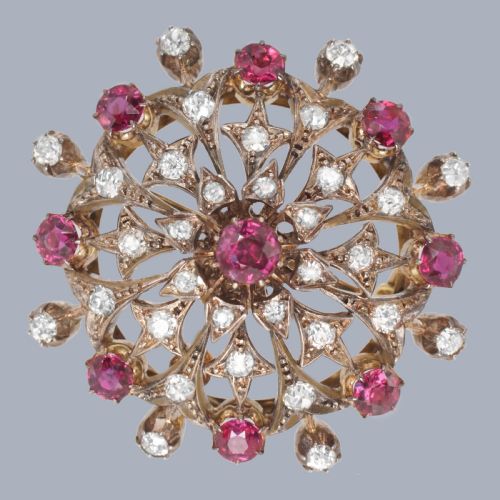


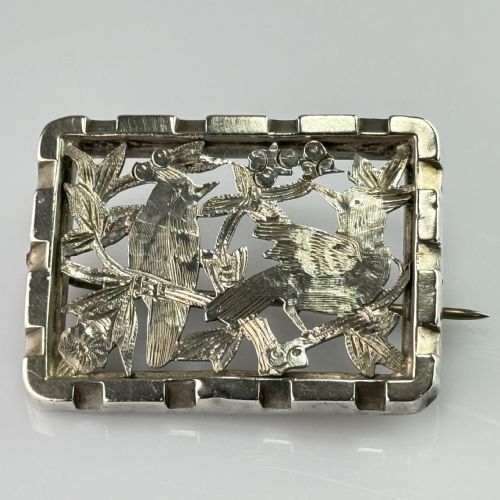
Victorian Openwork Brooch
These Victorian openwork brooch pieces are intricate silver and gold jewels set with diamonds, pearls, and amethysts that bring distinctive nineteenth-century elegance to any collection.
Victorian Openwork Brooch
When you search for a Victorian openwork brooch, you are looking at pierced and filigree metalwork jewellery from the latter half of the nineteenth century. These items often double as pendants, offering versatile wear as both brooches and neck ornaments.
The most common versions met here combine yellow gold or silver with central gemstones like amethyst, peridot, or garnet, framed by delicate seed pearls. Many examples originate from the 1870s to the 1890s, displaying floral, heart, or basket motifs.
Makers of this era utilised advanced piercing techniques to create light, airy structures that let light pass through the stones and metal. This lace-like metalwork defines the classic appearance of the period's wearable art.
Materials and construction
Craftsmen built these jewels using silver, 9ct gold, and 18ct yellow gold as the primary structural metals. Often, jewellers combined silver and gold together to mount diamonds securely while maintaining a warm gold backing.
Piercing and openwork sawing formed the characteristic pierced patterns, removing excess metal to lighten the piece. Artisans then set gemstones including diamonds, sapphires, rubies, and paste stones directly into the intricate frames, frequently embellishing the designs with natural pearls and seed pearls.
Listings feature yellow gold, silver, and gemstone combinations spanning the Victorian period from 1870 to 1890.
Quality and craftsmanship
The distinction between standard work and finer examples lies in the precision of the piercing and the balance of the design. Superior pieces demonstrate crisp, hand-sawn apertures that maintain structural strength while appearing remarkably delicate.
Gemstone selection and matching also dictate the grade of the jewel, with well-matched seed pearls and clean coloured stones elevating the overall finish. The integration of dual functions, such as hidden pendant loops, shows thoughtful craftsmanship.
The Victorian Openwork Brooch Glossary
- Openwork
- Metalwork that has been pierced or cut through to create a pattern with negative space. This technique reduces weight and lets light pass through the jewel.
- Seed pearl
- A very small, naturally occurring pearl, often fractionally sized and drill-holed for stitching or pegging onto jewellery. These tiny pearls form borders and floral clusters.
- Giardinetti
- A style of jewellery depicting a small garden or flower basket filled with gemstones. The name translates from Italian as little garden.
- Paste
- Hand-cut lead glass used as a gemstone substitute in antique jewellery. High-grade paste is faceted and foiled to mimic diamonds and coloured stones.
- Pendant brooch
- A convertible piece of jewellery equipped with a pin stem and a hidden loop or bale. This allows the item to be worn pinned to clothing or suspended from a chain.
Victorian Openwork Brooch: Frequently Asked Questions
How do I wear a convertible brooch?
Many of these pieces feature a fold-down pin or a small hidden loop at the top for a chain. You can secure the pin through heavier fabrics or thread a ribbon through the loop to wear it as a pendant.
Ensure the pin catch is secure when worn on clothing to prevent loss, or use a fitted pendant converter if the loop is small.
What is the difference between silver and gold settings?
Silver was frequently used on the face of nineteenth-century jewellery to reflect white light through diamonds and paste stones. Gold provided a sturdy backing and hypoallergenic contact with skin.
Over time, silver develops a dark patina, whereas yellow gold retains its warm metallic hue with minimal cleaning.
How can I date a Victorian openwork piece?
Dating relies on stylistic clues, gemstone combinations, and the specific type of metal mount. Pieces from the 1870s often feature heavier gold work and coloured stones like garnet, while 1890s examples frequently incorporate peridot and lighter silver-on-gold settings.
Gemological reports and hallmarks can sometimes narrow down the exact decade of production.