




Antique Peridot Brooch
An antique peridot brooch brings a distinctive olive-green sparkle to lapels and collars, combining period goldwork with vibrant gemstones.
Antique Peridot Brooch
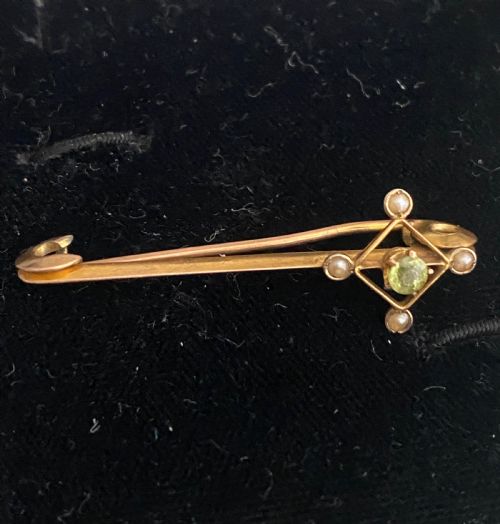
When you search for an antique peridot brooch, you find a range of jewels spanning the Victorian, Edwardian, and Art Nouveau eras. These pieces typically combine bright green peridot stones with yellow gold, silver settings, and seed pearls.
The designs on this page include floral clusters, clover motifs, star shapes, and versatile pendant brooches that detach to wear on a chain. Edwardian and late Victorian examples dominate the selection, often incorporating delicate openwork frames.
Victorian pieces tend toward robust gold clusters and symbolic twin heart designs, while Edwardian and Art Nouveau items favour lighter garland styles and flowing botanical lines.
How they were made
Goldsmiths worked with nine-carat, fifteen-carat, and fourteen-carat yellow gold, frequently backing silver settings with gold to enhance the brilliance of old-cut diamonds alongside the peridots.
Seed pearls and split pearls appear extensively as borders and accents, threaded or pegged onto gold foundations. Stone settings range from closed foils in earlier pieces to open-backed collets that let light pass through the transparent green stones.
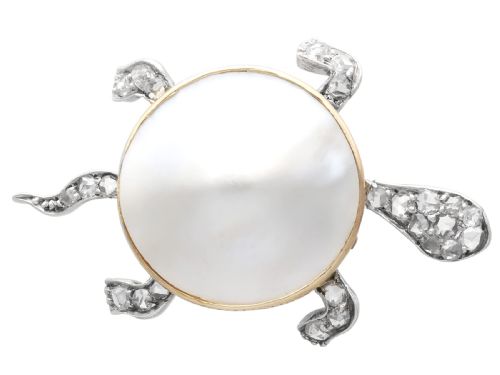
A tiny gold turtle brooch creeps across the selection, carrying a shell made of mother-of-pearl alongside sparkling peridots and diamonds.
What varies in quality
The distinction between standard workshop output and top-tier pieces lies in the depth of stone colour and the complexity of the metalwork. Finest examples feature large, richly saturated peridots paired with substantial diamond accents and intricate openwork construction.
Simpler bar brooches and cluster mounts rely on uniform smaller stones and straightforward gold casting. The presence of original fitted presentation cases or convertible pendant loops also elevates a piece within its period.
G Colani
The Antique Peridot Brooch Glossary
- Peridot
- A transparent olive-green gemstone prized since antiquity for its distinctive citrus hue. It is the defining stone of these brooches.
- Seed pearl
- A very small natural or cultured pearl, often half-drilled and glued or pegged onto tiny gold pins. They frame peridot clusters in Edwardian and Victorian designs.
- Pendant brooch
- A convertible jewel fitted with a hidden loop or bail at the back, allowing it to function as both a brooch and a necklace pendant.
- Collet setting
- A low collar of metal that wraps securely around the girdle of a gemstone. It holds the peridot flat within the gold frame.
- Trellis brooch
- A jewelled piece featuring an open lattice pattern of precious metal. Diamonds and peridots are typically pavé-set across the intersecting bars.
Antique Peridot Brooch: Frequently Asked Questions
How do I wear a pendant brooch?
These versatile jewels feature a discreet hinged bale or loop tucked behind the upper mount. You simply thread a fine gold chain through this loop to wear the piece as a pendant.
When you wish to wear it on clothing, the pin and safety clasp function just like any traditional brooch.
How do I date an Edwardian peridot brooch?
Edwardian pieces generally feature lighter, airier platinum or white metal accents combined with yellow gold backs. They often incorporate garlands, bows, and star motifs set with seed pearls.
By contrast, heavier yellow gold bezels and denser cluster arrangements typically point to earlier Victorian manufacture.
Are peridots treated in antique jewellery?
Natural peridots used in nineteenth and early twentieth-century brooches are untreated. The olive-green colour you see is entirely natural to the gemstone.
Lapidaries faceted these stones by hand, resulting in slightly irregular culets and table facets unique to period cutting techniques.