


Peridot Drop Necklace
A peridot drop necklace brings together vibrant green olivine stones and delicate gold work, offering a luminous piece of antique jewellery for everyday wear.
Peridot Drop Necklace
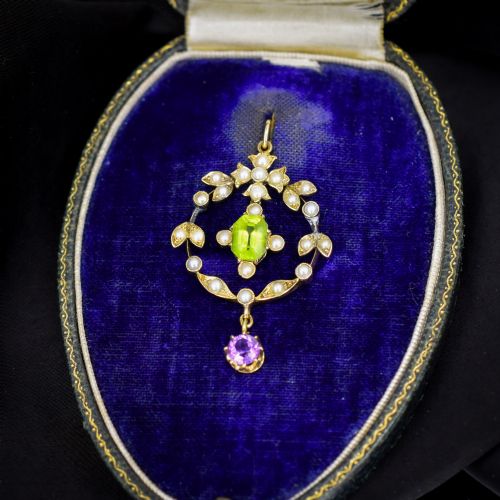
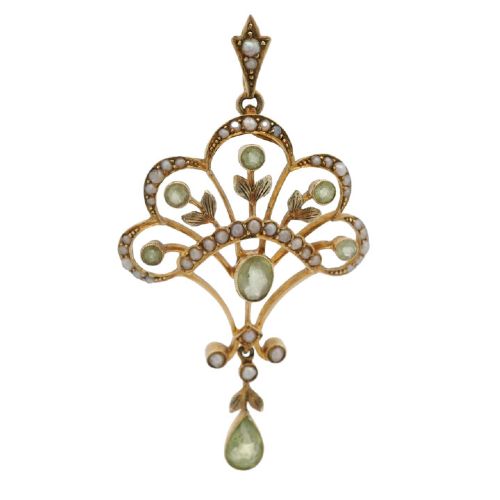
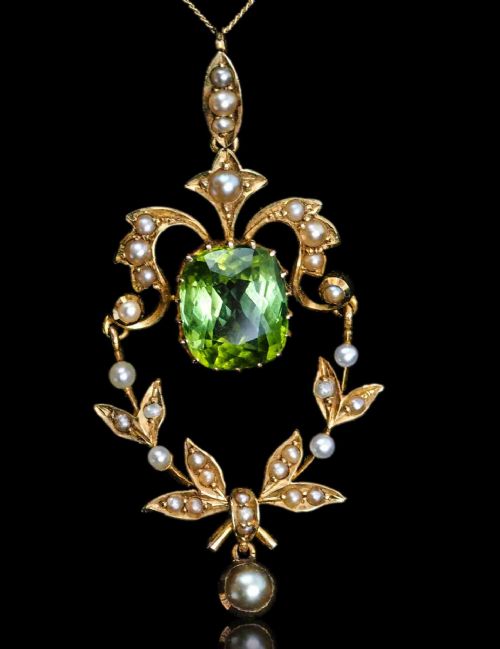
Buyers will most commonly encounter Edwardian and Victorian examples on this page, including Art Nouveau and Arts and Crafts designs. The configurations range from simple pear-shaped stone drops to elaborate lavaliers and multi-stone cascades incorporating pearls or complementary gemstones like amethyst.
The enduring appeal of a peridot drop necklace lies in its characteristic lime-green hue and delicate metalwork. Whether set in nine-carat or fifteen-carat gold, these items reflect the shifting aesthetic movements of the late nineteenth and early twentieth centuries.
How they were made
Craftsmen during the Victorian and Edwardian periods typically utilised nine-carat and fifteen-carat gold to mount peridot stones. These metals provided the necessary ductility for intricate wirework while maintaining structural integrity for delicate drops.
Seed pearls and occasionally diamonds or amethysts frequently complemented the peridot stones in clustered or lavalier arrangements. Goldsmiths employed traditional setting techniques, securing the pale green gems within claw or bezel mounts alongside finely drilled pearls threaded onto silk or fine wire.
Several pieces conceal tiny seed pearls arranged in floral clusters, whispering of secret late-night garden strolls.
What varies in quality
The refinement of the metalwork and the precision of the stone setting dictate the upper tier of these pieces. Maker attribution, particularly to known workshops of the Art Nouveau and Arts and Crafts movements, elevates the standing of an individual necklace.
Saturation and clarity of the peridot stones also differentiate examples, alongside the uniformity and lustre of any accompanying seed pearls. Original boxes and intact contemporary chains contribute further to the completeness and desirability of a piece.
Murrle Bennett
The Peridot Drop Necklace Glossary
- Lavalier
- A pendant necklace featuring a central dangling element, often suspended from a smaller component on a thin chain. This style gained immense popularity during the Edwardian period.
- Seed pearl
- A very small, naturally occurring or cultured pearl, typically drilled and used in clusters or bordering stones in antique jewellery. They add a delicate white contrast to the vibrant green of peridot.
- Art Nouveau
- An international style of art and architecture prevalent from the late nineteenth century to the First World War. It is characterised by fluid, organic lines and stylized plant motifs.
- Arts and Crafts
- A design movement championing traditional craftsmanship and medieval-inspired forms. Pieces from this tradition often display hand-beaten gold surfaces and simple, honest stone settings.
- Peridot
- A gem-grade variety of olivine valued for its distinctive lime or olive-green coloration. It has been utilised in jewellery for millennia and saw a notable revival during the late Victorian and Edwardian eras.
Peridot Drop Necklace: Frequently Asked Questions
How do I care for a peridot necklace?
Peridot is a softer gemstone compared to diamond or sapphire, rating around six and a half to seven on the Mohs scale. Cleaning should involve only warm soapy water and a soft cloth, avoiding ultrasonic cleaners and harsh chemicals that might damage the stone or the seed pearls.
Storage requires separate compartments or soft pouches to prevent scratching from harder jewellery pieces. Because many antique chains are delicate, removing the necklace before sleeping or strenuous activity preserves the original fixings and settings.
Are these necklaces fragile to wear?
Edwardian and Victorian drop necklaces often incorporate very fine gold chains and seed pearls which require gentle handling. The mounts are secure for normal daily wear, but sudden tugs or catching on clothing can strain the delicate wirework characteristic of the period.
Many surviving pieces retain their original structure precisely because previous owners treated them with care. Regular checks on the jump rings and claw settings by a specialist jeweller will ensure the pendant remains secure on its chain.
How can I date an antique pendant?
Dating relies heavily on the stylistic hallmarks of the mount, the cut of the stones, and any accompanying metal purity marks. Edwardian pieces often display airy, garland-style platinum or high-karat gold work, whilst Victorian examples can be heavier and incorporate richer yellow gold.
Certain motifs such as sinuous whiplash lines point towards the Art Nouveau movement around nineteen hundred. Hallmarks stamped on the reverse of the pendant or the clasp provide definitive clues to the year and place of manufacture.
What is a lavalier necklace?
A lavalier is a specific type of pendant featuring a main drop suspended below a smaller decorative station on the chain. This asymmetrical or multi-tiered dangling format became fashionable in the late nineteenth century and remained popular through the Edwardian decade.
The design allows the peridot and accompanying seed pearls to catch the light from multiple angles as the wearer moves. They are typically lighter and more intricate than standard solid pendants of earlier eras.