

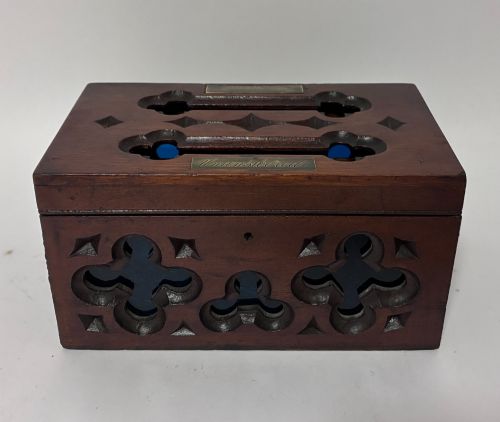


Victorian Oak Post Box
These robust victorian oak post box examples deliver tangible historical utility for your hallway, combining durable construction with period charm.
Victorian Oak Post Box
A victorian oak post box serves as a functional desktop or wall-mounted repository for correspondence, reflecting the heavy correspondence demands of period households. These items range from compact desk accessories to larger country house postal boxes designed to handle daily domestic mail.
You are most likely to encounter Victorian and Edwardian examples fashioned from golden or dark oak, frequently augmented with brass fitments and glazed panels. Common configurations include slope-front correspondence boxes, carved wooden chests, and wall-mounted letter boxes originating from hotels or private estates.
The aesthetic vocabulary spans simple utilitarian forms to ornate Gothic Revival designs and characteristic Arts and Crafts details. Pieces often feature designated letter slots, glazed viewing windows, and hinged compartments intended for systematic sorting.
Materials and construction
Makers utilised solid timber - principally oak, alongside occasional ash - to build rigid carcases capable of withstanding daily use. Wood surfaces were frequently carved, panelled, or polished to a rich golden or deep hue.
Structural integrity was enhanced through metalwork, incorporating brass hinges, escutcheons, straps, and copper or steel fixings. Glass panels were integrated into specific designs to allow occupants to view incoming letters without opening the main compartment.
Victorian Oak Post Box Retail Price Guide 2026
Typical asking prices for victorian oak post box among the pieces listed under this phrase on Sellingantiques today, from the lower quarter to the upper quarter. They describe what is for sale here now, not the wider market.
Some country house post boxes still retain faint traces of pipe smoke trapped within their oak interiors for over a century.
Assessing quality
The hierarchy of quality rests primarily on the depth of craftsmanship evident in the woodwork and the substantial nature of the metal mounts. Superior examples display crisp hand-carving, precise joinery, and heavy cast brass hardware rather than flimsy pressed plates.
Proportion and architectural detailing distinguish standard utility boxes from exceptional country house or hotel receptacles. Finer specimens integrate clever internal divisions, bevelled glass, and robust locking mechanisms with original key escutcheons.
The Victorian Oak Post Box Glossary
- Correspondence box
- A desk accessory specifically built to hold writing paper, envelopes, and incoming or outgoing mail. These often feature sloping lids and multiple internal compartments.
- Escutcheon
- A protective brass or metal plate surrounding a keyhole, frequently shaped decoratively on period letter boxes. It prevents the surrounding wood from wearing down through repeated use.
- Gothic Revival
- An architectural and decorative style popular during the nineteenth century, characterised by pointed arches, heavy moulding, and medieval motifs. It appears frequently on more ornate post boxes.
- Arts and Crafts
- A design movement emphasising handcraftsmanship, simple forms, and natural materials like oak and copper. Pieces from this tradition avoid mass-produced excess in favour of honest construction.
- Country house
- A term denoting large-scale domestic provenance, implying heavier, more durable furnishings built to service substantial estates. Post boxes bearing this association are typically built for heavy daily sorting.
Victorian Oak Post Box: Frequently Asked Questions
What is a victorian oak post box?
A victorian oak post box is a wooden container designed during the nineteenth or early twentieth century to collect and organise household mail. They were kept on desks or mounted to walls in large domestic settings.
These items reflect the high volume of written correspondence handled by households before the modern digital era. They combine sturdy timber framing with practical metal hardware.
Where were these postal boxes used?
Original locations included the halls, studies, and reception areas of country houses, hotels, and large town residences. Staff utilised them to gather mail before postal collections.
Smaller desk variants sat in private studies for personal letter organisation. Wall-mounted versions accommodated incoming post from delivery personnel.
How do I date a post box?
Dating relies on observing stylistic markers, hardware construction, and timber treatment. Pieces displaying Gothic Revival or elaborate hand-carving generally point to the middle and late nineteenth century.
Edwardian or later examples from around nineteen hundred often exhibit simpler Arts and Crafts influences. The presence of specific brass fixings and lock types also helps establish the period of manufacture.
Are these letter boxes still functional?
Many surviving examples remain entirely suitable for modern domestic use as desktop organisers or hallway mail drops. Their internal compartments continue to accommodate contemporary envelopes and small parcels.
Care should be taken with original hinges and locks to preserve their historical integrity during daily operation.