
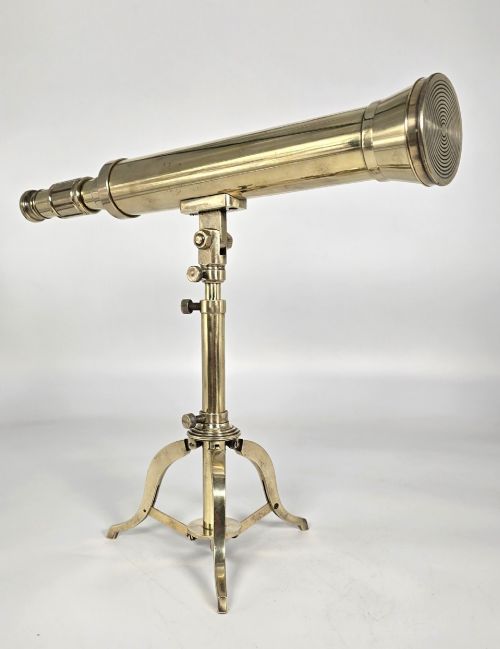


Victorian Nautical Spyglass
These Victorian nautical spyglass items are portable brass and leather optical instruments from the nineteenth century that bring maritime history directly to your desk.
Victorian Nautical Spyglass
A victorian nautical spyglass is typically a multi-draw terrestrial telescope designed for marine observation, often measuring in brass, leather, and wood.
You will most frequently encounter English single-draw, three-draw, and four-draw telescopes originating from the Victorian period.
The selections span from handheld navigational instruments to larger tabletop telescopes mounted on original folding brass tripods.
Materials and construction
Makers utilised polished brass for the main barrel tubes, frequently wrapping sections in stitched leather, mahogany, fruitwood, or oak for a secure grip at sea.
Optical systems combine precision glass lenses within draw tubes of nickel, steel, or gilt brass to achieve terrestrial magnification.
Many of these spyglasses still bear faint salt stains and minor dents from sailors scanning the horizon decades ago.
Judging quality
Quality rests in the precision of the draw action and the clarity of the glass optics, distinguishing utilitarian instruments from finer signed pieces.
The inclusion of maker signatures, original fitted cases, or matching folding tripod stands elevates the standing of an instrument.
Ross of London·Steward of London·Newton and Co·L Casella London·Chadburn Brothers of Sheffield·Davis of London
The Victorian Nautical Spyglass Glossary
- Draw
- An extending telescopic tube section that slides within another. More draws allow a longer instrument to collapse into a shorter handheld length.
- Terrestrial telescope
- An optical instrument that produces an upright image for viewing land or sea objects. It uses an erecting lens system rather than the inverted view of astronomical telescopes.
- Officer of the watch telescope
- A compact marine telescope carried by naval officers on deck for signalling and observation. These are usually single or multi-draw brass and leather handheld instruments.
- Marine telescope
- A durable brass spyglass built for use aboard ship. They were constructed to withstand salt air and rough handling.
Victorian Nautical Spyglass: Frequently Asked Questions
How do I use a draw telescope?
Gently pull each section of the brass barrel out to its full extension until the lenses lock into alignment. Support the main body firmly while adjusting the smallest eyepiece draw to bring distant objects into sharp focus.
Take care not to force the tubes beyond their natural stop points. Push them inward gently in reverse order when collapsing the instrument for storage.
What were nautical spyglasses used for?
Naval officers and merchant seamen relied on these optical instruments aboard ship to spot hazards, identify distant vessels, and read signals at sea. They were essential tools for navigation and maritime communication.
On land, gentlemen utilised them for observing distant landscapes and sporting events. Their portability made them practical companions for travel.
How do I date a Victorian telescope?
Examine the materials, the number of draw sections, and any engraved maker signatures on the brass eyepiece collar. Makers often updated their company names or addresses over the decades, which helps narrow down the production period.
The transition from wood and leather wrappings to nickel plating or heavier tabletop tripod mounts also points toward specific decades within the nineteenth and early twentieth centuries.