



Victorian Music Canterbury Drawer
A victorian music canterbury drawer holds sheet music and journals close to the hearth in rich mahogany or burr walnut.
Victorian Music Canterbury Drawer
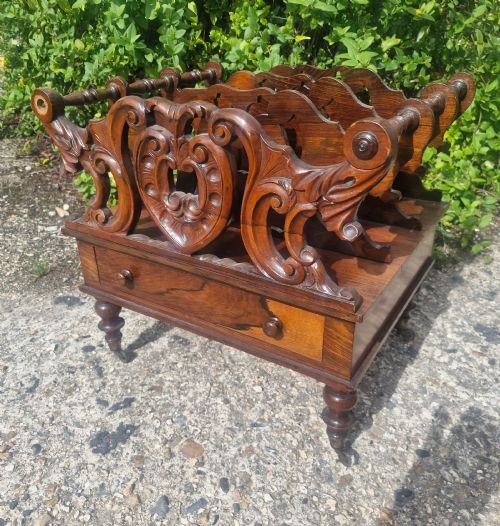
A victorian music canterbury drawer combines upright divisions for scores with a base compartment for smaller items. These pieces emerge from nineteenth-century parlours where sheet music required dedicated storage near the piano.
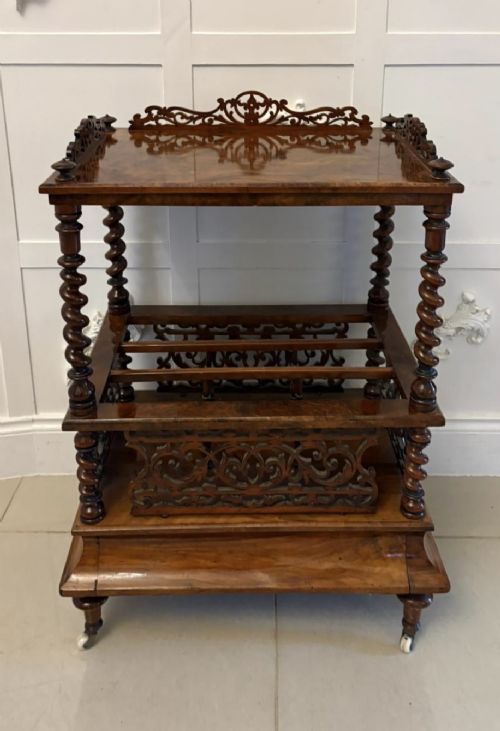
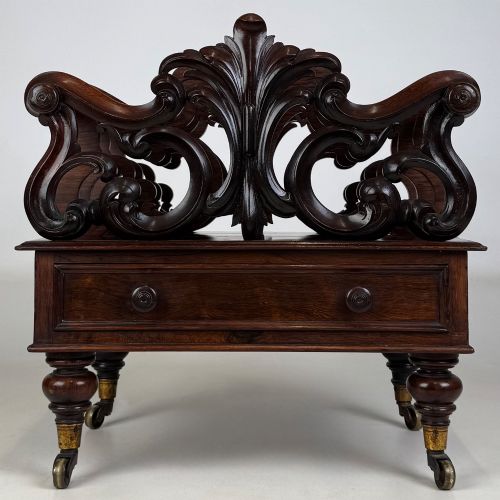
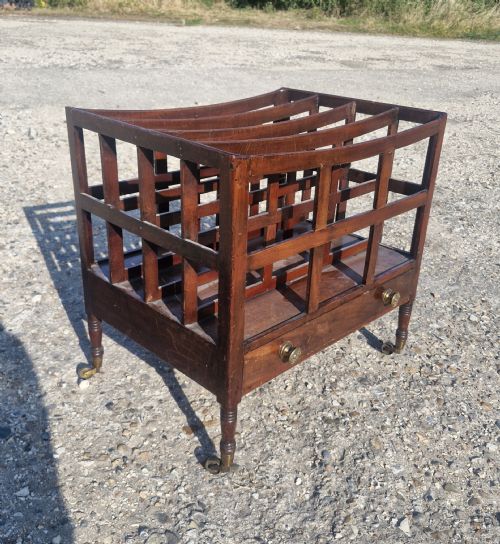
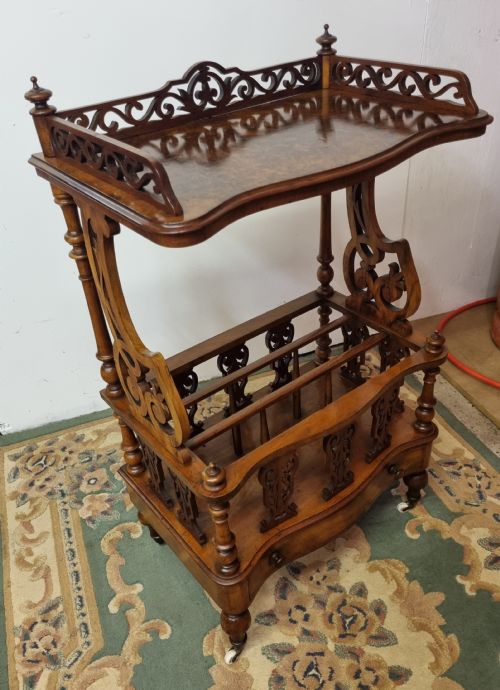
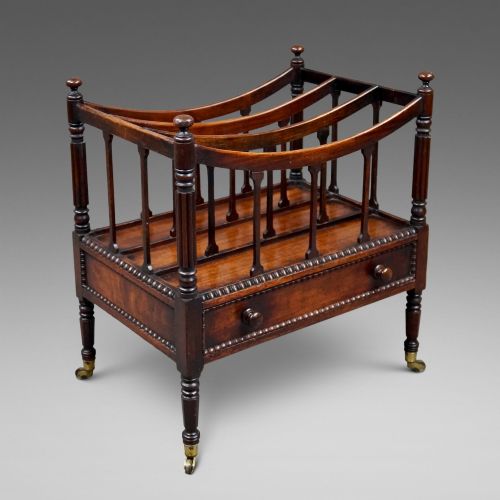
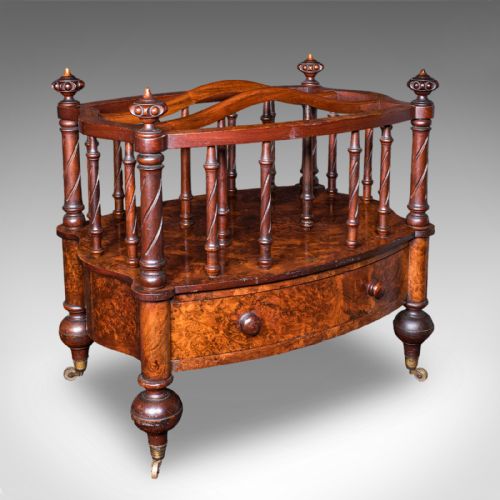
The evidence shows forms ranging from three-section mahogany racks to serpentine burr walnut examples and combined what-nots. Many items feature a single drawer beneath the slatted divisions, sometimes resting on short turned legs with castors.
Makers designed these stands in mahogany, rosewood, and satinwood, reflecting Regency, William IV, and Victorian tastes. Pieces with an integrated drawer offer extra utility for small accessories alongside the main rack.
Materials and Construction
Cabinet makers utilised dense hardwoods such as mahogany, rosewood, and burr walnut for structural stability and rich grain patterns. Timber selection dictated whether the frame received simple polished finishes or intricate ebony inlay.
Makers shaped the dividers through pierced fretwork, scroll cutouts, and turned spindles to keep the overall weight manageable. Brass details, such as castors and small drawer pulls, appear frequently across nineteenth-century examples.
Joinery techniques relied on sturdy framing to support the vertical load of books and sheets without warping. Drawer boxes utilised traditional dovetailing to ensure smooth movement within the lower carcass.
Victorian Music Canterbury Drawer Retail Price Guide 2026
Typical asking prices for victorian music canterbury drawer among the pieces listed under this phrase on Sellingantiques today, from the lower quarter to the upper quarter. They describe what is for sale here now, not the wider market.
Several examples include hidden lower compartments designed specifically to catch runaway guitar picks and errant tuning keys.
Judging Quality
The refinement of the pierced fretwork and the symmetry of the turned supports separate standard examples from finer works. Timber choice also dictates value, with figured burr walnut and richly grained rosewood sitting above plain secondary woods.
Proportion and execution of the lower drawer determine the overall harmony of the piece. Crisp joinery on the divider slats and original brass hardware indicate superior workshop production.
Edwards and Roberts·Howard and Sons·Shoolbred
The Victorian Music Canterbury Drawer Glossary
- Canterbury
- A low stand with upright divisions for holding sheet music, folios, or magazines. The form often includes a single shallow drawer at the base.
- Whatnot
- A set of open shelves supported by slender pillars, sometimes combined with a canterbury base for dual storage.
- Serpentine
- A curved line of furniture moulding that bends inward centrally and outward at the ends, creating a flowing shape.
- Fretwork
- Ornamental woodwork perforated with patterns, commonly seen on the upright partitions of these stands.
- Inlay
- A technique where contrasting materials are inserted into depressions in the wood base to form decorative patterns.
Victorian Music Canterbury Drawer: Frequently Asked Questions
What is a victorian music canterbury drawer used for?
These pieces served nineteenth-century households as tidy receptacles for sheet music, folios, and periodicals kept beside domestic keyboards.
The lower drawer accommodated smaller musical accessories, manuscript papers, or tuning tools away from the main compartment.
How do I identify a Victorian piece?
Victorian examples frequently employ dark dense timbers like rosewood and burr walnut, often paired with elaborate pierced fretwork.
Construction details such as turned legs fitted with brass castors point firmly to nineteenth-century workshop practices.
Where should I place a canterbury in a modern room?
These compact stands sit well beside a sofa, armchair, or piano to hold current reading material and journals.
The flat top surface also functions nicely as an occasional table for a small lamp or decorative object.
How do Regency and Victorian styles differ?
Regency pieces often show cleaner classical lines in mahogany, reflecting earlier nineteenth-century neoclassical design influences.
Victorian variations introduce heavier figured veneers, serpentine curves, and more elaborate fretwork patterns.