



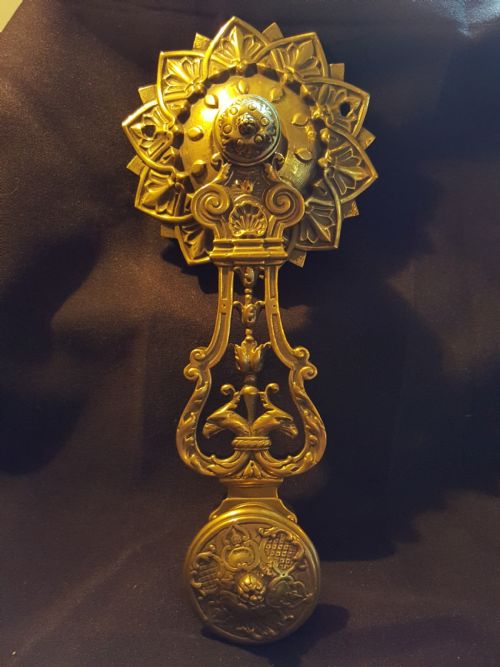


Victorian Mechanical Bell Pull
These Victorian mechanical bell pull examples are heavy, working household hardware built to summon servants across grand rooms.
Victorian Mechanical Bell Pull
When you search for a victorian mechanical bell pull, you encounter functional architectural hardware designed to connect a decorative handle to a mechanical chime or bell mechanism elsewhere in the house. The selection ranges across the Victorian period alongside earlier Georgian examples and continental imports.
Most entries function as door hardware or bell ringers, incorporating levers and pivots intended for daily operation. Their forms span simple domestic fixtures to ornate ornamental designs meant for prominent reception rooms.
How they were made
Makers shaped these fixtures primarily from cast brass, utilising the metal's strength and capacity for detailed surface decoration. Workshops frequently combined this core metalwork with contrasting materials like glass, horn, and cord.
Casting allowed craftsmen to produce complex French Rococo Revival scrollwork and symmetrical geometric mounts. Individual components were finished by hand to ensure the mechanisms operated smoothly under tension.
Materials across these listings span cast brass, glass, horn, cord, and gilded metal.
What varies in quality
Quality rests upon the crispness of the cast decoration and the integrity of the moving parts. Pieces featuring intricate French Rococo Revival detailing or unusual combinations of brass and horn demonstrate superior foundry work compared to simpler utilitarian designs.
The choice of secondary materials also elevates a piece, particularly heavy moulded glass handles or well-preserved natural horn inserts. The depth of the brass casting and the sophistication of the linkage mechanisms determine the overall standard.
The Victorian Mechanical Bell Pull Glossary
- Bell pull
- A hanging handle or lever mounted near a fireplace or beside a door, connected by wires and cranks to a remote bell. These devices served as the standard domestic communication system before electrical buzzers.
- Bell ringer
- An alternative term for a wall-mounted pull assembly, often featuring a rotary or lever action rather than a straight drop cord. They provide immediate mechanical leverage to ring a chime.
- Cast brass
- An alloy of copper and zinc melted and poured into a mould to create rigid hardware components. This method permitted mass production of decorative architectural fittings with consistent relief patterns.
- French Rococo Revival
- A decorative style characterised by asymmetrical scrollwork, C-scrolls, and naturalistic leaf motifs. Makers applied this continental aesthetic to ornate domestic hardware during the nineteenth century.
Victorian Mechanical Bell Pull: Frequently Asked Questions
How did a mechanical bell pull work?
A cord or wire linked the handle directly to cranks and levers concealed behind the wall panelling. Pulling the handle tensioned the wire, which swung a clapper against a bell in the service quarters.
Once released, internal springs returned the handle and wire to their resting positions. The system relied entirely on physical leverage rather than electricity.
Where were these bell pulls placed?
Homeowners installed them in principal reception rooms, dining rooms, and master bedrooms so residents could summon staff without leaving their seats. They sat beside fireplace mantels or flanking main entrance doors.
Their placement ensured guests and family members had immediate access to domestic assistance. Consequently, the most ornate designs appeared in public-facing spaces.
Can these old bell pulls still function?
Many surviving examples retain their internal mechanical linkages and can operate with appropriate wire and spring systems. However, modern users typically mount them as decorative architectural salvage rather than active household call systems.
Restoring full functionality requires matching the original tension and ensuring the wall cranks move freely. Most collectors appreciate them primarily for their substantial metalwork and period design.
How do I distinguish Georgian from Victorian pieces?
Georgian examples often favour restrained neoclassical symmetry, cleaner lines, and simpler geometric brass backplates. Victorian pieces frequently display heavier cast ornamentation, including French Rococo Revival scrolls and mixed materials like glass or horn.
Examine the weight of the casting and the style of the surface relief to gauge the era. The presence of moulded glass or natural horn points toward Victorian production standards.