



Victorian Marble Top Buffet
These Victorian marble top buffet selections bring substantial timber and stone surfaces together, offering a practical yet decorative centrepiece for a dining room or hall.
Victorian Marble Top Buffet
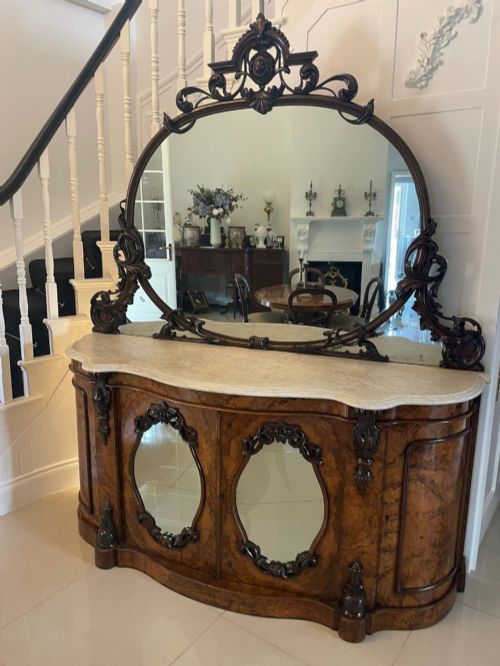
A victorian marble top buffet combines robust timber cabinetry with a smooth stone surface, typically functioning as a sideboard, credenza, or serving table. These pieces emerge primarily from the nineteenth century, spanning periods from eighteen fifty to eighteen seventy, alongside some French Louis Philippe and revival examples.
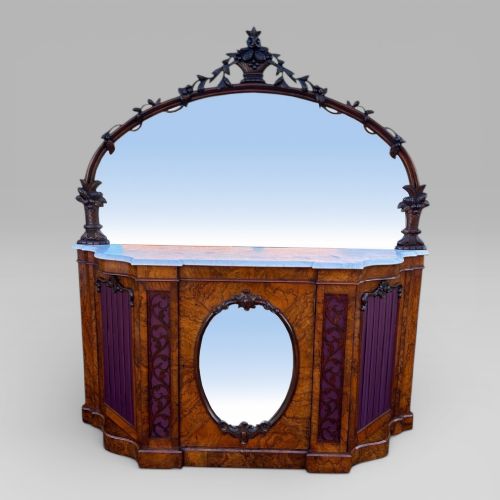
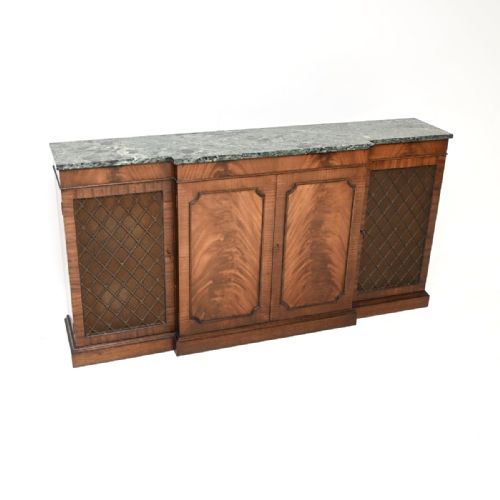
Forms vary from mirror-backed credenzas with carved details to grill front mahogany sideboards and serpentine four-door formats. Buyers most frequently encounter burr walnut and plain walnut constructions featuring inlaid marquetry or classical framing.
Origins stretch across English and French workshops, encompassing styles from French Neoclassical to Victorian Rococo Revival. Certain listings extend into eighteenth century dressers and nineteen thirty mahogany variations, reflecting the broad interpretations of the form.
Materials and construction methods
Makers utilised dense hardwoods such as burr walnut, flame mahogany, and kingwood, often applied as veneers over secondary timbers to display rich grain patterns. Marquetry inlay and carved mirror backs appear frequently on the more decorative examples.
The heavy stone surfaces require sturdy timber carcases to support the weight, frequently combined with brass mounts, glass panels, and gilt bronze elements. Finishing techniques highlight the natural figure of the wood alongside polished stone slabs.
One French example arrives designated as metamorphic, proving that nineteenth-century dining furniture occasionally enjoyed a secret identity.
Judging execution and finish
Quality rests upon the selection of timber veneers, where highly figured burr walnut or flame mahogany demonstrates superior material choice. The precision of the marquetry inlay and the depth of the hand-carved ornamentation further separate standard examples from exceptional ones.
Integration of the stone top with the timber base reveals the maker's competence, alongside the stability of mirror frames and the crispness of brass or gilt bronze details. Finer pieces maintain balanced proportions and harmonious secondary timbers throughout the interior and carcass.
The Victorian Marble Top Buffet Glossary
- Credenza
- A low cabinet or sideboard, frequently featuring glass doors or mirrored backs, designed for display and serving. These pieces often incorporate elaborate timber veneers and stone surfaces.
- Marquetry
- The art of applying small pieces of veneer to a structure to form decorative patterns or pictures. This technique showcases the varied natural colours of different woods.
- Serpentine
- A furniture front or surface that curves outward in the centre and inward at the sides. This shape demands considerable skill from the cabinetmaker.
- Veneer
- A thin layer of finely figured wood glued to a base timber to provide an ornamental exterior surface. Burr walnut and flame mahogany appear commonly in this application.
Victorian Marble Top Buffet: Frequently Asked Questions
How do I clean a marble top?
Use a soft cloth dampened with warm water and a mild, non-acidic soap to wipe the stone surface down. Avoid harsh chemical cleaners or vinegar, which can etch and dull the polished finish over time.
Dry the marble thoroughly with a clean towel to prevent water spots. Promptly wipe away spills, particularly acids like wine or citrus, to protect the stone.
Can I place these in a dining room?
These cabinets function ideally in dining spaces as serving surfaces or storage for tableware and linens. The stone top provides a durable, heat-resistant area for placing dishes during meals.
Ensure the room maintains stable humidity levels to protect the timber veneers and polished finishes. Placing the piece away from direct heat sources prevents the wood from drying out.
What is the difference between a credenza and a sideboard?
Credenzas traditionally feature enclosed cupboards and often incorporate mirrored backs or glass display sections. Sideboards frequently stand taller and may include more open serving space or integrated drawers.
Both forms utilise stone tops in specific regional and period styles, particularly within nineteenth-century French and English designs. The terms often overlap in marketplace descriptions depending on the configuration of doors and drawers.