


Victorian Mantle Lustres Pair
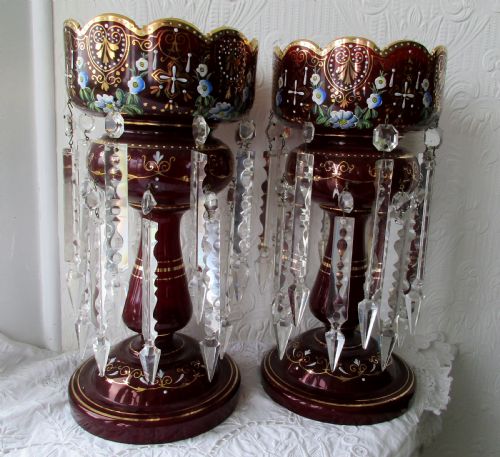
Victorian mantle lustres pair selections bring striking colour and cut-glass sparkle to a room, offering both traditional candle-lighting and decorative presence.
Victorian Mantle Lustres Pair
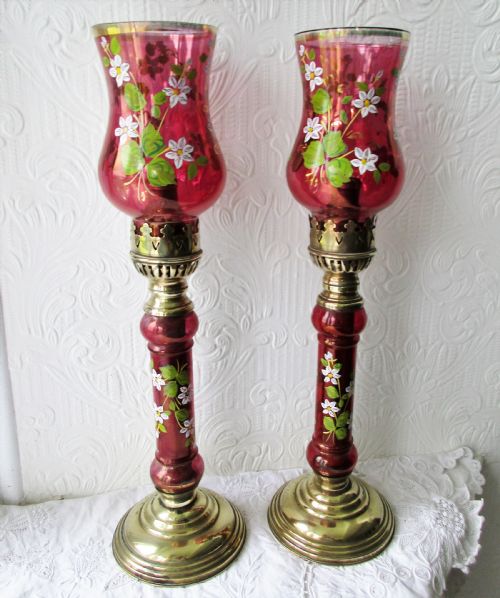
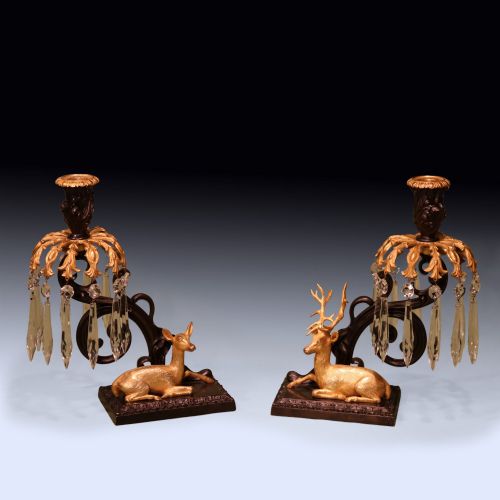
When you search for a victorian mantle lustres pair, you look at decorative dual candle holders designed to sit upon a fireplace mantelpiece. The pieces on this page appear predominantly in ruby glass, cranberry glass, and pink opaline, alongside brass, bronze, and ormolu variants.
Most examples date from the 19th century and the Victorian era, though earlier Regency styles and specific years like 1880 also appear in the records. Alongside standard mantle lustres and glass lustres, you encounter related forms such as candlesticks, candle lamps with storm shades, and decorative figurines.
The defining characteristic of these items is the arrangement of glass or crystal drops suspended around the sconce, which catch and refract the light. They are almost invariably found and sold in pairs to balance the symmetry of a mantel or tabletop.
How they were made
Makers utilised coloured glass techniques such as flash glass and layered cranberry or ruby hues, shaping them into vases and shafts. Lead crystal and cut glass were heavily employed to create facets that maximise optical refraction.
Metalwork components integrate brass, bronze, and ormolu, sometimes enhanced with gold leaf detailing or enamel painting. Crystal drops were hand-cut and hung from the rims using wire connections to complete the construction.
Among the stately glass and brass stands a cheerful gathering of hand-painted Staffordshire spaniels, keeping a ceramic watch over the mantel.
What varies in quality
The refinement of the glass cutting and the depth of colour saturation determine the visual impact of the piece. Superior examples display crisp faceting on the crystal drops and rich, even tones in the ruby or cranberry glass.
The integration and casting quality of the metal mounts, whether brass, bronze, or ormolu, set finer pairs apart from standard production. Completeness and originality of the hanging crystal drops also dictate the standing of an individual pair.
The Victorian Mantle Lustres Pair Glossary
- Lustre
- A decorative candlestick or vase featuring a ring of hanging crystal pendants designed to catch the light. They became highly popular during the nineteenth century for formal reception rooms.
- Cranberry Glass
- A rich red-pink transparent glass created by adding gold chloride to the molten batch. It is a defining material of many Victorian mantle displays.
- Ormolu
- Gilded bronze or brass used for decorative mounts and structural elements on decorative objects. The technique gives a bright gold finish that resists tarnishing.
- Flash Glass
- A method where a thin layer of coloured glass is fused over a clear or contrasting body before cutting through the top layer. This reveals the different colour underneath in sharp geometric patterns.
- Opaline Glass
- An opaque or translucent pale glass, often made in soft pink shades during the Victorian period. It provides a milky, pastel backdrop for hand-painted enamel decoration.
Victorian Mantle Lustres Pair: Frequently Asked Questions
What are mantle lustres?
Mantle lustres are decorative candlesticks fitted with dangling glass prisms or drops around the candle cup. They were designed to sit on fireplace mantelpieces, where the hanging crystals would sparkle in the flickering light of candles or gas lamps.
Beyond their decorative function, they served as status symbols in nineteenth-century drawing rooms. Their vibrant colours and reflective properties made them a focal point of interior decoration.
How do I clean the crystal drops?
Cleaning requires removing each drop gently and washing them individually in lukewarm soapy water. Harsh chemicals and abrasive cloths should be avoided to protect the historic glass surface.
Once washed and dried thoroughly with a lint-free cloth, the drops are reattached to the metal or glass pins. Care must be taken not to force the wire loops holding the pendants.
Are all lustres made of glass?
While the hanging prisms are invariably glass or crystal, the main bodies incorporate a variety of materials. Many combine coloured glass bowls with brass, bronze, or ormolu bases and stems.
Some examples rely entirely on metal construction with crystal drops, while others feature hand-painted enamel details or gold leaf accents. This variety reflects the diverse manufacturing output of the nineteenth century.
How do I spot a Regency pair?
Regency pieces generally pre-date the main Victorian output and often feature distinct neoclassical lines in their metalwork and glass shaping. They tend to use crisp cut-glass formations and gilt bronze or brass components.
By contrast, Victorian examples lean towards bolder saturated colours like ruby, cranberry, and pink opaline. Examining the weight, metal casting style, and glass coloration helps differentiate the periods.