



Victorian Cut Crystal Drop Lustres
Victorian cut crystal drop lustres are ornamental candle holders designed to refract candlelight through cascading glass pendants.
Victorian Cut Crystal Drop Lustres
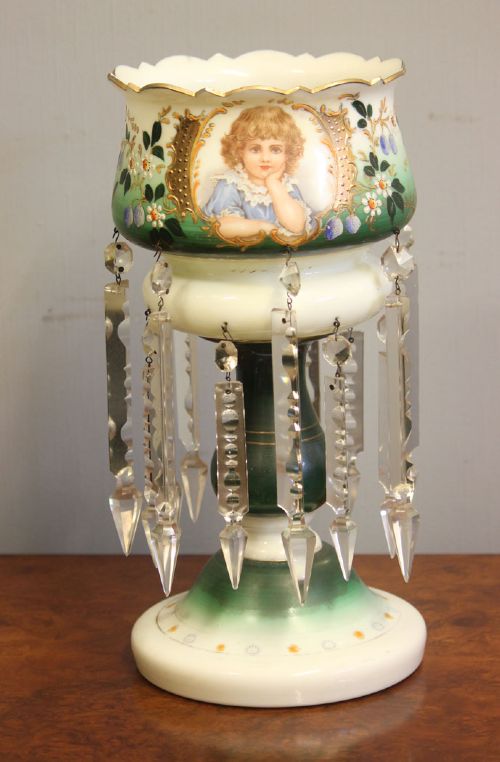
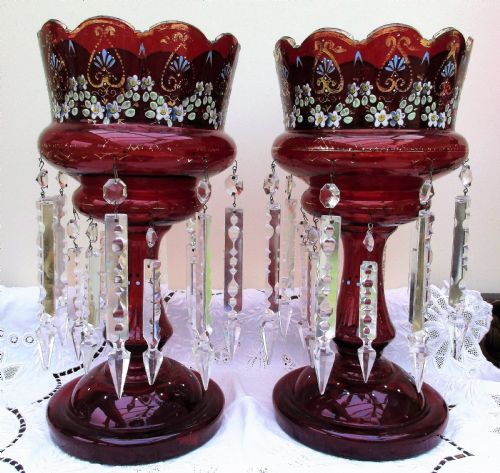
Victorian cut crystal drop lustres are decorative mantle and table objects engineered to double the flicker of a candle through suspended glass prisms. Buyers seeking victorian cut crystal drop lustres encounter mantel lustres and table lustres predominantly shaped as pairs.
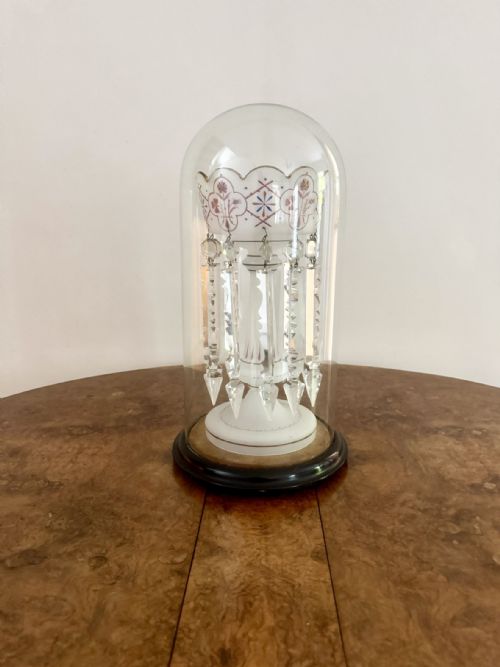
The objects span periods from the nineteenth century into nineteen hundred, with examples emerging from Victorian, Regency, and William IV eras. Formats range from standard mantle lustres to candelabras paired with glass domes or storm shades.
Origin variations include English and Bohemian workshops, often presenting as table lustres or larger candle holders. The primary function remains ornamental display upon mantelpieces and dining tables.
How they were made
Makers utilised crystal, cut glass, and coloured glass including ruby glass, cranberry glass, green glass, uranium glass, and milk glass. Molten material was blown into form before artisans applied surface cutting and facet polishing.
Gilt ornamentation and gold leaf details were frequently added to glass and brass bodies to catch the light. Cut crystal and glass drops were suspended from the rims using wire or pinned attachments to complete the design.
Some nineteenth century glass makers sneaked uranium into the batch just to make the green vases glow under the evening gaslight.
What varies in quality
Quality rests in the depth of the glass cutting and the clarity of the crystal drops. Deeper facets and heavier metal content in the glass create sharper prismatic reflections.
Colour saturation defines the visual weight of ruby, cranberry, and green glass bodies. Complete sets of matching crystal drops unaltered by later replacements elevate the standing of the piece.
The Victorian Cut Crystal Drop Lustres Glossary
- Lustre
- An ornamental candle holder hung with cut glass pendants designed to catch and refract light. They sat upon mantelpieces and tables in pairs.
- Mantel lustre
- A specific form of lustre designed to stand on a fireplace mantelpiece. These pieces often feature extensive crystal drops around the rim.
- Flash glass
- Glass formed by fusing a thin layer of coloured glass over a clear or contrasting body before cutting through the top layer. This technique reveals the base glass underneath in geometric patterns.
- Cranberry glass
- A rich pinkish-red glass produced by adding gold to the molten metal mixture. It appeared frequently in nineteenth century decorative wares.
- Prism
- A cut glass pendant hung from the rim of a lustre. These drops fragment candlelight into spectral colours.
Victorian Cut Crystal Drop Lustres: Frequently Asked Questions
What are victorian cut crystal drop lustres?
Victorian cut crystal drop lustres are ornamental candle holders featuring hanging glass pendants designed to refract light.
They were produced primarily in pairs to adorn nineteenth century mantelpieces and tables.
How were lustres used in houses?
Lustres served as decorative lighting on mantelpieces and dining tables during the nineteenth century.
The suspended crystal drops caught and multiplied the flickering light from candles before electricity became common.
How do I clean drop lustres?
Cleaning requires removing the glass drops individually and washing them in warm soapy water.
The main body should be wiped gently with a soft cloth to protect any gilt decoration or surface colouring.
Are all lustres made of clear crystal?
Many lustres feature coloured glass bodies alongside clear crystal drops.
Materials recorded include ruby glass, cranberry glass, green glass, and milk glass enhanced with gold leaf and gilt.
Did lustres always come in pairs?
The majority of surviving lustres appear in matched pairs designed for symmetrical placement on mantelpieces.
Single examples and larger arrangements such as chandeliers also occur in the material record.