

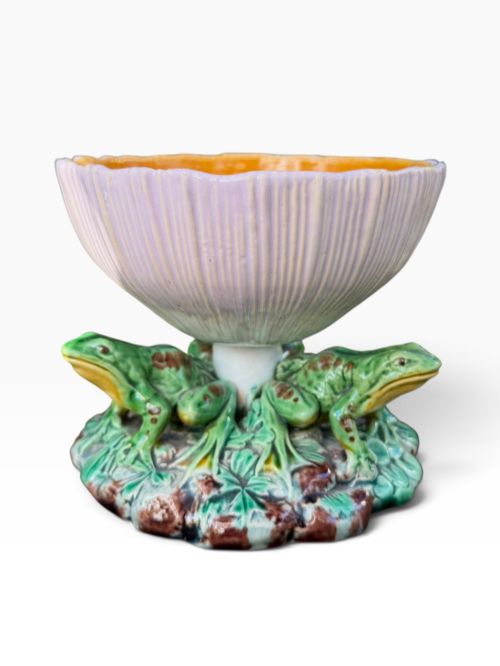


Victorian Majolica Vessel
These Victorian majolica vessel examples bring richly glazed earthenware forms into a room, offering tactile colour and sculptural depth.
Victorian Majolica Vessel
A victorian majolica vessel typically takes the form of a vase, umbrella stand, or decorative container shaped during the nineteenth century. These pieces draw upon styles such as Victorian naturalism, Renaissance revival, and Chinoiserie.
The most common versions met here include large vases and umbrella stands fashioned from glazed earthenware or terracotta. Makers often employed vibrant coloured glazes over moulded ceramic bodies to create striking decorative objects.
Materials and construction
Makers utilised earthenware and terracotta as the primary ceramic bodies for these pieces, forming them through moulding before application of the signature glaze. Potters then coated the fired clay in brightly coloured metallic oxide glazes that pooled in the recesses of the relief work.
The application of majolica glaze defined the technique, lending a glossy finish to hand-painted details on porcelain and pottery. Workshops combined this thick glaze layer with intricate moulding, particularly evident in figures and naturalistic plant motifs.
Victorian Majolica Vessel Retail Price Guide 2026
Typical asking prices for victorian majolica vessel among the pieces listed under this phrase on Sellingantiques today, from the lower quarter to the upper quarter. They describe what is for sale here now, not the wider market.
Listings feature earthenware and terracotta bodies decorated with majolica glaze, spanning styles from naturalism to Renaissance revival.
Distinctions in quality
Quality rests upon the crispness of the moulded relief and the control of the coloured glaze during firing. Superior examples display precise hand-painted details and an even distribution of glaze across complex surfaces without pooling clumsily.
The ambition of the form also separates standard production from superior pieces, with elaborate figural components and substantial scale demonstrating greater artistic capability in the pottery.
Joseph Holdcroft·Minton·Albert Carrier
The Victorian Majolica Vessel Glossary
- Majolica glaze
- A colourful opaque lead glaze applied over an earthenware body. This technique produces vibrant hues and a glossy surface texture.
- Terracotta
- Fired unglazed clay of a brownish-red colour. It served as the structural base for many large decorative vessels and umbrella stands.
- Renaissance revival
- A nineteenth-century design movement. It drew inspiration from sixteenth-century ornamentation and classical motifs.
- Chinoiserie
- European artistic interpretation of Chinese and East Asian motifs. It appeared frequently on decorative vases and vessels of the period.
Victorian Majolica Vessel: Frequently Asked Questions
What is a majolica vessel?
A majolica vessel is a ceramic container finished with a colourful opaque lead glaze, produced in various forms during the nineteenth century. These pieces range from large decorative vases to practical umbrella stands.
Potters shaped them from earthenware or terracotta, often decorating the surfaces with naturalistic or revivalist motifs. The resulting objects served primarily as ornamental furnishings for Victorian interiors.
How were umbrella stands used?
Umbrella and stick stands functioned as hall furniture designed to hold wet walking sticks and rain gear. Their heavy ceramic bodies provided the stability needed for tall items.
Placed near the entrance of a home, these glazed vessels protected floors while adding decorative colour to the hallway. Their waterproof glazed interiors made them practical for daily household use.
How do I identify a Victorian piece?
Victorian pieces often feature characteristic nineteenth-century revival styles such as Renaissance ornamentation, naturalism, or Chinoiserie. The combination of heavy earthenware bodies and bright majolica glazes points directly to this era.
Examining the moulding style and glaze characteristics helps distinguish nineteenth-century production from later revivals. Makers frequently incorporated floral, figural, or architectural elements typical of the period.
Where should I display these vessels?
These decorative vessels suit prominent spaces where their vibrant glazes and sculptural forms can be appreciated fully. Large vases and urns work well on sturdy pedestals or side tables.
Umbrella stands find a natural home in entrance halls, fulfilling both a decorative and a functional role. Placing them away from heavy traffic areas protects their glazed surfaces from accidental impacts.