




Victorian Mahogany What Not
A victorian mahogany what not provides open shelving for display, combining practical storage with the rich grain of nineteenth-century timber.
Victorian Mahogany What Not
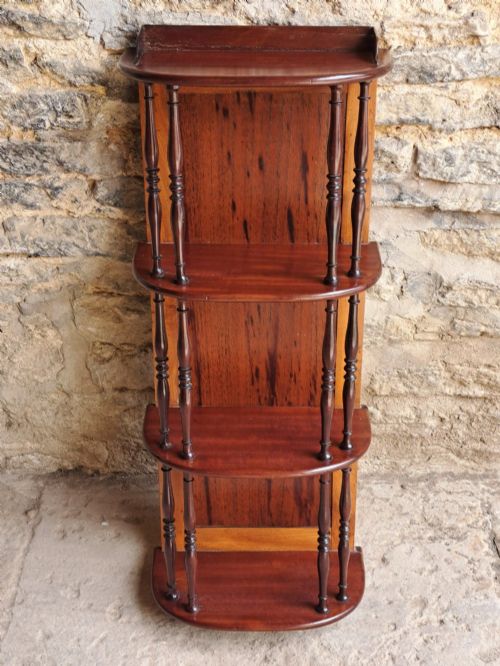
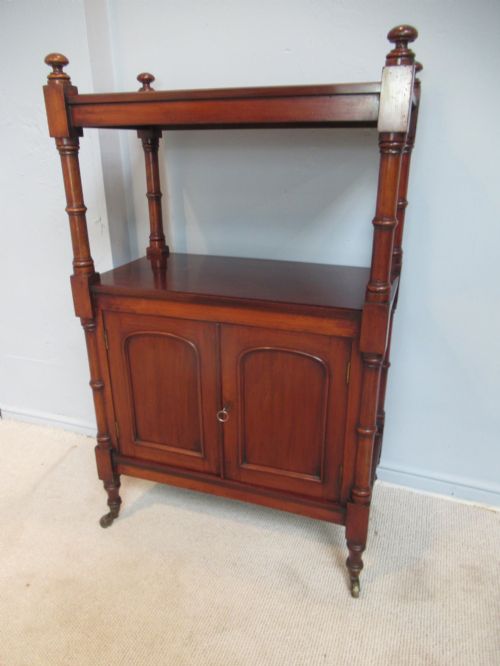
A victorian mahogany what not is an open shelved unit designed for displaying decorative objects, books, and small personal belongings in nineteenth-century interiors. These pieces appear in forms ranging from compact two-tier tables to substantial four-tier and five-tier freestanding towers, as well as wall-mounted hanging shelves.
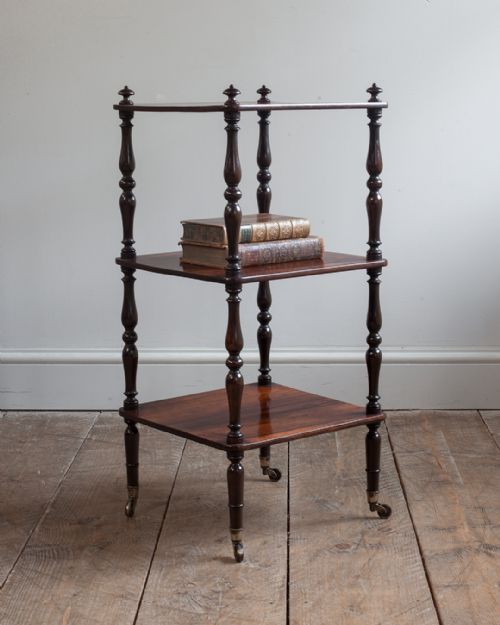
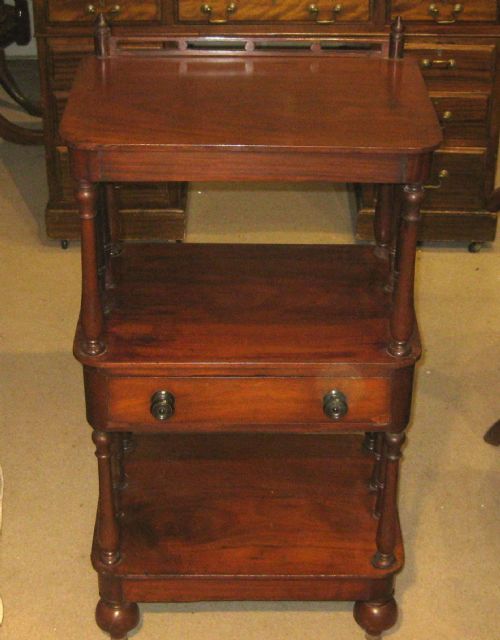
The versions most commonly met on this page date from the nineteenth century, including pieces from the Victorian and William IV eras. Many examples incorporate stacked tiers supported by turned or barley twist columns, and some include a single drawer at the base or a fitted Canterbury section for books and music.
How they were made
Makers built these pieces primarily using solid mahogany and mahogany veneers, often supplemented with secondary woods for internal framing. Selected examples incorporate contrasting details such as boxwood and ebony stringing, marquetry veneers, or ebonised finishes.
Structural joints typically rely on traditional cabinet-making techniques, with tiers secured by turned uprights, columns, or screw threads. Metal elements such as brass castors and fittings appear on mobile floor-standing models designed to be repositioned easily within a room.
Listings feature mahogany, rosewood, walnut, and ebonised finishes across nineteenth-century periods including the Regency and Victorian eras.
What varies in quality
The standard of timber selection and grain figuring largely separates standard pieces from finer examples, with well-chosen flame mahogany veneers commanding attention. The crispness of carved details, such as mirror backs or turned barley twist supports, also indicates the level of craftsmanship invested in the piece.
The Victorian Mahogany What Not Glossary
- Etagere
- A French term for a piece of furniture consisting of a set of open shelves for displaying small articles. These function similarly to English whatnots.
- Canterbury
- A low stand with partitioned sections originally used for holding sheet music, folios, or books. Some examples are integrated into the lower tier of a whatnot.
- Barley twist
- A type of turned wooden column resembling the spirals of a barley sugar twist. This decorative turning appears frequently on nineteenth-century upright supports.
- Marquetry
- Decorative veneer work formed by fitting together small pieces of different coloured wood to create pictorial patterns. It appears on selected tabletops and tiers.
Victorian Mahogany What Not: Frequently Asked Questions
What was a whatnot used for originally?
A whatnot served as an open display piece for porcelain, silver, books, and decorative ornaments in nineteenth-century reception rooms.
Their tiered shelving allowed owners to exhibit collections without enclosing them behind glass doors.
How do I tell a William IV whatnot from a later Victorian one?
William IV pieces often display bolder proportions, heavier timbers, and robust scroll or architectural carving characteristic of the 1830s.
Later Victorian versions tend towards lighter turned columns, sometimes utilising barley twist supports or delicate marquetry.
Can these shelves hold heavy books?
Most whatnots are intended for decorative objects, ceramics, and lighter volumes rather than heavy reference libraries.
The slender uprights and tier joints provide stability for display rather than load-bearing storage.
Where should I place a freestanding whatnot?
These pieces suit corners, alcoves, or wall spaces where open vertical display adds height and interest to a room.
Freestanding models with finished backs can also function as room dividers or bedside stands.