

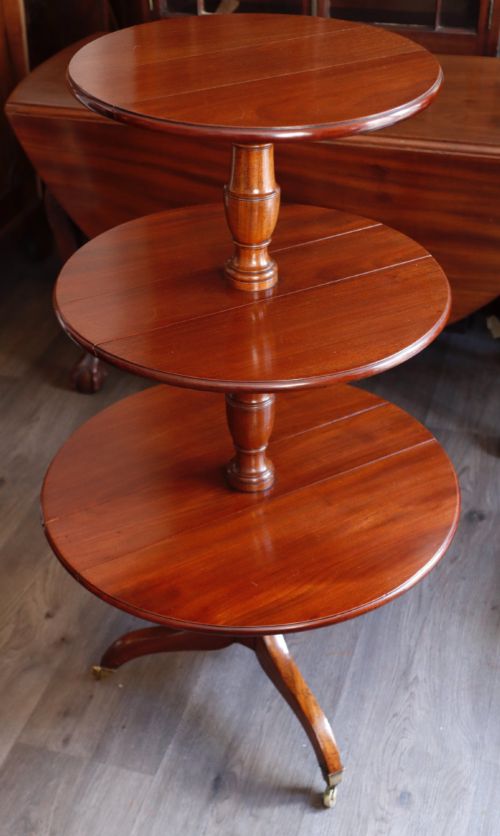


Victorian Mahogany Dessert Stand
A Victorian mahogany dessert stand brings tiered elegance to the dining room, offering a clever way to present fruit and sweet courses.
Victorian Mahogany Dessert Stand
A victorian mahogany dessert stand usually takes the form of a tiered dumb waiter, designed to hold dishes within reach of the dining table without requiring a servant close at hand. These pieces serve multiple tiers, often featuring circular shelves supported by turned columns.
The selections span the nineteenth century, encompassing Georgian, Regency, and William IV influences alongside proper Victorian examples. Buyers most commonly meet multi-tiered stands and dumb waiters ranging from two to three tiers.
Origins point firmly to English workshops, utilising robust timber configurations to build stable serving furniture. The forms bridge the gap between practical dining accessories and fine decorative household furnishings.
Judging the standard
Quality rests in the timber selection and the crispness of the turning on the central column, where finer pieces display superior grain and more ambitious moulding. The stability of the tiered structure and the quality of any brass castors dictate the overall calibre.
Proportion sets the better examples apart, as well-balanced shelves and graceful tapering columns reveal the hand of a more accomplished cabinetmaker. Simpler utility pieces contrast with refined versions boasting sophisticated tiered engineering.
Victorian Mahogany Dessert Stand Retail Price Guide 2026
Typical asking prices for victorian mahogany dessert stand among the pieces listed under this phrase on Sellingantiques today, from the lower quarter to the upper quarter. They describe what is for sale here now, not the wider market.
Current listings feature pieces spanning the nineteenth century, incorporating mahogany and brass across various tiered table forms.
Maple & Co
The Victorian Mahogany Dessert Stand Glossary
- Dumb waiter
- A tiered serving stand designed to hold food and utensils beside a dining table. These pieces allowed diners to help themselves during meals.
- Tiered stand
- Furniture constructed with multiple horizontal surfaces rising one above another. This design maximises display space while maintaining a compact footprint.
- Mahogany
- A durable tropical hardwood prized for its reddish-brown colour and fine grain. It forms the primary structural and visual material for these stands.
- Regency
- A stylistic period spanning the early nineteenth century defined by classical restraint and clean lines. Pieces from this era often show elegant proportions.
Victorian Mahogany Dessert Stand: Frequently Asked Questions
How were dumb waiters used?
Dumb waiters held plates, glasses, and food courses close to the dining table for easy access during meals. Guests or hosts could reach for additional items without needing constant assistance from household staff.
Over time, these tiered tables transitioned from working dining room furniture into decorative display pieces for porcelain and ornaments.
How do I tell periods apart?
Distinguishing between Georgian, Regency, and Victorian pieces involves looking at the turning style, timber finish, and overall proportions. Georgian and Regency examples often display cleaner classical lines, whereas Victorian pieces can feature heavier mouldings and richer carved detail.
Hardware such as brass castors and the method of joining the tiers to the central shaft also offer clues to the manufacturing decade.
Where should I place a tiered stand?
These stands fit well in dining rooms, living spaces, or hallways where they can serve as display surfaces for plants, books, or decorative objects. Their vertical format provides ample surface area while taking up minimal floor space.
Positioning them away from direct sunlight protects the polished mahogany finish from fading over time.