
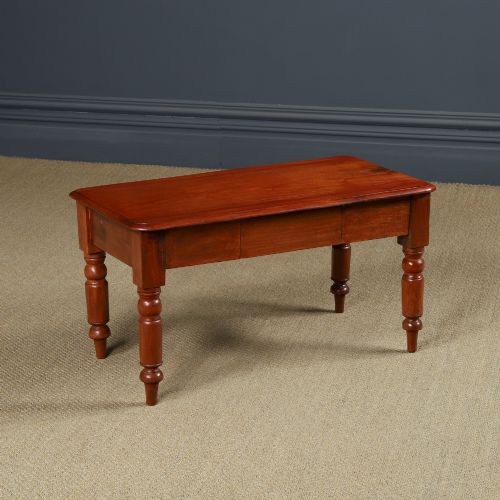
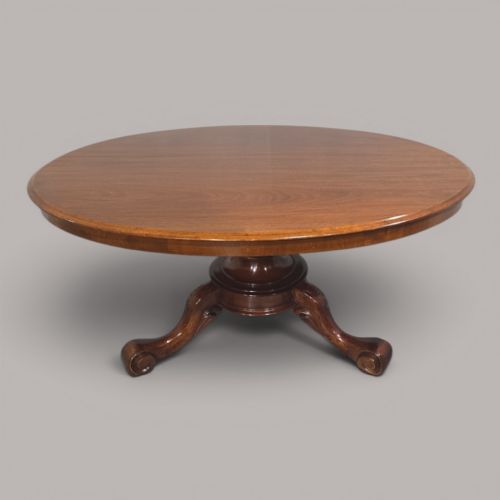


Victorian Lounge Table
These victorian lounge table pieces are solid timber occasional and coffee tables that bring period warmth and low surface utility to a room.
Victorian Lounge Table
When you search for a victorian lounge table, you encounter low coffee tables, occasional pieces, and folding garden party serving tables from the nineteenth century. These forms reflect the changing domestic habits of the period, moving from formal height to lower formats suited to seating areas.
The pieces on this page span the Victorian era, including examples dated around 1860, 1880, 1890, and the broader nineteenth century. You also find specialised regional items such as Burmese teak folding book racks alongside traditional English forms.
Mahogany and walnut dominate the offerings, appearing as solid timber or highlighted with marquetry inlay, fruitwood inlay, and burr walnut tops. Some examples pair period tops with later supports, such as modern cast iron tripod bases.
How they were made
Cabinet makers utilised dense hardwoods like mahogany and walnut, selected for their structural stability and rich grain patterns. Timber was hand-carved for bases and legs, often following Rococo Revival or Regency stylistic influences.
Surface decoration involved precise marquetry and fruitwood inlay to create geometric or floral patterns across the tabletops. Folding mechanisms on campaign and garden party tables relied on clever hinged joints and durable ironwork.
One clever piece doubles as a Burmese teak folding book rack, ready for instant relocation.
What varies in quality
The refinement of the timber and the complexity of the inlay separate standard examples from finer works. Burr walnut veneers and crisp, hand-carved bases demonstrate a higher level of workshop skill than plain mahogany surfaces.
Integrity of construction defines value, distinguishing pieces that retain their original frames from those altered with later bases. The subtlety of the polish and the crispness of the joinery reveal the original maker's hand.
The Victorian Lounge Table Glossary
- Burr walnut
- A prized timber harvested from the wart-like growths on walnut trees, showing swirling, highly decorative grain patterns. It was sliced into thin veneers for tabletops.
- Marquetry
- The art of applying small pieces of wood veneer to a structure to form decorative patterns or pictures. Craftsmen used various tinted woods to achieve contrast.
- Rococo Revival
- A nineteenth century design style referencing the curves, asymmetry, and ornamentation of the mid eighteenth century. It appears in the C-scrolls and carved details of table bases.
- Occasional table
- A small, movable table designed for a specific, intermittent use in a principal room. These include low centre tables and side pieces.
- Two tier
- A furniture design featuring a primary upper surface supported above a secondary lower shelf. The lower level often serves for books or magazines.
Victorian Lounge Table: Frequently Asked Questions
What is a victorian lounge table used for?
These tables provide low surface space in a seating area for drinks, books, and decorative objects. They function as central coffee tables or side pieces next to armchairs and sofas.
Historically, many of these formats evolved from low centre tables or serving furniture adapted for relaxed domestic entertaining.
How do I date a victorian lounge table?
Dating relies on timber choice, construction methods, and stylistic cues present in the carved base and inlay. Pieces from the mid nineteenth century often feature heavy mahogany, while later decades show lighter walnut and refined marquetry.
Archive records and dated examples from the 1860s through the 1890s help anchor stylistic shifts in domestic furniture design.
Are these tables solid wood?
Makers constructed these tables using a mix of solid timbers and decorative veneers applied to stable secondary woods. Mahogany and teak frequently appear as solid boards, while burr walnut is typically used as a veneer over a firmer base.
This technique preserved costly decorative grain timber while maintaining structural strength for daily use.
What styles are common in these tables?
Rococo Revival and Regency influences appear frequently in the curved legs and carved wooden bases. Anglo-Indian and colonial pieces also emerge, bringing distinct regional timbers and folding formats into the mix.
These varied styles reflect Britain's wide manufacturing networks and global trade during the nineteenth century.