


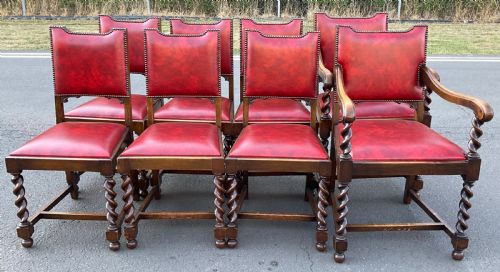


Victorian Library Chair Set
These Victorian library chair set pieces are substantial seating groups built for serious reading spaces, prized for their sturdy frames and traditional upholstery.
Victorian Library Chair Set
A victorian library chair set comprises matching seating designed for study rooms, reading spaces, and formal dining environments. These groups range from small pairs to substantial sets of ten.
The selections span mid nineteenth century examples through to Edwardian periods and later twentieth century interpretations. Common forms include captain's chairs, smokers bows, and carved library armchairs.
Makers and workshops constructed these seats in oak, mahogany, walnut, elm, and beech. Many feature leather or velvet upholstery suited to prolonged scholarly use.
How They Were Made
Cabinetmakers utilised hardwoods such as oak, mahogany, walnut, elm, and beech to build sturdy frames that could withstand daily use in reading rooms and libraries. Joinery relied on traditional pegging and mortise and tenon techniques.
Upholstered versions incorporated brass tacks and filled seats with horsehair or comparable stuffing beneath leather, velvet, or woven fabric coverings.
Carving was executed by hand on exposed timber elements, notably on the crest rails, arms, and front legs of Victorian and revival styles.
Victorian Library Chair Set Retail Price Guide 2026
Typical asking prices for victorian library chair set among the pieces listed under this phrase on Sellingantiques today, from the lower quarter to the upper quarter. They describe what is for sale here now, not the wider market.
Listings feature oak, mahogany, walnut, elm, and beech frames paired with leather, velvet, and fabric upholstery.
What Varies In Quality
The grade of timber and the depth of hand-carved detail distinguish standard sets from exceptional examples. Dense mahogany and figured oak command greater appreciation among collectors.
Uniformity across a matched set of chairs determines overall desirability, as matching timber grain and consistent wear patterns ensure a cohesive appearance around a table.
The original integrity of the frame, the retention of brass hardware, and the quality of the leather or fabric upholstery influence the character of each group.
HOLLAND & SON'S
The Victorian Library Chair Set Glossary
- Captain's chair
- A low-backed wooden armchair with a rounded top rail supported by vertical spindles. These sturdy seats originated for shipboard use before moving into domestic studies and offices.
- Smokers bow
- A low Windsor-style wooden armchair with a curved back rail and turned spindles, commonly built in elm and beech. They provide comfortable seating in libraries and smoking rooms.
- Cross-frame
- A furniture base constructed with intersecting diagonal stretchers or legs for added structural support. This design strengthens heavy armchairs.
- Gothic Revival
- A nineteenth-century design movement drawing inspiration from medieval architecture. Pieces in this style feature pointed arches, trefoils, and heavy carved tracery.
- Jacobean Revival
- A later nineteenth-century style replicating seventeenth-century English furniture. These items display turned legs, geometric panels, and dark oak finishes.
Victorian Library Chair Set: Frequently Asked Questions
How many chairs come in a set?
Sets vary widely, ranging from pairs of armchairs up to larger groups of six, eight, or ten matching seats. Large sets were typically commissioned for institutional reading rooms or large dining spaces.
Buyers should verify the exact count listed, as matched sets of ten or more are less common than smaller groupings of four or six.
Were these used for dining or reading?
Many nineteenth-century seating groups served double duty as both library and dining chairs. Their sturdy construction and comfortable upholstered or wooden seats made them suitable for long hours at a table.
Library desks and reading rooms often utilised the same robust armchairs found in formal dining environments during the Victorian and Edwardian eras.
What materials should I expect to find?
The frames are constructed from hardwoods including oak, mahogany, walnut, elm, and beech. Upholstered versions feature leather, velvet, or woven fabric.
Brass hardware such as tacks and castors also appear frequently on nineteenth-century library armchairs.
How do I care for leather upholstery?
Leather-upholstered library chairs require gentle cleaning with a damp cloth and occasional application of appropriate leather conditioner to prevent drying. Avoid placing antique seating in direct sunlight or near heat sources.
Preserving the original leather maintains the character and historical integrity of Victorian and Edwardian examples.
How do I distinguish Victorian from Edwardian chairs?
Victorian pieces, produced up to 1901, often feature heavier carved mahogany or oak frames with deep upholstery and Gothic or Jacobean revival influences. Edwardian examples tend to display lighter proportions and brighter mahogany or satinwood tones.
Examining the turning, joinery, and timber species helps clarify the period of manufacture.