
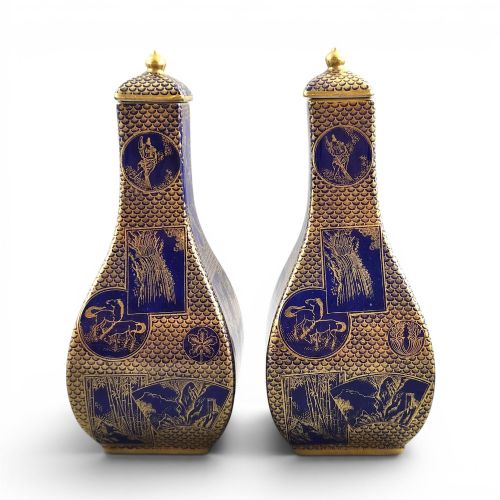


Victorian Ironstone Vases
Victorian ironstone vases are heavy, durable ceramic vessels displaying rich enamelled patterns that bring robust colour and decorative presence to any interior.
Victorian Ironstone Vases
When you search for victorian ironstone vases, you encounter substantial ceramic vessels that combine the heft of stoneware with the refined appearance of porcelain. These pieces typically date from the nineteenth century, including examples from the Georgian and Edwardian eras, as well as the year 1900.
The forms available include standard vases, lidded vases, garnitures, and potpourri pots designed for display or fragrance. Many examples adopt Chinoiserie styles, English Imari palettes, or specific decorative schemes such as the Bird and Peony and Fence and Doves patterns.
The most common pieces on this page are sturdy items produced in varied shapes, often featuring mazarine blue grounds or elaborate painted motifs. They serve as enduring examples of nineteenth-century ceramic manufacturing traditions designed for domestic ornamentation.
How they were made
Makers utilised heavy ceramic and stoneware bodies, fired at high temperatures to achieve exceptional durability and resilience. This dense composition allowed potters to form large vases and lidded garnitures that resisted chipping far better than standard porcelain.
Surfaces received intricate decoration through hand-painted enamel colours and glossy glaze applications. Artisans frequently added gilt, gold leaf, and gold gilt highlights to accentuate the patterns, particularly on pieces finished in Victorian Chinoiserie and English Imari styles.
Listings feature nineteenth-century ironstone incorporating materials such as enamel, glaze, and gold leaf across diverse Chinoiserie and Imari styles.
What varies in quality
The distinction between standard production and superior examples lies in the crispness of the moulded form and the complexity of the painted decoration. Pieces featuring intricate hand-painted Chinoiserie details or scarce shapes demonstrate a higher level of artistic ambition from the maker.
The application of enamel and gold leaf also differentiates the range, with superior items showing precise brushwork and well-preserved gilding. Complete garnitures and lidded vessels naturally command greater visual impact than single, simpler pots.
Mason s
The Victorian Ironstone Vases Glossary
- Ironstone
- A dense, heavy ceramic paste patented in the nineteenth century to imitate porcelain while offering superior strength. It forms the structural base for these durable vases and pots.
- Garniture
- A matching set of three or more vases designed to be displayed together on a mantelpiece or sideboard. They typically feature a central lidded vessel flanked by smaller matching pieces.
- Chinoiserie
- A decorative style reflecting European interpretations of Chinese and East Asian artistic traditions. It frequently appears on nineteenth-century ceramics depicting imaginary landscapes, fences, and birds.
- Potpourri
- A mixture of dried petals and spices kept in a pierced or lidded vessel to scent a room. Potpourri vases feature perforated covers designed to release fragrance into the interior.
Victorian Ironstone Vases: Frequently Asked Questions
What is ironstone?
Ironstone is a heavy, durable ceramic body patented in the nineteenth century to provide a strong, utilitarian alternative to porcelain. It allowed manufacturers to create robust vessels suitable for everyday display.
The material accepts enamel colours and glazes readily, making it an ideal surface for vibrant hand-painted patterns and rich gilding.
How are garnitures displayed?
Garnitures are matching sets of vases, usually numbering three or five pieces, arranged symmetrically across a mantelpiece or large piece of furniture. The tallest lidded vessel typically sits in the centre with the smaller pieces flanking it.
This balanced arrangement originated in the seventeenth century and remained popular throughout the nineteenth century for formal room decoration.
What defines Chinoiserie decoration?
Chinoiserie is a European decorative style that interprets East Asian motifs through imaginative depictions of landscapes, figures, exotic birds, and garden fences. On these ceramics, it appears in bright enamel colours often enhanced with gold leaf.
This aesthetic reflected a nineteenth-century fascination with Asian art, adapted to suit British domestic tastes and manufacturing techniques.
Are lidded vases rare?
Lidded vases often survive in fewer numbers because the separate covers were easily dropped, chipped, or lost over generations of domestic use. Finding a complete piece with its original matching lid adds significantly to its integrity.
Many surviving examples miss their covers, making intact lidded vessels and potpourri pots particularly desirable for collectors.