

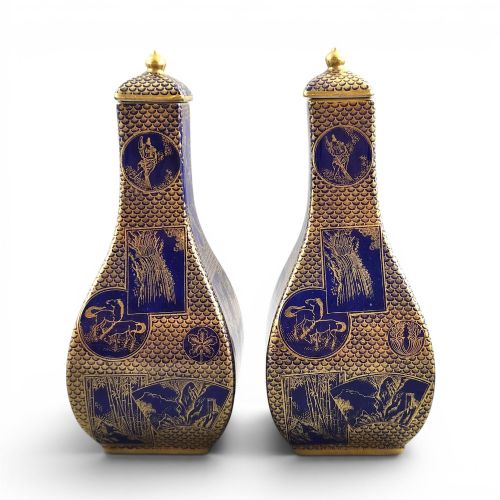


Victorian Ironstone Urns
These robust victorian ironstone urns bring weighty nineteenth-century presence and striking decorative colour to a room.
Victorian Ironstone Urns
Victorian ironstone urns encompass heavy ceramic vessels and lidded vases produced primarily during the nineteenth century, alongside related pieces spanning the Georgian to Edwardian eras. These decorative pieces take forms such as garnitures, potpourri vases, and posy vases, often influenced by Chinoiserie styles and specific decorative motifs like the Bandana pattern.
The pieces appearing on this page originate predominantly from workshops associated with Mason's, showcasing the durable stoneware and ironstone bodies characteristic of the period. Buyers frequently encounter pairs or matched sets featuring rich mazarine blue grounds, bird and peony motifs, or distinct sculptural shapes.
How they were made
Potters shaped durable ironstone and stoneware bodies to withstand heavy daily use while retaining crisp surface details for moulded ornament. These dense ceramic bodies received smooth glazes that provided a dependable base for intricate hand-painted or transferred surface designs.
Decorators applied vibrant pigments alongside enamel, gilt, and gold leaf highlights to enhance the visual depth of the Chinoiserie patterns. Skilled hands executed detailed motifs like birds and peonies before firing the vessels to set the metallic and enamel finishes permanently.
Victorian Ironstone Urns Retail Price Guide 2026
Typical asking prices for victorian ironstone urns among the pieces listed under this phrase on Sellingantiques today, from the lower quarter to the upper quarter. They describe what is for sale here now, not the wider market.
The listings here demonstrate a strong representation of nineteenth-century production, featuring robust ironstone and stoneware bodies decorated in vivid Chinoiserie styles.
What varies in quality
The distinction between standard production and superior pieces lies in the crispness of the moulding and the ambition of the ceramic form. Elaborate shapes, such as lidded potpourri vessels or garniture sets, require greater skill from the potter than simple baluster vases.
Painted surface detail and gilding application further separate ordinary items from exceptional ones. Rich mazarine blue grounds combined with precise hand-painted enamel work demonstrate a higher grade of workshop output than simpler, mass-produced transfer prints.
Mason's Patent Ironstone
The Victorian Ironstone Urns Glossary
- Ironstone
- A patented ceramic material developed to imitate porcelain while offering superior strength and durability. It provides a heavy, opaque body suited to large decorative urns and vases.
- Garniture
- A set of matching vases or urns designed to be displayed together on a mantelpiece or sideboard. These sets typically consist of three or five graduated pieces.
- Chinoiserie
- A European artistic style reflecting Chinese decorative motifs and imaginary oriental landscapes. It appears frequently on nineteenth-century ceramics through painted birds, flora, and architectural elements.
- Potpourri
- A vase featuring a pierced or perforated lid designed to hold scented dried plant material. The openings allow fragrance to disperse while concealing the contents.
- Mazarine blue
- A deep, rich shade of dark blue used extensively as a ground colour on ceramic bodies. It provides a striking contrast for gilt highlights and polychrome enamel painting.
Victorian Ironstone Urns: Frequently Asked Questions
What are victorian ironstone urns made of?
These vessels utilise a dense, heavy ceramic body known as ironstone or stoneware, developed to combine the durability of earthenware with the refined appearance of porcelain. Potters coated this robust base in smooth glazes before applying intricate enamel and gilt decoration.
Makers selected these hard-wearing materials to create large decorative shapes that could resist chipping while supporting elaborate moulding and rich surface colour.
How were garnitures used originally?
Garniture sets served as prominent decorative centerpieces on drawing room mantelpieces and large sideboards throughout the nineteenth century. The balanced arrangement of three or five graduated vessels created visual symmetry in formal interiors.
While some functional variants held potpourri or fresh posies, many remained purely ornamental displays showcasing the owner's taste for exotic Chinoiserie patterns.
How do I care for ironstone vases?
Maintain these ceramic pieces by dusting them gently with a soft, dry cloth to protect the historic glaze and delicate surface gilding. Avoid using harsh chemical cleaners or submerging painted vessels in water for extended periods.
Display the urns away from direct sunlight and areas of extreme temperature fluctuation to preserve the integrity of the enamel colours and gold leaf highlights.
How can I tell the period?
Dating relies on observing the interplay of ceramic body weight, glaze characteristics, and decorative style alongside any impressed or printed maker marks. Pieces produced under early nineteenth-century patents often exhibit sharper moulding and deeper cobalt grounds than later Edwardian revivals.
Comparing the specific floral or avian motifs, such as bandanas or peony subjects, helps place a vessel within the broader timeline of nineteenth-century ceramic production.