



Victorian Impressionist Watercolour
These Victorian impressionist watercolour works capture light and atmosphere across coastal harbours, rural cottages and Venetian canals.
Victorian Impressionist Watercolour
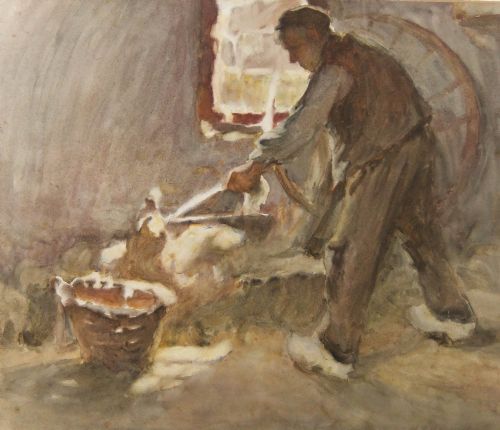
A victorian impressionist watercolour brings together the loose brushwork of impressionism with the traditional subjects of the nineteenth century. Buyers seek these paintings for their luminous handling of light on paper, recording coastal villages, rural scenes and bustling waterways.
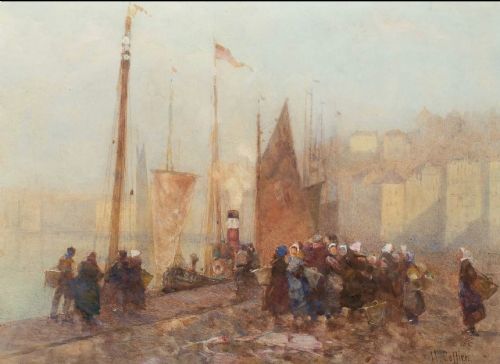
The pieces on this page mostly date from the late nineteenth century and the early decades of the twentieth century. Common subjects include St Ives, Venice, Whitby and rural cottage life, rendered with fluid pigment rather than rigid academic detail.
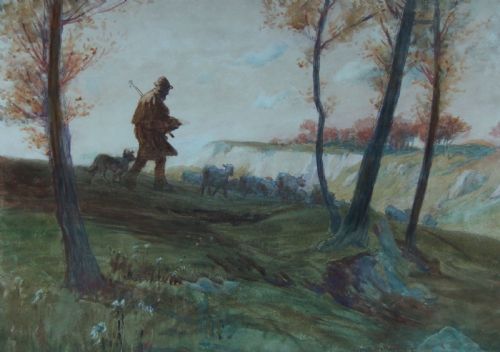
Collector interest centres on the atmosphere captured by artists working in Britain and on the continent. The works range from intimate studies of flowers and domestic scenes to large topographical views of London and foreign ports.
Materials and technique
Artists painted primarily with watercolour pigment suspended in water, applied directly to heavy paper surfaces. Ink was occasionally used to define structural lines beneath or alongside the washes of colour.
Finished works were framed behind glass to protect the delicate water-soluble pigments from moisture and atmospheric damage. Traditional framing often utilised wooden mouldings finished with a gilt layer.
Artists frequently chased the light from quiet Thameside villages all the way to the bustling canals of Venice.
Judging quality and execution
Quality rests upon the confidence of the brushwork and the artist's command of light. Superior examples convey atmosphere and movement with economy, whilst lesser works appear overworked or muddy in tone.
The preservation of the paper and the vibrancy of the pigments dictate desirability. Strong compositions that maintain their original tonal contrast stand well above weaker, faded sheets.
William Banks Fortescue·Henry Silkstone Hopwood·Hector Caffieri·Albert Ludovici Jnr·Lester Sutcliffe·Frederick William Hattersley·Clara Montalba·Hercules Brabazon Brabazon·Ralph Todd·Frank Wasley·David Woodlock·Henry Sykes·Frederick William Jackson·George Faulkner Wetherbee·Frank Rousse·Henry Wimbush·Frances E Nesbitt·Herbert John Finn·Yeend King·Matthew Hale·Charles Edward Wilson·James W Booth·Thomas Mackay·Edward Aubrey Hunt·William Mark Fisher
The Victorian Impressionist Watercolour Glossary
- Watercolour pigment
- Finely ground colour particles mixed with a water-soluble binder for painting on paper.
- Gilt wood
- Timber framing coated with a thin layer of gold leaf or metallic paint.
- Topographical
- Representing specific places, buildings or landscapes with geographical accuracy.
- Genre watercolour
- A painting depicting scenes from everyday life involving ordinary people.
Victorian Impressionist Watercolour: Frequently Asked Questions
What defines a victorian impressionist watercolour?
These works combine the atmospheric light effects of impressionism with the traditional nineteenth century subjects favoured by British and European painters. They rely on fluid washes and expressive brushwork.
Subjects typically span coastal harbours, Venetian canals, rural cottages and genre scenes painted on paper.
How should I frame and display these paintings?
Watercolours require framing behind glass to shield the delicate pigments from dust, humidity and direct sunlight. Acid-free mounts prevent the paper from discolouring over time.
Hang them on interior walls away from direct sunlight to preserve the original vibrancy of the washes.
Where were these artists active?
The painters represented worked across British coastal colonies like St Ives and Newlyn, as well as northern fishing ports such as Whitby. Many also travelled extensively to Venice and various European locations.
Their output records both rural idylls at home and bustling international waterways.
How do I care for antique paper works?
Keep the paintings in stable environmental conditions with minimal fluctuations in temperature and moisture. Avoid hanging them in damp rooms or areas exposed to harsh, direct light.
Professional framing using conservation materials ensures the paper remains stable for decades.