



Victorian Horse Brasses
Victorian horse brasses are solid brass amulets mounted on leather martingales that once decorated working draught horses and now display rich nineteenth-century rural iconography.
Victorian Horse Brasses
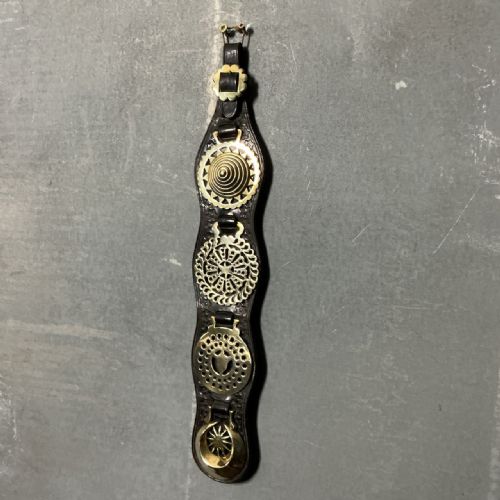
Victorian horse brasses are decorative cast brass plaques that collectors most frequently encounter mounted upon original leather straps or martingales. These pieces span the nineteenth century, including specific dates such as 1880 and 1890, alongside broader Victorian and 19th Century designations.
The objects originate from British and Scottish traditions, recording the working life of heavy horses through regional designs and motifs. While some items appear individually, others survive grouped on original leather straps complete with pottery-centred examples.
How they were made
These items rely principally on cast brass, utilising sand-casting and finishing techniques common to nineteenth-century metalwork. Makers frequently combined this metal with leather for the martingales, while certain variants integrate ceramic elements or pottery centres.
The production involved pouring molten brass into moulds before hand-finishing the surface details and polishing the metal to a bright finish. Straps were assembled using sturdy leather and stitched construction to withstand daily use on working harness.
The site listings include Victorian horse brasses mounted on leather straps, alongside related equestrian items in brass, oak, and glass.
What varies in quality
The quality of these brasses depends upon the crispness of the casting and the depth of the relief work. Finer examples show sharp detailing in the motifs and clean edges, whereas lower grades suffer from worn moulds and soft outlines.
The integrity of the associated leather strap also dictates overall merit. Original martingales complete with securely attached brasses hold greater interest than isolated items stripped from their original context.
Henry Jacot
The Victorian Horse Brasses Glossary
- Horse brass
- A solid brass ornament designed to decorate the harness of a heavy draught horse. These amulets often depicted animals, royal events, or local emblems.
- Martingale
- A strap of leather running from the horse's girth to the noseband or collar. This forms the primary backing upon which brasses are displayed.
- Pottery-centred
- A description for brasses inset with a small ceramic medallion. These glazed centres usually display painted transfers or simple geometric patterns.
- Cast brass
- Metal shaped by pouring molten alloy into a mould. This method allowed nineteenth-century founders to produce repeating decorative motifs efficiently.
Victorian Horse Brasses: Frequently Asked Questions
What are victorian horse brasses?
Victorian horse brasses are solid metal ornaments originally fixed to the harness gear of heavy working horses. They served both a decorative purpose and functioned as protective amulets along trade routes.
Today, collectors encounter them either as single medallions or mounted on their original leather straps. The designs reflect rural trades, royal jubilees, and familiar animals of the period.
How were horse brasses used?
These brasses were fastened to leather martingales that hung across the chest or bridle of heavy horses pulling wagons and carts. Owners polished them brightly to showcase the pride of the stable.
As mechanisation replaced working horses, the brasses were removed from harness and repurposed as interior wall decorations. People mounted them on leather straps inside homes and inns.
How do you clean brasses?
Cleaning historic brass requires a mild metal polish and a soft cloth to remove tarnishing without wearing away the underlying metal relief. Care must be taken around pottery centres and aged leather.
Many collectors prefer to leave a mellow patination on older pieces rather than polishing them to a brilliant shine. Harsh abrasives should be avoided to preserve the original surface texture.
Are straps original?
Original leather straps show genuine age, stiffness, and wear consistent with nineteenth-century harness use. The stitching and leather colour offer clues to their period authenticity.
Many loose brasses were mounted onto modern leather straps later in the twentieth century for display purposes. Examining the method of attachment helps determine whether the strap and brasses belong together.