

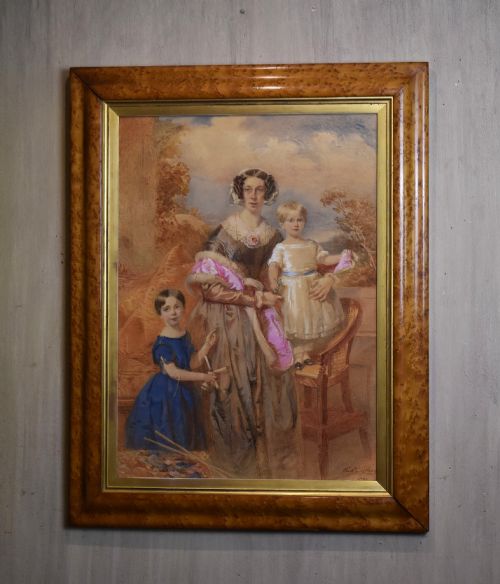


Victorian Group Family Portrait
A victorian group family portrait captures the intimate bonds of the household through delicate watercolour, silhouette, or oil.
Victorian Group Family Portrait
A victorian group family portrait brings together multiple members of a household within a single painted, drawn, or cut paper composition. These works range from informal watercolours of children to formal oil paintings and intricate silhouettes created during the nineteenth century.
The pieces available here represent the Victorian era alongside related nineteenth-century works, encompassing framed silhouette art, oil paintings, and watercolour studies. Collectors frequently encounter domestic scenes executed by regional British and European schools.
Makers and artists span named practitioners such as Frederick Tatham and William Egley, alongside specialised establishments like the Royal Victoria Gallery and K & K Hof Atelier Pietzner. Staffordshire pottery portrait figure groups also appear, translating domestic and royal family groupings into three-dimensional ceramic form.
How they were made
Artists executed these works on paper or canvas, employing watercolour, ink, oil paint, and mixed media to render likenesses and interior or garden settings. Framed examples commonly utilise wood and maple veneer alongside gilt and giltwood moulding to complement the artwork.
Silhouettes involved precise cutting and dark paper work, often presented as conversation pieces within traditional frames behind glass. Ceramic portrait groups were moulded in Staffordshire pottery, utilising hand-painted glazes to define figures such as Napoleon III, the Empress, and the Prince.
Victorian Group Family Portrait Retail Price Guide 2026
Typical asking prices for victorian group family portrait among the pieces listed under this phrase on Sellingantiques today, from the lower quarter to the upper quarter. They describe what is for sale here now, not the wider market.
Napoleon III and his family occasionally share display space with solemn Victorian children and anonymous domestic groups.
What varies in quality
The framing and preservation of the materials also dictate the standing of a piece. Original giltwood frames and clean glass protection enhance the presentation of nineteenth-century paper and silhouette works.
Frederick Tatham·William Egley·K & K Hof Atelier Pietzner·Royal Victoria Gallery
The Victorian Group Family Portrait Glossary
- Watercolour
- A paint consisting of pigment suspended in a water-based solution, widely utilised on paper for domestic portraiture during the Victorian period.
- Silhouette
- A portrait profile cut from dark paper or painted in solid black ink, capturing the outline of a sitter.
- Giltwood
- Wood carved and treated with a thin layer of gold leaf, frequently forming the decorative frames around nineteenth-century paintings.
- Staffordshire pottery
- Earthenware produced in the Staffordshire potteries, including three-dimensional portrait figures and groups modelled in the nineteenth century.
- Conversation piece
- An informal painting or silhouette showing a group of people engaged in pleasant interaction, usually in a domestic or garden setting.
Victorian Group Family Portrait: Frequently Asked Questions
What is a conversation piece?
A conversation piece is an informal portrait depicting family members interacting within a domestic or outdoor setting rather than posing formally.
These works provide insight into nineteenth-century domestic life and social customs through the grouping of the sitters.
How do I date these portraits?
Dating relies on costume details, framing styles, and inscriptions recorded on the reverse of the canvas, paper, or panel.
Nineteenth-century works often carry period stamps or handwritten notes identifying the sitters and the year of creation.
Are silhouettes considered paintings?
Silhouettes are distinct works created through paper cutting or ink work rather than the application of oil or watercolour pigments.
They function as profile portraits and frequently appear mounted under glass within traditional wooden frames.
Where were Staffordshire figures made?
Staffordshire pottery figures originated in the kilns of the Staffordshire pottery district in England during the nineteenth century.
These ceramic groups portray both royal families and domestic subjects as decorative mantel ornaments.