


Victorian Gold Diamond Drops
Victorian gold diamond drops bring together the warm lustre of period gold and the quiet sparkle of old-cut stones.
Victorian Gold Diamond Drops
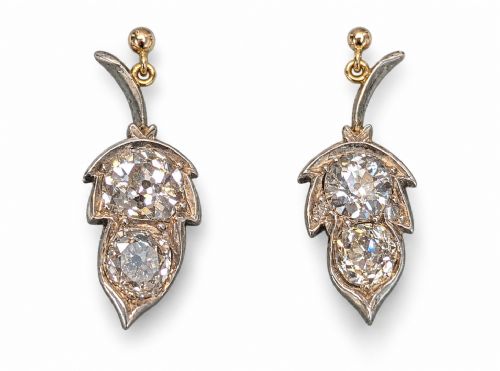
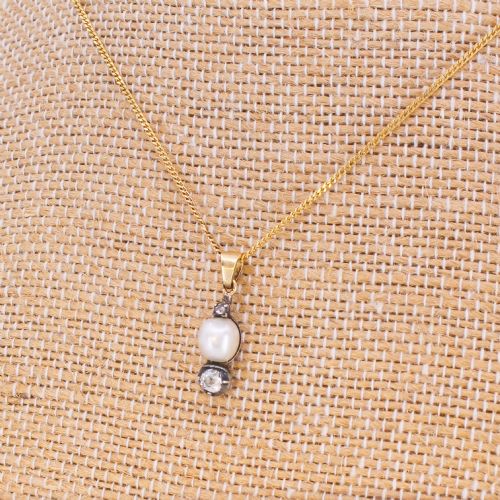
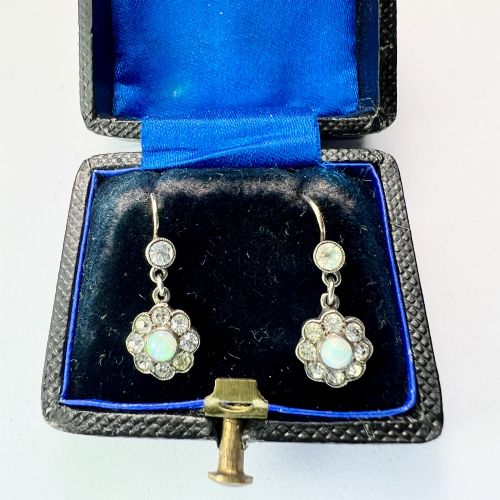
Victorian gold diamond drops comprise pendant earrings, drop necklaces, and lavalieres created during the nineteenth and early twentieth centuries. These pieces typically feature yellow or rose gold settings combined with diamonds, often accented by natural pearls, opals, or coloured gemstones. Earrings and pendant drops dominate the selection, designed to catch the light with movement.
The materials reflect the jewellery practices of the period, utilising combinations of gold, silver-topped gold, and natural pearls. Makers paired diamonds with coloured stones such as green tourmaline, ruby, peridot, and emerald. Forms range from simple teardrops to elaborate cluster configurations and foliate mounts.
While the core of the selection stems from the Victorian era, related pieces extend into the Edwardian period and the early twentieth century. These variations share a reliance on hand-cut stones and traditional metalwork techniques. Buyers encounter both delicate daily wear and larger, ornate presentation pieces.
Materials and construction
Goldsmiths of the era worked primarily in various karats of yellow and rose gold, frequently backing silver settings with gold to enhance the whiteness of the diamonds. This dual-metal technique allowed jewellers to mount stones securely while maintaining a warm gold reverse against the skin. Settings were predominantly handmade or cast and hand-finished.
Diamonds used in these drops are principally old mine cuts or old European cuts, characterised by high crowns, small tables, and open culets. These cuts produce a softer, candlelight sparkle rather than the sharp brilliance of modern machine-cut stones. Pearls were almost exclusively natural, sourced from saltwater or freshwater environments and drilled for suspension.
Mounts incorporate detailed hand-engraving, millegrain edging, and wirework to form swags, clusters, and foliate motifs. Hinged connections allow the drop sections to articulate freely with the wearer's movement. Enamel work and gemstones like banded agate, rock crystal, and conch pearls provide additional colour and texture.
Listings feature items spanning the Victorian, Edwardian, and mid-twentieth-century periods, utilising gold, silver, natural pearls, and diamonds.
Factors of quality and execution
Quality rests significantly on the matching and selection of the stones, particularly the gradation of old-cut diamonds and the uniformity of natural pearls. Superior pieces display harmonious proportions between the drop length and the supporting mount, without excessive weight that pulls awkwardly on the earlobe or chain.
The crispness of the hand-finishing defines the upper tier of these items. Fine granulation, sharp foliate carving in silver or gold, and secure, flush settings indicate a higher level of benchwork. Inferior examples show uneven metal thickness, heavy soldering marks, or replacement stones that disrupt the original design rhythm.
Originality of components also separates standard examples from exceptional survivals. Pieces retaining their original hooks, omega backs, or matching chains hold greater integrity. Alterations to convert brooches into pendants or changes to earring wires alter the original balance of the piece.
Knoll and Pregizer
The Victorian Gold Diamond Drops Glossary
- Old European cut
- A transitional diamond cut popular in the late nineteenth and early twentieth centuries featuring a circular girdle, high crown, and small table. This cut precedes the modern brilliant cut and displays broad facet patterns.
- Lavaliere
- A pendant necklace featuring a central drop suspended from a chain, often incorporating smaller stones or secondary drops. The style gained popularity during the late Victorian and Edwardian eras.
- Silver-topped gold
- A manufacturing method where a thin layer of silver is soldered to the front of a gold mount. This technique allowed jewellers to set diamonds against a bright white metal while retaining the strength and warm reverse of gold.
- Natural pearl
- A pearl formed organically within a mollusc without human intervention, distinct from cultured pearls. These exhibit irregular growth characteristics and soft orient.
- Culet
- The small flat facet at the bottom of an old-cut diamond, visible as a tiny open circle through the table. Its presence is a diagnostic feature of antique stones.
Victorian Gold Diamond Drops: Frequently Asked Questions
How do I care for antique gold and diamond drops?
Clean these pieces gently using warm water and a soft brush, avoiding harsh ultrasonic cleaners that can damage natural pearls or sealed foil backs. Store them individually in lined boxes to prevent the metal and stones from scratching one another.
Because antique settings and natural pearls are delicate, remove them before swimming, exercising, or applying cosmetics and perfumes. Periodic checks by a specialist jeweller will ensure the claw settings and hinged connections remain secure.
Can antique drop earrings be converted for pierced ears?
Many Victorian earrings were originally designed for screw-backs or wire fittings and may have undergone conversion over time. Any alteration should be undertaken carefully by an experienced restorer to preserve the original metalwork.
When purchasing, check the description for details regarding original fittings versus modern replacement wires. Keeping original mechanisms intact maintains the historical integrity of the piece.
How can I tell an old-cut diamond from a modern one?
Old-cut diamonds display smaller tables, higher crowns, and larger culets visible through a loupe. Their facets are broader and hand-polished, producing a distinct, softer pattern of light.
Under candlelight or low indoor lighting, these stones perform with a characteristic warm scintillation. Modern brilliant cuts show a more uniform, geometric flash across the stone's surface.
What does a silver-topped gold setting indicate?
Silver-topped gold points to nineteenth-century manufacturing methods where silver was applied to the face of a gold mount. This allowed jewellers to showcase diamonds against a bright white background without sacrificing the structural strength of gold.
This technique is common in fine Victorian and Edwardian diamond jewellery. It helps date pieces to the period before platinum became widely utilised for mounting gemstones.