


Victorian Diamond Drops
Victorian diamond drops are pendant jewels of considerable brilliance, prized for candlelight wear and historic character.
Victorian Diamond Drops
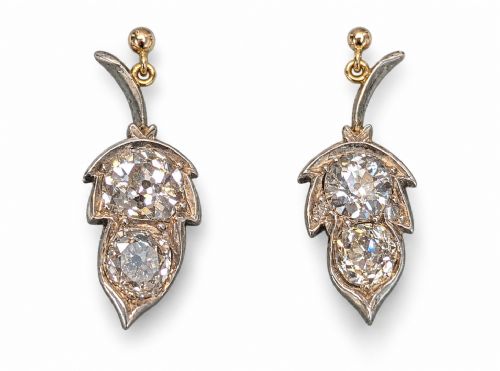
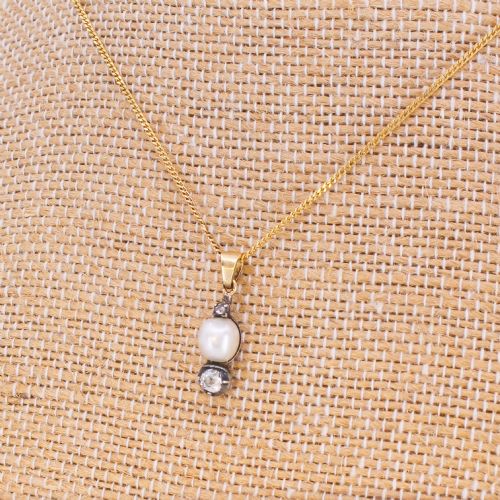
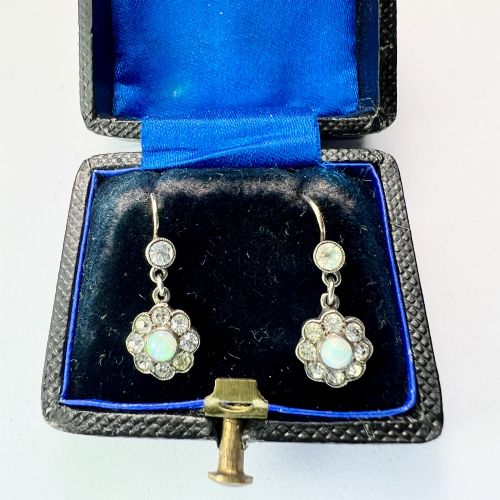
Victorian diamond drops encompass earrings, pendants, and lavalieres created during the nineteenth and early twentieth centuries. These pieces display vertical movement, hanging from ear wires or chains to catch the light with every turn of the head.
The selections on this page draw heavily from Victorian and Edwardian periods, alongside surrounding eras such as 1890 and 1900. Alongside central diamonds, many incorporate natural pearls, rubies, sapphires, opals, and emeralds.
Earrings and pendant necklaces dominate the forms available. Jewelers of the nineteenth century utilised versatile designs that often functioned as both pendants and brooches.
How they were made
Craftsmen mounted stones in combinations of silver and gold, frequently setting diamonds in silver over gold to enhance the brilliance of old-cut stones against a dark metal background. Platinum also appears in later Edwardian and transitional pieces.
Goldsmiths utilised various carat weights of yellow gold, rose gold, and white metals to fabricate intricate foliate mounts, bezels, and articulated drop links. Handcrafted settings accommodated old European cuts, old mine cuts, and rose-cut diamonds.
Some Victorian makers hid tiny spring mechanisms inside pendant drops so the central stone could tremble independently of the frame.
What varies in quality
Quality rests upon the proportion and integration of the drop elements, the matching of natural pearls or coloured gemstones, and the crispness of the metalwork. Superior examples maintain original articulated joints and secure settings that preserve the intended movement.
The distinction between standard production and exceptional work lies in the hand-cut facets of the diamonds and the delicacy of the foliate mounts. Balanced proportions and harmonious pairing of central stones elevate individual pieces within the range.
Knoll and Pregizer
The Victorian Diamond Drops Glossary
- Old cut
- A diamond facet style hand-polished before modern machinery, characterised by a smaller table, higher crown, and open culet. These stones display a softer, deeper glow under artificial light.
- Lavaliere
- A pendant necklace featuring a central drop suspended from a delicate chain, popular during the late Victorian and Edwardian eras. This form emphasises vertical lines and swaying movement.
- Natural pearl
- A pearl formed organically in molluscs without human intervention, frequently found paired with diamonds in Victorian and Edwardian drop earrings and pendants.
- Folliate mount
- Metalwork shaped to resemble leaves and foliage, commonly utilised in Edwardian and Victorian jewellery to frame central diamonds and pearls.
- Culet
- The small flat facet at the bottom of an antique diamond, visible as a tiny circle through the stone from above.
Victorian Diamond Drops: Frequently Asked Questions
How do I wear victorian diamond drops?
These pieces suit evening wear and formal occasions, where natural light and candlelight accentuate old-cut diamonds.
Pair pendant earrings with simple necklines to allow the drop movement to remain the focal point.
Are these pieces converted from older items?
Many Victorian and Edwardian jewels utilise components or repurposed elements from earlier eras, reflecting period recycling practices.
Evidence in the mounts and findings helps determine if a drop configuration is original to its manufacture date.
What is the difference between silver-topped gold and solid gold?
Silver-topped gold places a thin layer of silver over a gold backing to reflect light brightly from diamond facets while utilising gold's strength.
Solid gold settings provide uniform metal colour throughout the mount without the dual-metal construction.
How should I care for natural pearl drops?
Natural pearls require protection from cosmetics, perfumes, and harsh chemicals that can damage their organic nacre over time.
Store them separately in soft pouches and wipe them gently with a dry cloth after wear.