



Victorian Enamel Glassware
Victorian enamel glassware brings vibrant colour and meticulous hand-painting to period interiors through spirited floral, figural and armorial motifs.
Victorian Enamel Glassware
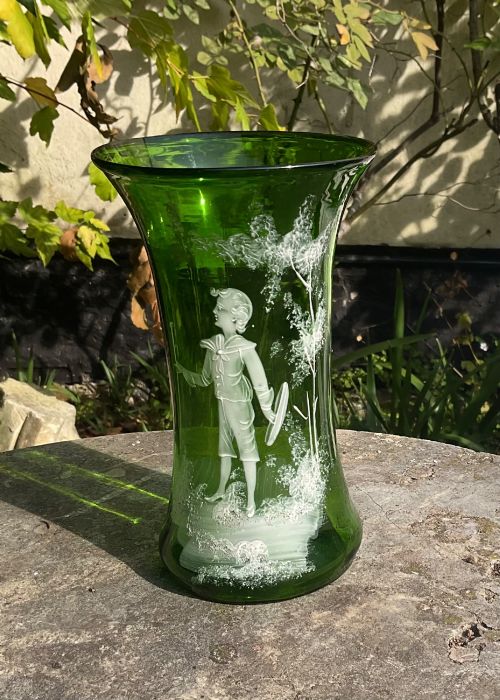
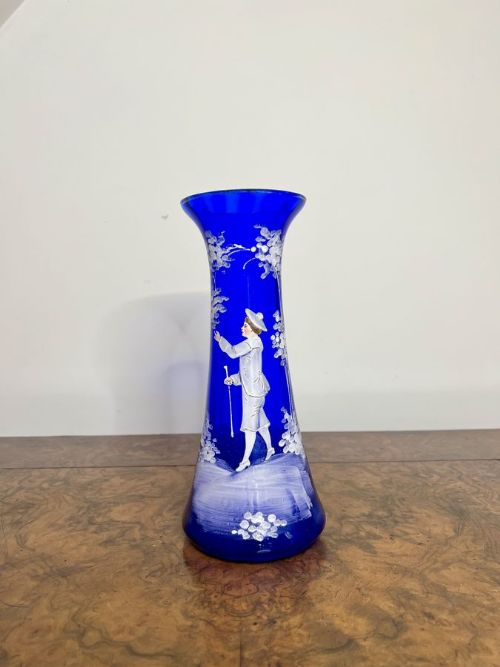
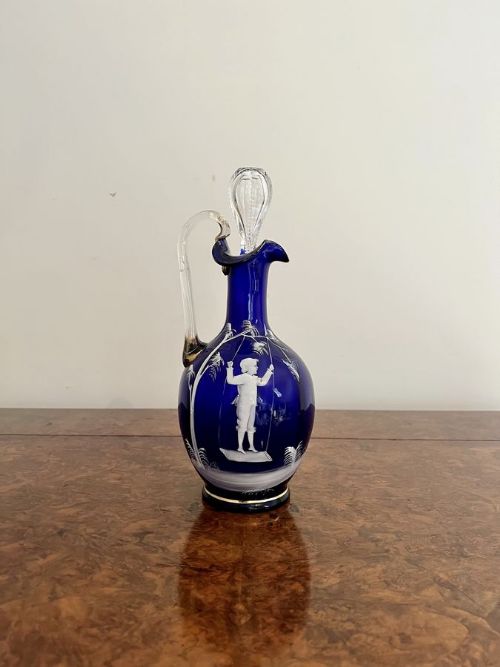
Victorian enamel glassware encompasses a diverse array of decorative and functional vessels, including vases, decanters, ewers, and complete liqueur or tableware sets. When exploring this selection, buyers frequently encounter the distinct silhouettes of Mary Gregory pieces alongside rich Bohemian and German productions.
The objects span from the mid-nineteenth century into the early twentieth century, incorporating styles such as Victorian Historicism, German Historismus, and Art Nouveau. Forms range from single cabinet vases and garniture sets to expansive drinking services and dressing table sets.
Origins represented on this page stretch across Britain, Bohemia, Austria, and Germany, reflecting varied regional approaches to glassmaking and enamelling. Tableware services and tall display vases dominate the configurations available to collectors today.
Assessing Quality
Quality rests upon the precision and delicacy of the hand-painted enamel work, where finely rendered figural details and crisp botanical lines distinguish superior examples. The richness of the underlying glass colour, whether deep cranberry or vibrant green, also dictates the visual impact of the piece.
The presence of hand-gilding and the complexity of the vessel's form contribute significantly to the standing of an item. Works attributed to notable houses display superior draughtsmanship and heavier glass manipulation than standard commercial wares.
Victorian Enamel Glassware Retail Price Guide 2026
Typical asking prices for victorian enamel glassware among the pieces listed under this phrase on Sellingantiques today, from the lower quarter to the upper quarter. They describe what is for sale here now, not the wider market.
Materials appearing across current selections include blown glass, gold leaf, and white enamel applied to coloured glass grounds.
Lobmeyer·Fritz Heckert·Moser
The Victorian Enamel Glassware Glossary
- Mary Gregory glass
- A style of glassware featuring silhouette painting in white enamel, usually depicting Victorian children amidst foliage. The technique gained immense popularity during the nineteenth century.
- Cranberry glass
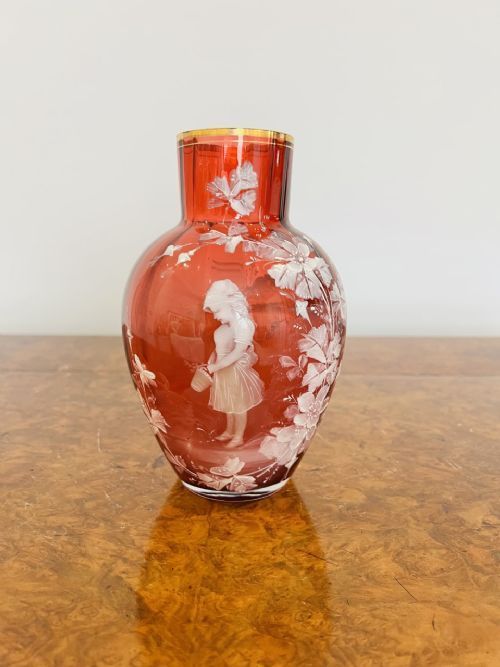
- Transparent red glass produced by adding gold chloride to the molten batch. It forms the striking background for numerous Victorian decorative items.
- Historismus
- A nineteenth-century stylistic movement reviving historical artistic periods, prominent in German and Austrian glass production. It draws heavily on Renaissance and medieval motifs.
- Epergne
- A large table centrepiece featuring a central bowl with multiple branching attachments for holding fruit or flowers. They often incorporate blown glass and enamel elements.
- Garniture set
- A matched group of three or more vases or decorative vessels designed to be displayed together on a mantelpiece or sideboard.
Victorian Enamel Glassware: Frequently Asked Questions
What is Mary Gregory glass?
Mary Gregory glass is a distinct type of Victorian glassware characterised by white enamel painting depicting children in outdoor settings. These pieces appear frequently on coloured glass grounds like cranberry and green.
Although named after a specific American artist historically, the vast majority of these decorated wares were actually produced in Bohemia and Britain during the nineteenth century.
Where was most Victorian enamel glassware made?
While significant quantities were produced in Britain, major manufacturing centres also operated in Bohemia, Austria, and Germany. Houses such as Moser and Lobmeyer produced exceptional enamelled glass.
Regional styles often reveal the origin, with Bohemian and German workshops favouring armorial designs and heavy gilding alongside folk art motifs.
How do I identify a decanter set?
Decanter sets typically comprise a matching pair or single decanter accompanied by a series of small wine glasses, cordials, or a serving tray. These items were designed for entertaining in the parlour.
Complete services often feature uniform enamel decoration across every component, creating a cohesive display for a table or sideboard.
What is cranberry glass?
Cranberry glass is a rich pinkish-red glass created by introducing gold into the molten glass mixture during the manufacturing process. It served as a popular background for white enamel work.
Victorian makers utilised this material extensively for vases, epergnes, and liqueur sets to achieve a warm, glowing aesthetic.