

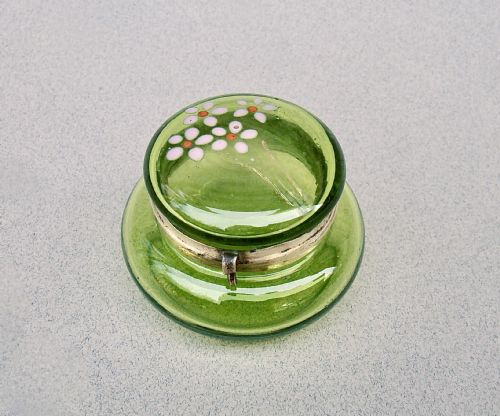


Victorian Enamel Glass Jar
A victorian enamel glass jar brings rich colour and hand-painted detail to a dressing table or shelf, offering a tangible link to nineteenth-century craftsmanship.
Victorian Enamel Glass Jar
A victorian enamel glass jar encompasses small trinket boxes, dressing table jars and biscuit barrels produced during the nineteenth century. These items frequently emerge in vibrant hues like green, Bristol blue, cranberry and pale blue, often accented by applied enamel painting.
Makers across England and France utilised blown or moulded glass bodies, sometimes pairing them with porcelain lids or mounting them in metal and brass hardware. Pieces span simple domestic containers to decorative vases and complete dressing table sets.
The aesthetic shifts from traditional Victorian floral motifs to later nineteenth-century French designs and occasionally into early twentieth-century Art Nouveau styles on opaline glass. Buyers encounter both diminutive trinket boxes and larger storage vessels.
Materials and methods
Artisans formed the core vessels using coloured or clear glass, shaping them through blowing or moulding before adding painted enamel decoration. Many examples feature delicate floral or figural enamel work baked onto the surface.
Metal mounts, brass collars and gold leaf details frequently complete the construction, securing lids and hinges on boxes and jars. Certain pieces integrate porcelain elements alongside the primary glass body.
Victorian Enamel Glass Jar Retail Price Guide 2026
Typical asking prices for victorian enamel glass jar among the pieces listed under this phrase on Sellingantiques today, from the lower quarter to the upper quarter. They describe what is for sale here now, not the wider market.
Even a simple biscuit barrel could sport cheerful hand-painted enamel flowers to brighten a Victorian parlour.
Assessing quality
The refinement of the enamel painting dictates much of the distinction between standard and superior pieces, with delicate brushwork and detailed motifs showing greater artistry. Richness of the underlying glass colour, such as deep Bristol blue or layered cranberry tones, also elevates a piece.
The integration of mounts, including heavy brass hardware and gold leaf accents, marks the difference between basic utilitarian containers and luxury dressing table items.
George Tye·Mary Gregory
The Victorian Enamel Glass Jar Glossary
- Bristol blue
- A deep cobalt blue glass traditionally produced in the Bristol area during the eighteenth and nineteenth centuries. This striking colour became a popular choice for dressing table jars and decorative glassware.
- Cranberry glass
- A transparent pinkish-red glass created by adding gold chloride to the molten batch. It frequently appears in Victorian tableware and decorative containers.
- Opaline glass
- An opaque, slightly translucent pale glass that emerged in various pastel shades during the nineteenth century. It often served as a canvas for painted enamel decoration in later Victorian and Art Nouveau pieces.
- Mary Gregory
- A style of decorative glass featuring white enamel silhouettes of children amidst foliage or landscapes. The technique gained widespread popularity during the late nineteenth century.
Victorian Enamel Glass Jar: Frequently Asked Questions
What were glass jars used for?
These jars served practical functions on dressing tables and in reception rooms, holding small cosmetics, trinkets or biscuits. Their decorative enamel finishes ensured they remained visible items of room furnishing rather than hidden storage.
Over time, their role shifted from utilitarian household containers to collected examples of nineteenth-century glass artistry.
How do I date a glass jar?
Dating relies on observing the combination of glass colour, mounting hardware and enamel painting style. Pieces from the mid-nineteenth century often display different floral conventions compared to later French or Art Nouveau examples.
Examining the base and construction of any metal mounts helps establish whether an item belongs to the early Victorian era or the close of the century.
How should I clean my jar?
Maintenance requires gentle dusting with a soft cloth to protect the delicate enamel painted surfaces from abrasion. Water immersion should be avoided if metal mounts or gold leaf details are present.
Regular careful upkeep preserves both the coloured glass body and the applied painted decoration without risking damage to historic materials.
Are French and English pieces different?
French production from the nineteenth century frequently emphasises ornate metal mounts and distinct enamel colour palettes on dressing table boxes. English versions often utilise rich local glass traditions like Bristol blue or green.
Both origins share a reliance on hand-painted enamel details, though the overall form and hardware styling typically indicate the place of manufacture.