




Victorian Ebony Box
These dark, dense Victorian ebony box pieces bring nineteenth-century craftsmanship into modern rooms to organise correspondence, jewellery, and games.
Victorian Ebony Box
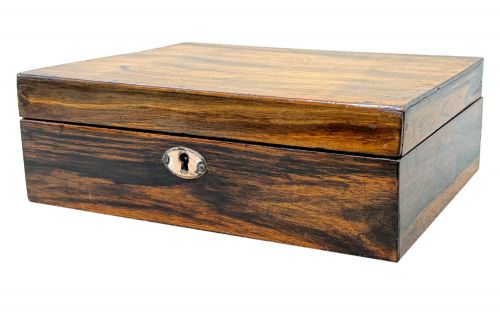
A Victorian ebony box comprises writing slopes, correspondence cases, trinket vessels, and game sets originating from nineteenth-century British, European, and colonial workshops. When searching this phrase, a buyer encounters solid ebony items alongside pieces featuring contrasting boxwood, ivory, satinwood, and brass details.
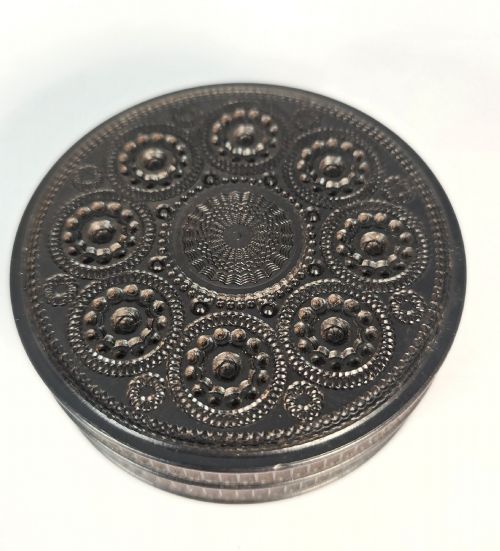
The selection ranges from plain nineteenth-century trinket boxes to intricate Anglo-Indian and Ceylonese examples displaying reeded decoration, porcupine quill work, and intricate inlay. Writing boxes and campaign slopes dominate the form, alongside smaller snuff boxes and parlour game sets.
Most surviving pieces date from the Victorian era and the latter half of the nineteenth century, reflecting global trade routes that brought exotic tropical hardwoods into British homes. These objects served practical domestic and travel functions before becoming decorative collector pieces.
Materials and construction methods
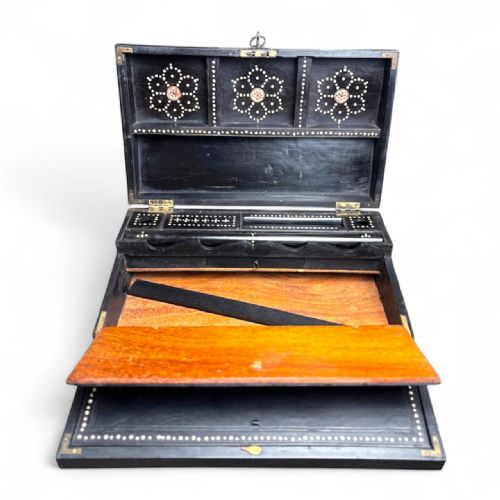
Maker workshops utilised dense, heavy ebony as the primary timber, often combining it with contrasting boxwood, ivory, satinwood, and bone for interior fittings and exterior ornamentation. Metal elements such as brass mounts, locks, and hinges provided structural reinforcement and secure closures for portable writing slopes.
Surface decoration involved engine turning, reed carving, and geometric mosaic inlay, particularly in Anglo-Indian, Ceylonese, and Tunbridge Ware traditions. Internal compartments typically utilised secondary woods like mahogany or cedar, lined with felt or velvet to protect writing instruments and personal valuables.
Some nineteenth-century gentlemen carried walking canes secretly fitted with snuff box handles and four-leaf clover motifs.
Judging quality and execution
The finest pieces demonstrate precision in geometric ivory and boxwood inlay, where individual tesserae align without gaps across complex surfaces. Solid ebony construction ranks higher than veneered alternatives, particularly when timber selection maintains a uniform, deep black grain without artificial darkening.
Internal arrangement determines utility and craftsmanship, with superior writing boxes retaining complete inkwells, secret compartments, and undamaged velvet or leather writing surfaces. Exterior brass hardware, original locks, and crisp reeded or engine-turned carving separate workshop masterworks from standard commercial production.
Jaques·Whitty·British Chess Company·F. H. Ayres
The Victorian Ebony Box Glossary
- Ebony
- A dense, hard black wood derived from tropical trees, prized for its ability to take a high polish and accept intricate carving.
- Writing slope
- A portable desk featuring a hinged, sloping lid that opens to reveal a slanted writing surface, inkwells, and storage compartments.
- Anglo-Indian
- A descriptive term for nineteenth-century decorative arts produced in the Indian subcontinent under British rule, frequently incorporating indigenous carving techniques.
- Tunbridge Ware
- A type of nineteenth-century woodwork decorated with mosaic patterns created from thousands of tiny tinted wood blocks, forming pictorial or geometric designs.
- Reeded
- A decorative moulding consisting of parallel convex projections carved directly into the surface of the wood.
Victorian Ebony Box: Frequently Asked Questions
What is a Victorian ebony box used for?
These boxes served as portable writing desks, secure storage for correspondence and jewellery, and vessels for tobacco or games.
Today, collectors utilise them on desks and side tables to hold modern trinkets while displaying nineteenth-century craftsmanship.
How do I identify Anglo-Indian boxes?
Anglo-Indian pieces typically display distinctive regional carving, such as reeded surfaces or intricate ivory and bone inlay work.
Originating from centres like Ceylon, these items combine dense tropical hardwoods with motifs distinct from standard British cabinet making.
Are interior fittings usually original?
Many surviving writing slopes and jewellery boxes retain their original velvet liners, secret drawers, and glass or pewter inkwells.
Replacements do occur due to nineteenth-century wear, so inspect hinges, interior compartments, and locks for consistency in age.
How should I care for ebony wood?
Ebony requires stable room humidity to prevent the dense timber and contrasting inlay elements from drying or splitting over time.
Apply microcrystalline wax sparingly to maintain the natural sheen without sealing moisture into the grain or fabric linings.