

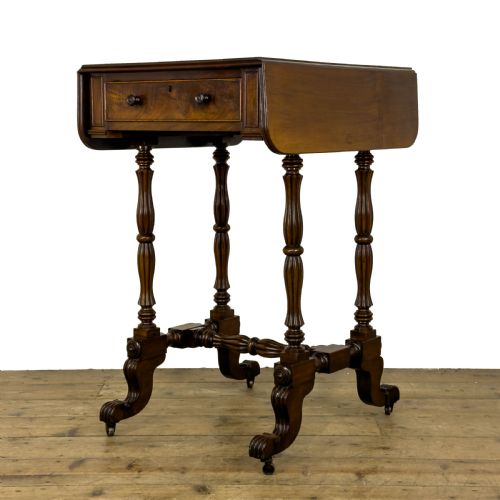


Victorian Drop Leaf Tea Table
A victorian drop leaf tea table provides a folding surface for hospitality, uniting nineteenth-century cabinet work with practical domestic adaptability.
Victorian Drop Leaf Tea Table
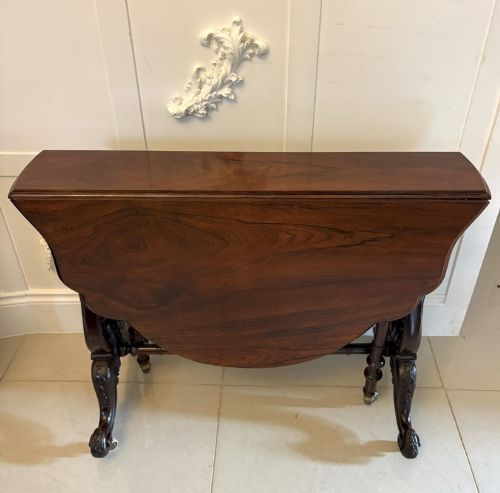
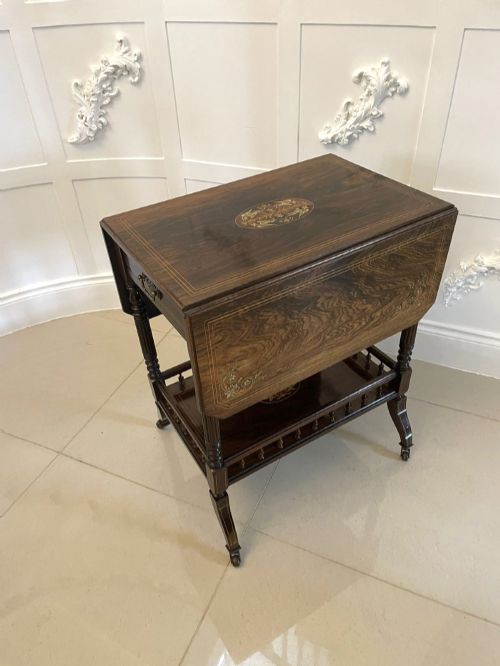
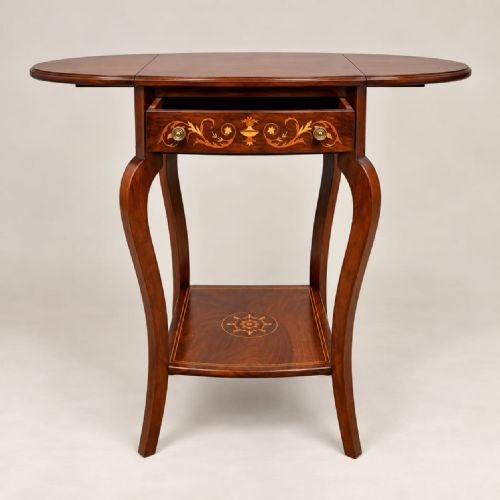
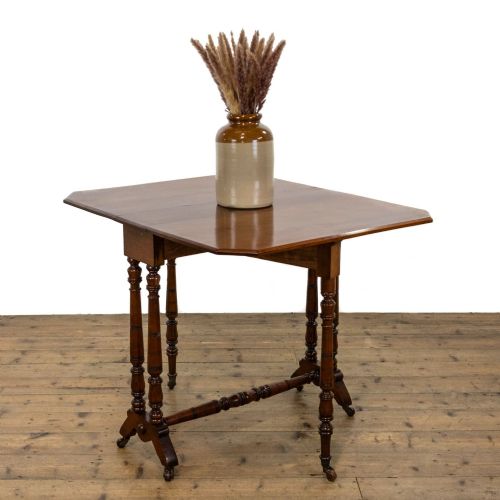
A victorian drop leaf tea table encompasses folding occasional furniture designed for flexible interior use, appearing most frequently on this page as walnut and mahogany Sutherland tables, Pembroke tables, and drop-leaf occasional tables. These pieces date primarily from the Victorian and nineteenth-century periods, with occasional Edwardian examples.
The form relies on hinged flaps that drop down or fold up to expand the top surface, supported by gate legs, scissor actions, or pivoting brackets. Makers utilised these folding designs to save space in smaller parlours while retaining a substantial surface for serving tea or displaying objects.
Buyers encountering this selection will find formats ranging from full-sized Sutherland tables to miniature and baby proportions, alongside specialised variants incorporating satinwood inlay, floral marquetry, and brass elements.
Materials and construction
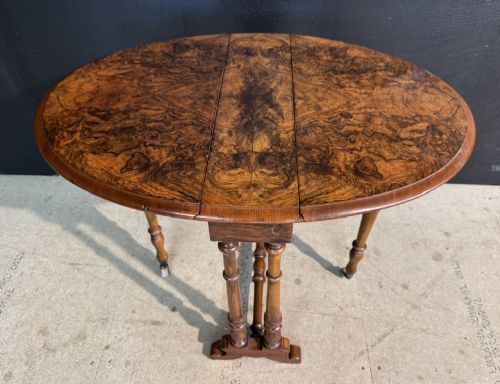
Cabinet makers constructed these tables using dense timbers such as mahogany, rosewood, and burr walnut, often selecting figured veneers to create decorative patterns on the folding leaves. Satinwood and brass provided contrasting details for stringing, inlay, and hardware.
The drop leaves required precise hinging and stable support structures, seen in the slender gate legs of Sutherland tables and the pivoted flaps of Pembroke designs. Joinery methods prioritized both the lateral stability of the extended top and the smooth movement of the folding sections.
Listings span the Victorian, Edwardian, and William IV periods, utilising mahogany, rosewood, burr walnut, and satinwood across diverse table formats.
Judging construction and finish
Quality in these folding tables rests upon the selection of timber veneers and the precision of the marquetry or inlay work. Burr walnut and figured mahogany with consistent grain patterns distinguish higher grade examples from plain stock.
The structural integrity of the folding mechanism determines the longevity of the piece, particularly the joints of the drop leaves and the stability of the gate leg supports when fully extended.
Johnstone and Jeanes·Jenks & Woods·Liberty & Co.
The Victorian Drop Leaf Tea Table Glossary
- Sutherland table
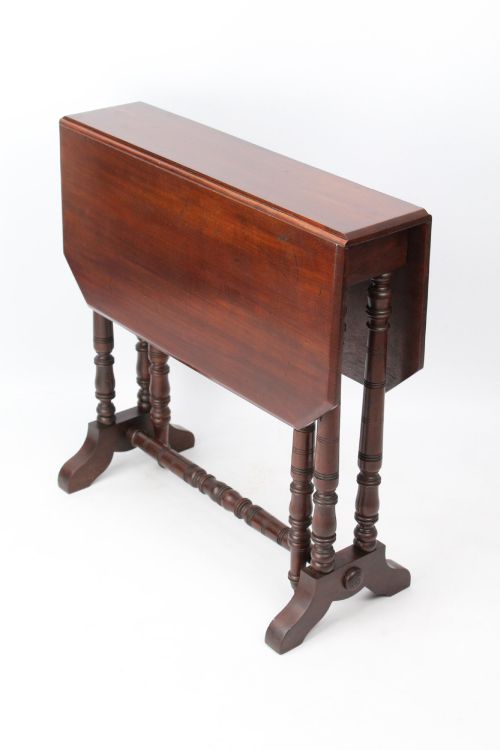
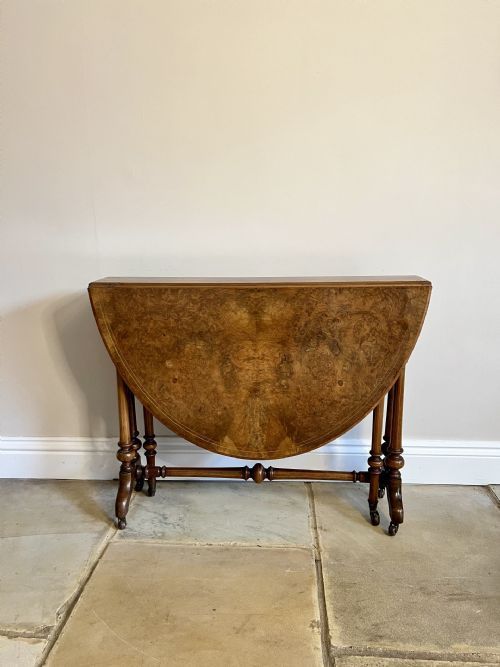
- A narrow-bodied drop leaf table with exceptionally slender folding flaps supported by swinging gate legs. This form became popular during the Victorian period for space-saving parlour use.
- Pembroke table
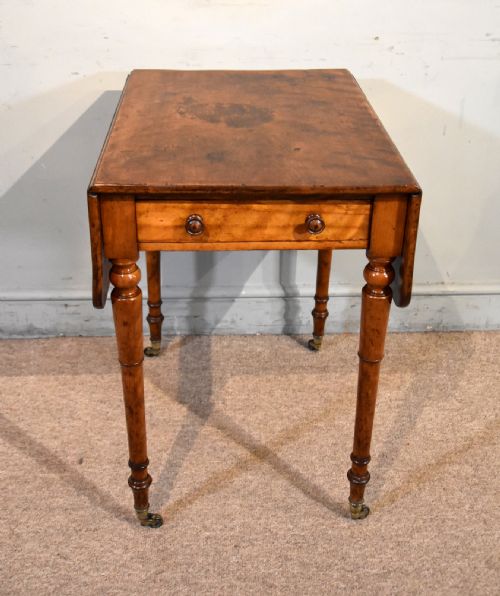
- A rectangular table featuring two hinged drop leaves on opposite sides and typically a single drawer beneath the top. The design dates to the eighteenth century but continued through the Victorian era.
- Marquetry
- The art of applying decorative pieces of veneer to a structure to form intricate floral or geometric designs. Victorian makers employed this technique on walnut tabletops.
- Gate leg
- A hinged leg that swings outward from the frame to support an extended drop leaf. It provides crucial weight-bearing strength to tables with folding flaps.
Victorian Drop Leaf Tea Table: Frequently Asked Questions
How do you operate a Sutherland table?
Lifting the drop leaves releases the hinged gate legs underneath, which swing outward from the central frame to lock the extended surface into position. Lowering the leaves simply requires folding the legs back against the central support.
This scissor-like action allows the table to rest flat against a wall when not in use, making it practical for rooms with limited floor space.
Where were these tables used in a Victorian home?
These folding tables functioned primarily in parlours and drawing rooms as surfaces for serving tea, holding lamps, or displaying ornamental objects. Their adaptable footprint allowed servants to move and reconfigure them easily for social gatherings.
Today, they adapt readily to modern interiors as compact coffee tables, lamp tables, or side desks.
How can you distinguish Victorian from Edwardian examples?
Victorian examples frequently showcase heavy burr walnut, rich rosewood, and elaborate floral marquetry, reflecting the period's preference for dense wood grains and ornamental inlay. Edwardian pieces often exhibit lighter satinwood elements and simpler Sheraton Revival influences.
Examining the secondary timbers and the style of the inlay helps determine the manufacturing era.