


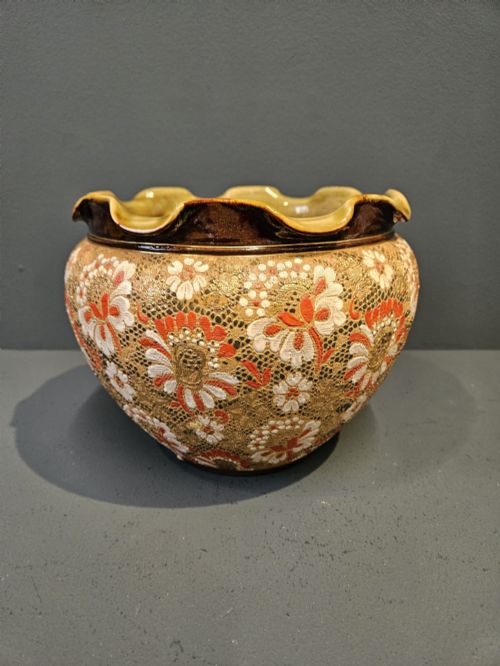


Victorian Doulton Jardiniere
A victorian doulton jardiniere brings heavy ceramic presence and rich glaze work to a room, offering a distinct piece of British pottery history for plants.
Victorian Doulton Jardiniere
A victorian doulton jardiniere is a decorative ceramic plant pot designed to hold indoor foliage or large planters within domestic interiors and orangeries. These vessels take the form of substantial jardinieres and planters, often accompanied by matching stands.
The pieces encountered on this page span from the late nineteenth century into the early twentieth century, reflecting the stylistic shifts of the period. Forms range from standard pots to larger tree planter bases originating from English settings.
Makers from this tradition produced work crossing several stylistic boundaries, notably Victorian, Art Nouveau, and Arts and Crafts aesthetics. These designs capture the transition from ornate nineteenth-century decoration to more organic twentieth-century forms.
How they were made
Makers utilised robust stoneware and earthenware bodies to form the heavy walls required for large plant vessels. These ceramic bases received specialised glazes that varied from textured surfaces to smooth finishes.
Decoration often incorporated applied enamel and gold leaf accents over the fired clay body. Individual artists shaped the distinct surface patterns seen on Slaterware and standard glazed ceramic productions.
Victorian Doulton Jardiniere Retail Price Guide 2026
Typical asking prices for victorian doulton jardiniere among the pieces listed under this phrase on Sellingantiques today, from the lower quarter to the upper quarter. They describe what is for sale here now, not the wider market.
Listings feature stoneware, earthenware, and glazed ceramic materials across Victorian, Art Nouveau, and Arts and Crafts styles.
What varies in quality
Quality rests upon the crispness of the modelled detail and the depth of the glaze applied to the ceramic body. Pieces showing distinct artistic handwork stand apart from standard factory output.
The presence of identified makers or specific studio artists elevates the standing of an individual jardiniere. Complexity in surface treatment, such as combined enamel and gold leaf detailing, dictates the upper tier of production.
Royal Doulton·Doulton Lambeth·Doulton Burslem·Ethel Beard
The Victorian Doulton Jardiniere Glossary
- Stoneware
- A dense, impermeable ceramic fired at high temperatures. This material forms the durable body characteristic of many heavy nineteenth-century planters.
- Slaterware
- A specific Doulton ceramic technique involving textured body surfaces that mimic woven lace or fabric. This treatment creates a tactile, patterned exterior.
- Jardiniere
- A large ornamental pot designed to hold plants or flowers indoors. These vessels often sit on matching pedestals or floor stands.
- Earthenware
- Porous pottery fired at lower temperatures than stoneware. It serves as a common base material for glazed decorative vessels.
- Art Nouveau
- A decorative style characterised by fluid, organic lines and floral motifs. This aesthetic heavily influences early twentieth-century ceramic designs.
Victorian Doulton Jardiniere: Frequently Asked Questions
What is a victorian doulton jardiniere used for?
These vessels serve primarily as decorative holders for potted indoor plants and large greenery. They function as standalone floor or table ornaments within domestic interiors.
Historically, homeowners placed them in parlours, hallways, and orangeries to display palms and ferns. Their weight and sturdy ceramic construction provide stable housing for substantial root systems.
How do I identify a Doulton Lambeth piece?
Doulton Lambeth pieces typically feature dense stoneware bodies with impressed factory marks and artist initials. The decoration often relies on textured clay surfaces rather than purely painted designs.
Examining the base usually reveals specific factory stamps used during the nineteenth and early twentieth centuries. These markings help distinguish London studio output from other potteries.
What is Slaterware?
Slaterware is a distinctive Doulton ceramic finish created by pressing actual lace or textiles into damp clay before firing. This process leaves a textured impression that mimics woven fabric across the vessel body.
Potters often highlighted these textured areas with coloured glazes and gold leaf accents. The resulting surface offers a tactile contrast to smooth glazed sections.
How do these pieces fit into modern interiors?
A victorian doulton jardiniere works effectively as a heavy planter for large houseplants or small indoor trees. The neutral tones and rich glazes complement both traditional and contemporary room schemes.
Placing them on the floor or on low plant stands allows the decorative surface patterns to remain visible. Their durable ceramic build ensures they handle regular watering safely.