


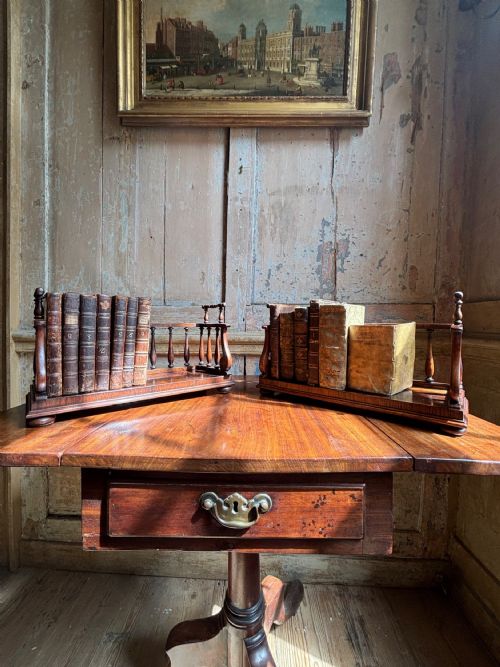


Victorian Desk Book Rack
These Victorian desk book racks are ingenious expanding library accessories designed to keep working volumes orderly on a surface.
Victorian Desk Book Rack
A Victorian desk book rack takes the form of an expanding slide or stationary stand, designed to hold volumes upright on a library table. You will frequently encounter walnut models fitted with brass mounts alongside richly grained rosewood examples.
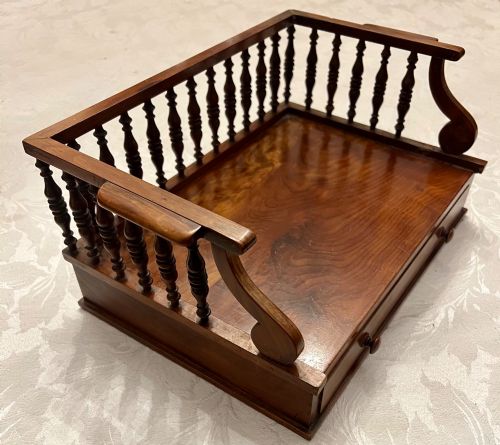
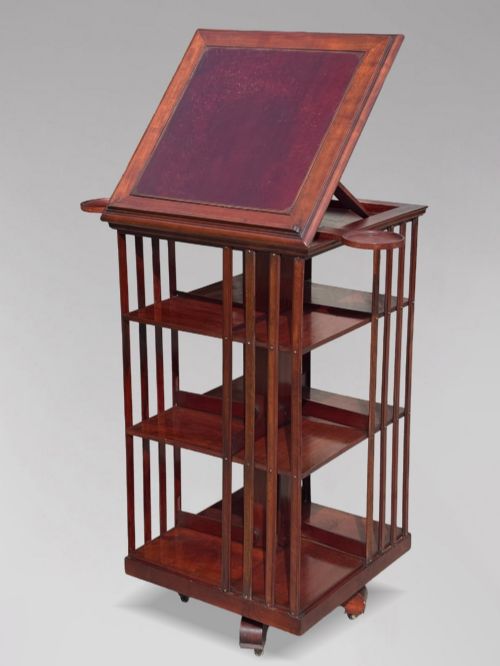
Makers produced these pieces in various configurations, including folding music stands, desk tidies, and novel rests. The core function remained the containment of books within arm's reach of the reader.
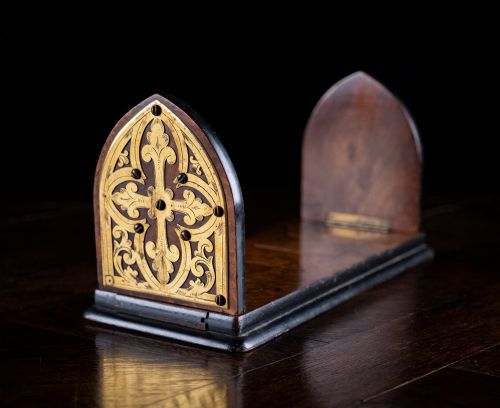
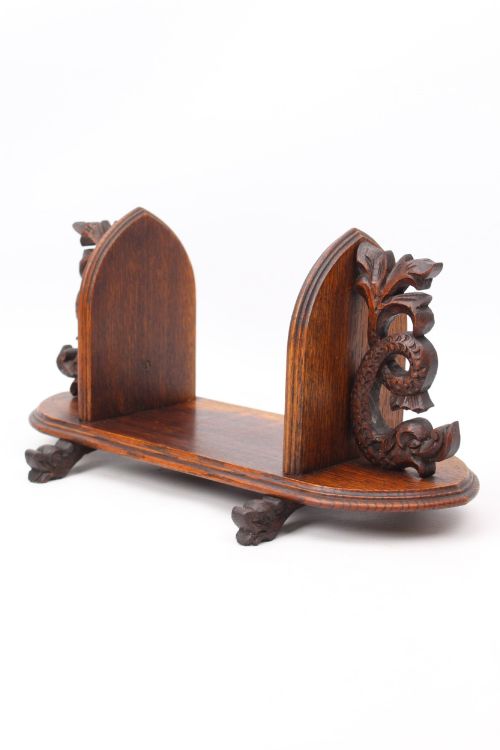
Originating predominantly in the nineteenth century, these accessories incorporate styles ranging from plain mahogany to ornate Victorian Gothic revival and Anglo-Indian carved teak. The expanding mechanism allows the wooden ends to pull outward as the collection grows.
Materials and construction
Cabinet makers utilised dense hardwoods such as walnut, rosewood, coromandel, and oak to construct the main body and expanding leaves. These timbers often display strong natural grain patterns or specialist decoration like Tunbridge ware mosaic work.
Metalwork played a structural and decorative role, with brass hinges, mounts, and extending scissor actions reinforcing the joints. Some examples incorporate inset painted porcelain plaques, bone details, or boxwood stringing.
Joinery methods ensured the sliding actions moved smoothly while supporting the weight of heavy volumes. Carved elements on teak and oak versions demonstrate traditional hand woodworking skills of the period.
Victorian Desk Book Rack Retail Price Guide 2026
Typical asking prices for victorian desk book rack among the pieces listed under this phrase on Sellingantiques today, from the lower quarter to the upper quarter. They describe what is for sale here now, not the wider market.
Listings feature items from the 1830s through to the Edwardian period, utilising woods like walnut, rosewood, coromandel, and oak alongside brass mounts.
Judging quality and execution
Superior examples distinguish themselves through the choice of exotic timbers, such as figured coromandel or burr walnut, rather than plain mahogany or basic oak. The complexity of the mechanism, such as patented sliding actions, also indicates higher production ambition.
Decorative embellishments separate standard pieces from exceptional ones. Finely painted porcelain plaques, intricate Tunbridge ware marquetry, or elaborate brass mountings elevate a simple desk accessory into a piece of fine cabinet work.
The precision of the expanding action and the retention of original finish dictate the overall desirability. Pieces displaying crisp carving and intact interior mechanisms represent the upper tier of the range.
Gillows·Betjemanns·Tiffany and Co
The Victorian Desk Book Rack Glossary
- Book slide
- An expanding rack with two upright ends connected by a sliding mechanism to hold varying numbers of volumes. This design permits adjustment on the desk surface.
- Tunbridge ware
- A form of British woodwork characterised by tiny mosaic tiles formed from naturally coloured woods to create geometric or pictorial scenes. It adorns specific Victorian desk accessories.
- Gothic revival
- An architectural and decorative style drawing inspiration from medieval forms, featuring pointed arches and heavy oak construction. This aesthetic appears frequently on nineteenth century book stands.
- Coromandel
- A dense, heavily variegated timber imported from Asia, prized for its dark brown colour and dramatic black stripes. Cabinet makers used it for high status Victorian desk pieces.
- Patent mount
- Metal hardware registered with the patent office, indicating a specific mechanical improvement in the sliding action. Makers like Betjemanns utilised such innovations.
Victorian Desk Book Rack: Frequently Asked Questions
How do extending book slides work?
Extending book slides use a concealed or exposed sliding mechanism that allows the two wooden upright ends to pull apart. This adjustment accommodates a growing or shrinking row of volumes on a desk.
The mechanical action often relies on brass linkage bars or sliding wooden channels beneath the base. When pushed together, they occupy minimal space while keeping the books firmly upright.
What woods were used for these racks?
Cabinet makers selected durable and decorative hardwoods for these desk accessories. Walnut, rosewood, oak, mahogany, and exotic coromandel appear frequently across the pieces.
More specialised examples incorporate olive wood, boxwood inlay, or carved teak. These materials reflected the tastes of nineteenth century home libraries and offices.
Are these book racks heavy?
Most desk book racks possess a solid weight due to the dense hardwoods and brass components used in their construction. This heft ensures the base remains stable when books are added or removed.
Larger library stands and music rests provide even greater substance to support heavy reference volumes. Smaller sliding versions remain easily portable around a study table.
How should I clean a wooden book slide?
Dust the wooden surfaces and brass mounts gently with a dry, soft cloth to prevent accumulation. Avoid using harsh chemical sprays or excess moisture on antique polishes.
Periodic application of a suitable wax helps maintain the lustre of the timber. Care should be taken around inset porcelain plaques or delicate Tunbridge ware.