


Victorian Crescent Moon Jewellery
Victorian crescent moon jewellery captures the celestial fascination of the nineteenth century through gold, silver, and precious stones.
Victorian Crescent Moon Jewellery
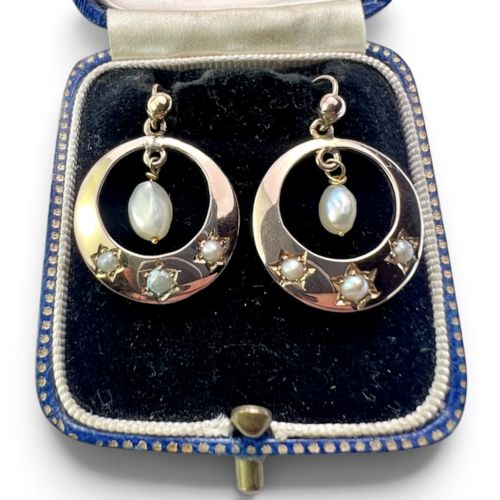
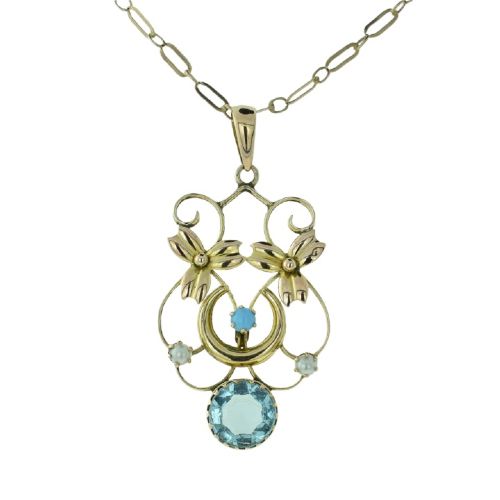
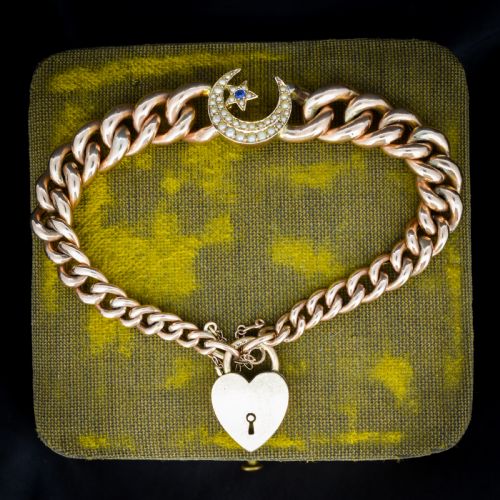
Victorian crescent moon jewellery encompasses brooches, pendants, earrings, and bracelets shaped into the lunar motif, frequently paired with stars or swallows. The pieces span periods from the nineteenth century into the Edwardian era, reflecting a widespread cultural obsession with the night sky.
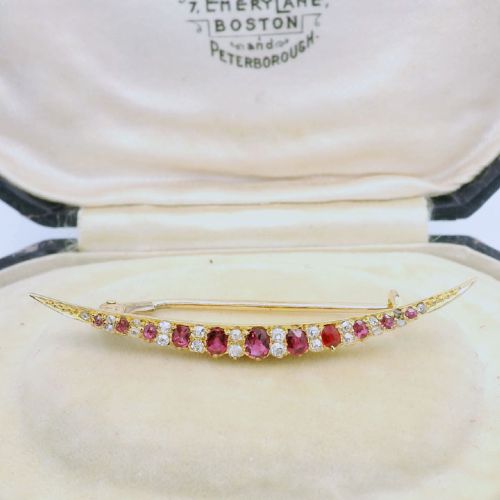
The version a buyer most commonly meets on this page is the brooch, often rendered in yellow gold and set with combinations of diamonds, rubies, sapphires, and pearls. These items range from delicate seed pearl designs to substantial multi-stone configurations incorporating rubies and diamonds.
Materials and construction
Goldsmiths utilised various purities of gold, including nine-carat, fifteen-carat, and eighteen-carat variants, alongside silver and platinum settings. These metals were shaped to support close-set gemstones following the curve of the lunar body.
Gemstones such as rubies, sapphires, diamonds, turquoise, and seed pearls were meticulously arranged along the crescent form. Master jewellers employed star-setting techniques to secure small diamonds and pearls flush into the gold ground.
Swallows occasionally join the crescent moon, carrying messages of safe return on fluttering wings of gold and seed pearls.
Distinctions in quality
Quality reveals itself in the selection and matching of the gemstones, particularly the saturation of rubies and sapphires alongside the uniformity of seed pearls. Superior examples demonstrate precise stone-cutting and secure claw or flush settings that follow the precise geometry of the lunar arc.
The weight and purity of the gold or platinum provide another measure of distinction, moving from nine-carat yellow and rose gold up to higher-carat alternatives. Construction details on the reverse, including robust pin mechanisms and integrated loops, separate utilitarian pieces from finer atelier work.
The Victorian Crescent Moon Jewellery Glossary
- Seed pearl
- A very small, natural or cultured pearl, often drilled and threaded or glued onto pegs in clusters. These tiny gems form delicate white accents along the crescent shape.
- Star-setting
- A mounting technique where a gemstone is set flush into the metal, and small triangular cuts are chased around the stone to resemble a star. This method protects the stone edges while adding decorative sparkle.
- Curb bracelet
- A chain bracelet formed of uniform, interlocking flat links. These pieces frequently incorporate charms or pendants, such as a gold crescent moon.
- Paste
- Hand-cut and polished lead glass used to imitate gemstones. In period pieces, high-quality paste provides brilliant light reflection.
Victorian Crescent Moon Jewellery: Frequently Asked Questions
What periods do these pieces date from?
The items span the Victorian era, the Edwardian period, and the early twentieth century. Makers produced these celestial designs across several decades with stylistic shifts.
Specific dates within the listings range from the late nineteenth century through to nineteen thirty, showing enduring popularity for lunar motifs.
How were crescent brooches worn?
Wearers pinned these ornaments to lapels, collars, or the fabric of hats and shawls. They served as prominent decorative accessories during daytime and evening events.
Some designs include integrated loops, allowing the brooch to convert into a pendant hung from a chain.
What metals are commonly found?
Gold forms the primary structural metal, appearing in nine-carat, fifteen-carat, and eighteen-carat variations, alongside rose and yellow hues. Silver and platinum also appear in specific settings.
These metals provided durable foundations for securing pavé diamonds, rubies, and delicate pearls along the curved frame.
Are pearls natural on these items?
Many pieces incorporate seed pearls or larger pearls alongside coloured gemstones and diamonds. The type and size of pearl vary according to the scale of the jewellery.
Jewellers utilised these organic gems to contrast sharply with the polished gold and bright faceted stones.