



Victorian Crescent Jewellery
Victorian crescent jewellery captures the celestial fascination of the nineteenth century through gold and gemstone brooches, pendants, and earrings.
Victorian Crescent Jewellery
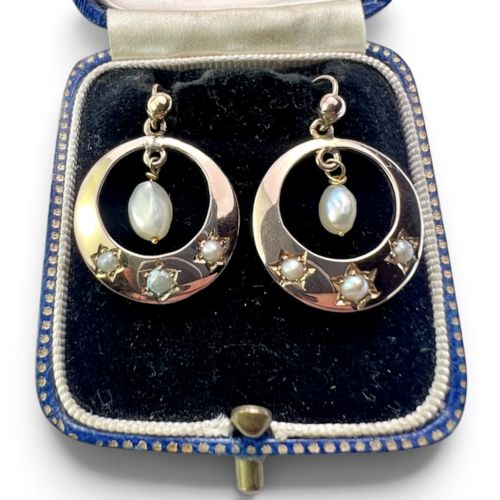
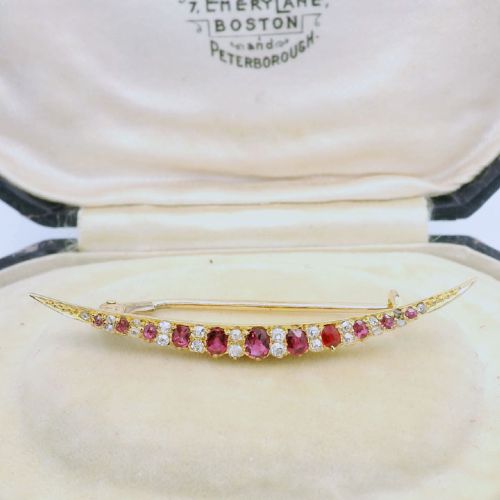
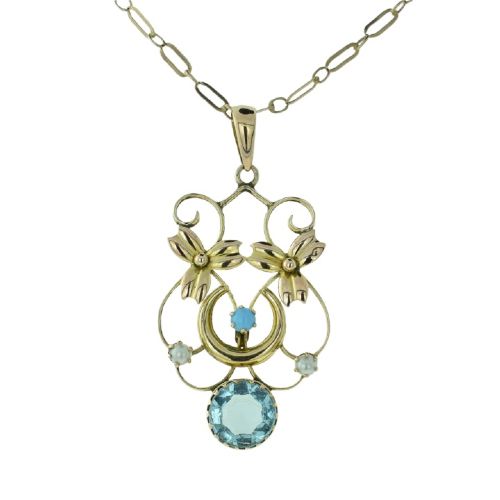
Victorian crescent jewellery comprises brooches, pendants, and earrings shaped into lunar motifs, often paired with stars, swallows, or floral elements. When searching for victorian crescent jewellery, buyers most frequently encounter gold brooches set with combinations of pearls, rubies, and diamonds.
The surviving pieces span the Victorian and Edwardian periods, stretching from the late nineteenth century into the early twentieth century. Common forms include crescent bar brooches and drop pendants fashioned from yellow gold, rose gold, or silver.
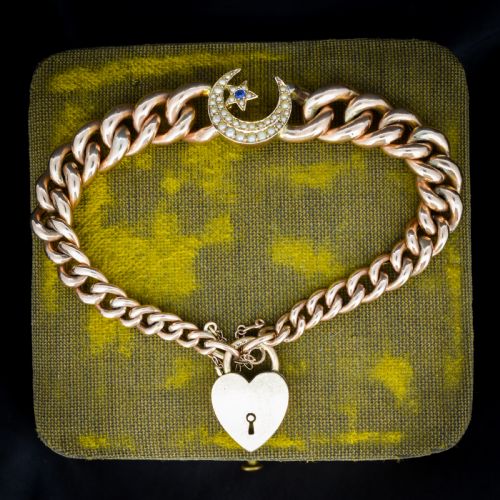
Makers of this era frequently combined the crescent motif with seed pearls and bright gemstones like sapphires and turquoise. These ornaments reflect the revival styles popular during the period, including Ottoman influences and celestial designs.
Materials and Construction
Goldsmiths utilised various grades of gold, notably 9ct and 15ct, alongside silver and platinum highlights to construct these crescent settings. Stones were securely held by claw settings or flush star-settings directly into the metal body.
Gemstones such as rubies, sapphires, and diamonds were selected alongside delicate seed pearls and turquoise to fill the curved frames. Metalwork often featured textured engraving or hollow-formed gold construction to keep larger brooches lightweight for wear on fabric.
Listings feature yellow gold, rose gold, and silver paired with rubies, sapphires, turquoise, and seed pearls across Victorian and Edwardian periods.
Quality Variations
The distinction between standard and superior pieces rests on the choice of precious materials and the precision of the gem-setting. Higher quality examples employ higher carat gold or platinum alongside well-matched natural rubies, sapphires, and clean diamonds.
Workmanship also dictates value, seen in the regularity of pearl grading and the delicacy of the surrounding wirework or engraving. Pieces that integrate complex secondary motifs, such as swallows or floral clusters, demonstrate greater artisanal investment.
The Victorian Crescent Jewellery Glossary
- Seed Pearl
- Tiny natural or cultured pearls used to trace the curved outline of crescent jewellery. They are typically half-drilled and secured onto tiny pins.
- Star-Setting
- A technique where a gemstone is flush-set into the metal, with radiating engraved lines resembling a star surrounding the stone. This was common in Victorian rings and brooches.
- Bar Brooch
- A horizontal metal pin featuring a decorative centrepiece, such as a gemstone-set crescent. These were designed to fasten securely onto heavy Victorian fabrics.
- Curb Bracelet
- A chain bracelet formed of uniform interlocking links. In period pieces, these often support charms or padlocks alongside crescent ornaments.
- Ottoman Style
- A design influence drawing from Turkish aesthetics, featuring intricate silverwork and distinct granulation or wire ornamentation. Pieces in this style appeared during the late nineteenth century.
Victorian Crescent Jewellery: Frequently Asked Questions
How do I wear a crescent brooch?
These brooches fasten securely to lapels, scarves, or heavy winter coats using traditional pin and C-clasp mechanisms.
Because many pieces are lightweight, they sit well on delicate fabrics when anchored properly through a fold.
Are these pieces made of solid gold?
Many items utilise distinct grades of solid gold, such as 9ct, 15ct, or 18ct, stamped or tested to confirm their composition.
Some examples also incorporate silver or platinum sections, particularly around gemstone settings to enhance the brilliance of diamonds.
What do crescent motifs symbolise?
The moon motif often represented female empowerment, new beginnings, and eternal love during the Victorian era.
When paired with stars or swallows, the symbolism expanded to encompass guidance, safe journeys, and loyalty.
How do I date crescent jewellery?
Dating relies on material hallmarks, the style of the pin fastening, and the types of gemstones popular in specific decades.
Pieces originating from the late nineteenth century often display distinct Victorian revival traits, whereas Edwardian examples favour lighter platinum and diamond arrangements.