

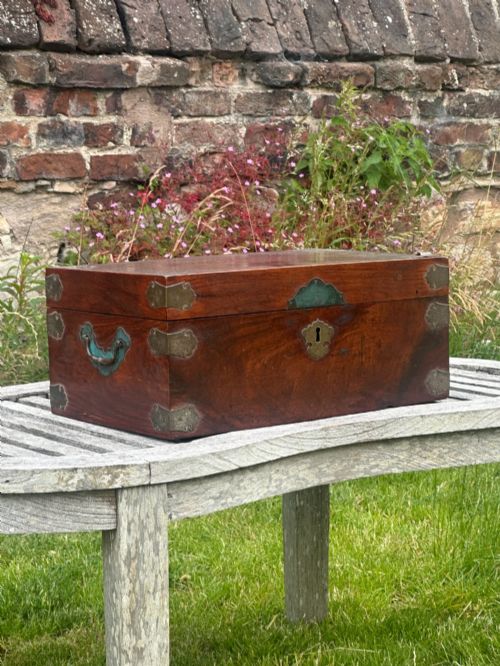


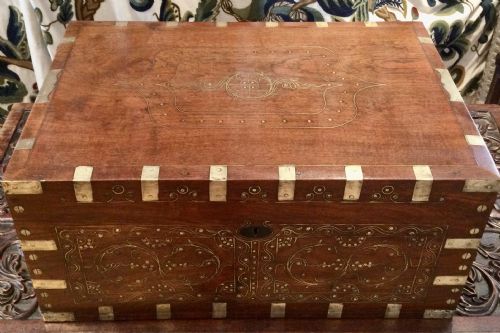


Victorian Colonial Document Box
These nineteenth-century pieces of furniture and storage transport the heavy craftsmanship of the British Empire straight into your study.
Victorian Colonial Document Box
A victorian colonial document box combines utilitarian colonial utility with domestic British storage, manifesting most frequently as writing boxes, writing slopes, and correspondence chests from the nineteenth century. These objects served travellers, administrators, and merchants operating across the British Empire, requiring secure storage for paperwork and valuables in transit.
The regional origins of these items span Anglo-Indian, Ceylonese, Sri-Lankan, Burmese, and Jamaican workshops, each bringing distinct local timber traditions to British utilitarian forms. You will frequently meet compact trunks, display chests, and stationery boxes constructed during the Victorian period.
Forms range from brass-bound deed boxes and dome-top tin caskets to intricately carved rectangular caskets and porcupine quill boxes. These diverse objects reflect the varied administrative and personal correspondence needs of the era.
How they were made
Makers utilised dense exotic hardwoods such as ebony, padouk, teak, and mahogany, selecting timbers capable of withstanding tropical climates and arduous sea voyages. These woods frequently received surface ornamentation including reeded decoration and intricate carved wood details.
Construction techniques often incorporated contrasting organic materials such as bone and porcupine quill inlaid into the timber carcass. Metal reinforcement appeared through brass binding, mounts, and campaign-style hardware designed to protect corners and edges during transport.
Victorian Colonial Document Box Retail Price Guide 2026
Typical asking prices for victorian colonial document box among the pieces listed under this phrase on Sellingantiques today, from the lower quarter to the upper quarter. They describe what is for sale here now, not the wider market.
The documented periods on this site stretch from the 1880s through the Edwardian era, anchored firmly in the nineteenth century.
What varies in quality
The standard of execution separates everyday utility items from pieces destined for colonial officials or wealthy households. Superior examples display precise joinery, meticulous brass work, and complex surface embellishments such as sadeli mosaic work or deep relief carving.
Material selection dictates much of the distinction, with solid ebony and figured padouk commanding greater attention than simpler mixed woods or tin. The integration of specialised internal fittings for writing and correspondence also marks out superior construction.
The Victorian Colonial Document Box Glossary
- Sadeli work
- A form of micro-mosaic craft originating in Western India, typically utilising horn, bone, ivory, and metal fitted into geometric patterns. This decorative technique appears on boxes and caskets from the region.
- Writing slope
- A portable desk featuring a sloping lid designed for correspondence, opening to reveal compartments for stationery and inkwells. These boxes often doubled as lap desks during travel.
- Campaign style
- Furniture and boxes designed for portability by military officers and travellers, characterised by recessed brass handles, reinforced corners, and robust construction. Such items broke down or packed easily for long journeys.
- Porcupine quill box
- A decorative container covered in arranged quills, frequently produced in nineteenth-century Ceylon. The quills provide a striking striped texture across the surface of the wood.
- Padouk
- A heavy tropical hardwood prized for its rich reddish-brown colour and durability. Makers utilised this timber extensively for campaign chests and deed boxes.
Victorian Colonial Document Box: Frequently Asked Questions
What is a victorian colonial document box?
It is a portable nineteenth-century container used to store letters, deeds, and valuable papers across the British Empire.
These pieces were constructed in regions such as India, Ceylon, and Burma before being brought back to British homes.
How were these boxes used?
Officials, merchants, and travellers used them to keep important documents safe, organised, and dry during long voyages.
At home, they functioned on desks as secure repositories for personal correspondence and writing equipment.
What woods were used in these boxes?
Carvers and cabinetmakers worked with dense tropical timbers including ebony, teak, padouk, and mahogany.
These strong woods resisted warping in humid colonial climates and protected contents from rough handling.
How do I identify Anglo-Indian boxes?
Look for characteristic regional decorative details such as deep carved woodwork, brass binding, and bone inlay.
Materials like padouk and distinctive styles like sadeli mosaic work point directly to South Asian workshops.