




Victorian Cocktail Glasses
These victorian cocktail glasses bring genuine period character to a modern bar, combining the weight of lead crystal with the delicacy of hand-cut stems.
Victorian Cocktail Glasses
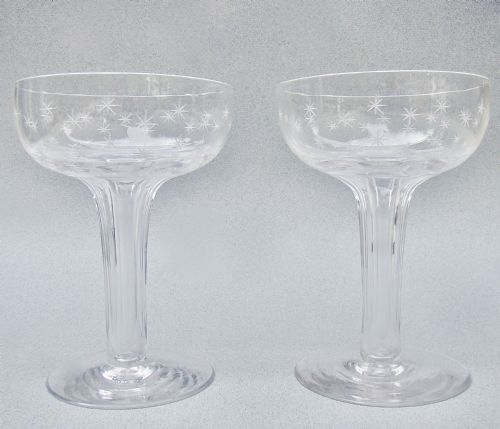
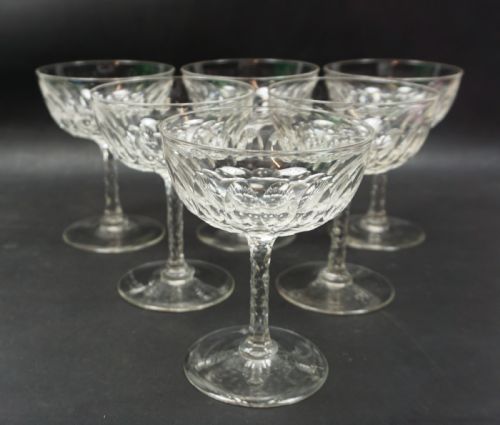
Victorian cocktail glasses encompass the glassware used for sparkling wine, aperitifs and mixed drinks during the nineteenth century, most commonly taking the form of champagne coupes and hollow-stem bowls. The selection here leans towards English and continental production from the eighteen-eighties, featuring wide shallow bowls designed for champagne and iced drinks.
Beyond standard glassware, the wider category includes silver-plated lemonade jugs equipped with ice tubes, alongside matched sets intended for multi-course dining and entertaining. These pieces reflect the expanding social rituals of the late nineteenth century, where distinct vessels emerged for specific alcoholic beverages.
Makers ranged from major English manufacturers to continental glasshouses, producing items that survived through careful household use. Surviving examples demonstrate how households served beverages before the standardisation of modern glassware.
How they were made
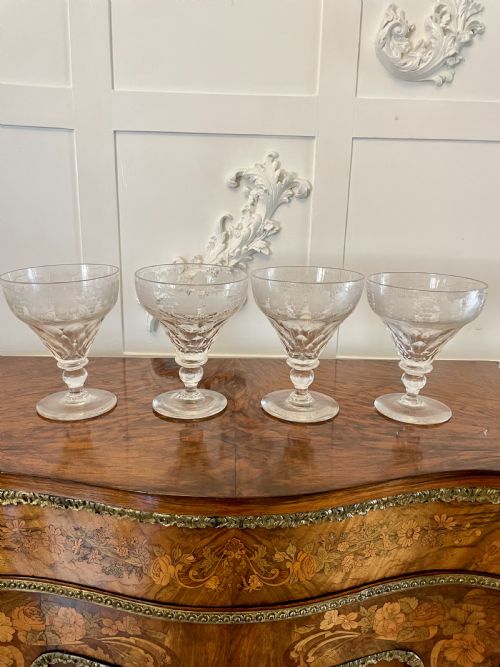
Production relied on heavy lead crystal and clear glass blown by hand, often subjected to deep facet cutting along the stem and base to catch the light. Engraving techniques applied floral or geometric motifs directly onto the surface of the bowl.
Enamel work and overlay techniques introduced colour and opacity, as seen in red over crystal variants decorated with fruiting vines. Silver plating provided durable mounts and ice tubes for serving vessels, combining metalwork with blown glass.
Nineteenth-century hosts relied on internal ice tubes within lemonade jugs to chill drinks without diluting the punch.
What varies in quality
Quality rests on the clarity of the metal, the precision of the wheel-cut or star-etched decoration, and the overall balance of the piece in the hand. Thicker bases and well-proportioned stems indicate superior manufacturing standards from established workshops.
The crispness of the engraving separates ordinary production from finer output, where motifs remain sharp and evenly spaced across the glass surface. Preservation of original gilding, enamel colours and silver-plated elements also determines the standing of a piece.
Mappin & Webb·Fritz Heckert·Elkington & Co
The Victorian Cocktail Glasses Glossary
- Champagne coupe
- A shallow-bowled glass with a short stem, traditionally utilised for sparkling wine and early mixed drinks.
- Lead crystal
- Heavy, high-clarity glass containing lead oxide, which increases brilliance and allows for deeper cutting.
- Star-etched
- A decorative motif incised into glass using a small rotating wheel to form a geometric star pattern.
- Silver plate
- A layer of silver fused to a base metal substrate, commonly applied to jugs and serving hardware during the period.
- Overlay
- A technique involving a layer of coloured glass cased over a clear crystal body, then partially cut away to reveal the contrast.
Victorian Cocktail Glasses: Frequently Asked Questions
Can I use antique glassware for parties?
These pieces were designed for regular dining and entertaining, making them robust enough for occasional use today. Hand washing remains essential to preserve the vintage glass and any applied enamel or silver plating.
Sudden thermal shock should be avoided by not pouring boiling liquids directly into cold crystal vessels.
How do I clean vintage silver-plated jugs?
Maintenance requires mild soapy water and a soft cloth to clean the plated surfaces without removing the protective metal layer. Abrasive cleaners and harsh scrubbing pads will scratch the silver plate and dull the finish.
Dry the metal thoroughly after washing to prevent water spots and tarnishing over time.
Are mismatched sets appropriate for display?
Assembling varied glasses creates an eclectic arrangement that reflects how nineteenth-century households actually acquired and used tableware. Subtle variations in cutting and stem thickness add historical depth to a drinks cabinet.
Matching sets remain desirable, but mismatched groups offer flexibility for modern entertaining.
What defines the Victorian period for glassware?
The era spans the reign of Queen Victoria, marked by industrial expansion in glass production alongside retained craft traditions like wheel engraving. Design motifs shifted from heavy cut patterns towards lighter floral and historicist styles.
Pieces from this timeframe frequently incorporate lead crystal and silver-plated accessories for dining.