


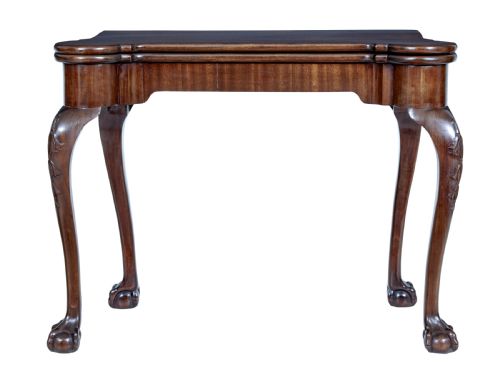


Victorian Chippendale Console Table
A victorian chippendale console table brings substantial mahogany woodwork and revival carving into a room with striking presence.
Victorian Chippendale Console Table
A victorian chippendale console table draws on eighteenth-century revival styles, taking shape primarily through the nineteenth century, including specific dates such as 1860, 1880, and 1900. These tables appear in forms such as console tables, serving tables, side tables, centre tables, and games tables like card tables.
The aesthetic bridges Victorian interpretation and Georgian style, often incorporating Chippendale Revival and Chinese Chippendale manners. Makers utilised mahogany as the primary timber, sometimes pairing it with brass hardware and baize surfaces for games tables.
Buyers encounter serpentine shapes, hand-carved details, and fold-over mechanisms designed for versatile domestic use. Freestanding centre tables and large serving tables represent the broader scale of these nineteenth-century pieces.
How they were made
Craftsmen shaped these tables from figured mahogany, relying on hand-carved techniques to produce the intricate ornamentation associated with the Chippendale revival manner. Timber selection ensured both structural durability and decorative grain visibility across console and games tables.
Joinery and mechanical ingenuity define the folding card tables, which incorporate baize-lined surfaces and precise hinges. Brass components often reinforced structural points or served as functional hardware on games and serving tables.
Surfaces received careful smoothing and polishing to highlight the natural qualities of the mahogany, while serpentine frames required precise timber bending and cutting.
Victorian Chippendale Console Table Retail Price Guide 2026
Typical asking prices for victorian chippendale console table among the pieces listed under this phrase on Sellingantiques today, from the lower quarter to the upper quarter. They describe what is for sale here now, not the wider market.
Listings span the nineteenth century, including specific production years like 1860, 1880, and 1900, utilising mahogany, brass, and baize.
What varies in quality
The depth and crispness of the hand carving distinguish finer examples from simpler production, particularly where Chinese Chippendale motifs or elaborate revival patterns appear on the timber. Superior pieces exhibit confident execution in every curved line and carved flourish.
Timber selection dictates visual impact, with figured mahogany providing richer grain movement than plain stock. Structural integrity, especially in the joints of serpentine card tables and large centre tables, marks the difference between standard workshop output and exceptional cabinetmaking.
Edwards and Roberts
The Victorian Chippendale Console Table Glossary
- Console table
- A table designed to stand against a wall, frequently secured or supported by brackets, which became popular during the nineteenth-century revival periods.
- Chippendale revival
- A nineteenth-century design movement that reinterpreted the mid-eighteenth-century aesthetics of Thomas Chippendale, featuring ornate carving and classical proportions.
- Serpentine
- A curved shape consisting of a convex centre flanked by concave sides, frequently utilised on the front edges of card and console tables.
- Baize
- A coarse woolen material resembling felt, traditionally used to line the playing surfaces of antique card and games tables.
- Chinese chippendale
- A specific sub-style of Chippendale design characterised by lattice patterns, fretwork, and pagoda-inspired motifs executed in mahogany.
Victorian Chippendale Console Table: Frequently Asked Questions
What is a victorian chippendale console table?
It is a nineteenth-century revival piece inspired by earlier Georgian designs, featuring carved mahogany and classic styling.
These tables function as decorative and practical furniture for hallways, living rooms, and dining spaces.
How were antique card tables used?
Card tables served primarily for indoor gaming and social evenings, remaining folded against the wall when not in use.
The hinged top opened to reveal a baize-lined playing surface supported by swing legs.
What timber was used for these tables?
Makers relied almost exclusively on mahogany, often selecting figured timber to enhance the visual texture of the surface.
Secondary materials such as brass and baize appear mainly in hardware and game table linings.
How do I identify the chippendale revival style?
The style is recognisable through elaborate hand-carved ornamentation, ball-and-claw feet, and motifs drawn from eighteenth-century pattern books.
Chinese Chippendale variations introduce distinctive fretwork and lattice details into the woodwork.